
Photo by goodrich kingrey on Unsplash
Demographics of St Francis County
Affluence Level in St Francis County
A below-average socioeconomic profile. Incomes, home values, and educational attainment trail the U.S., with higher poverty and unemployment.
People of St Francis County
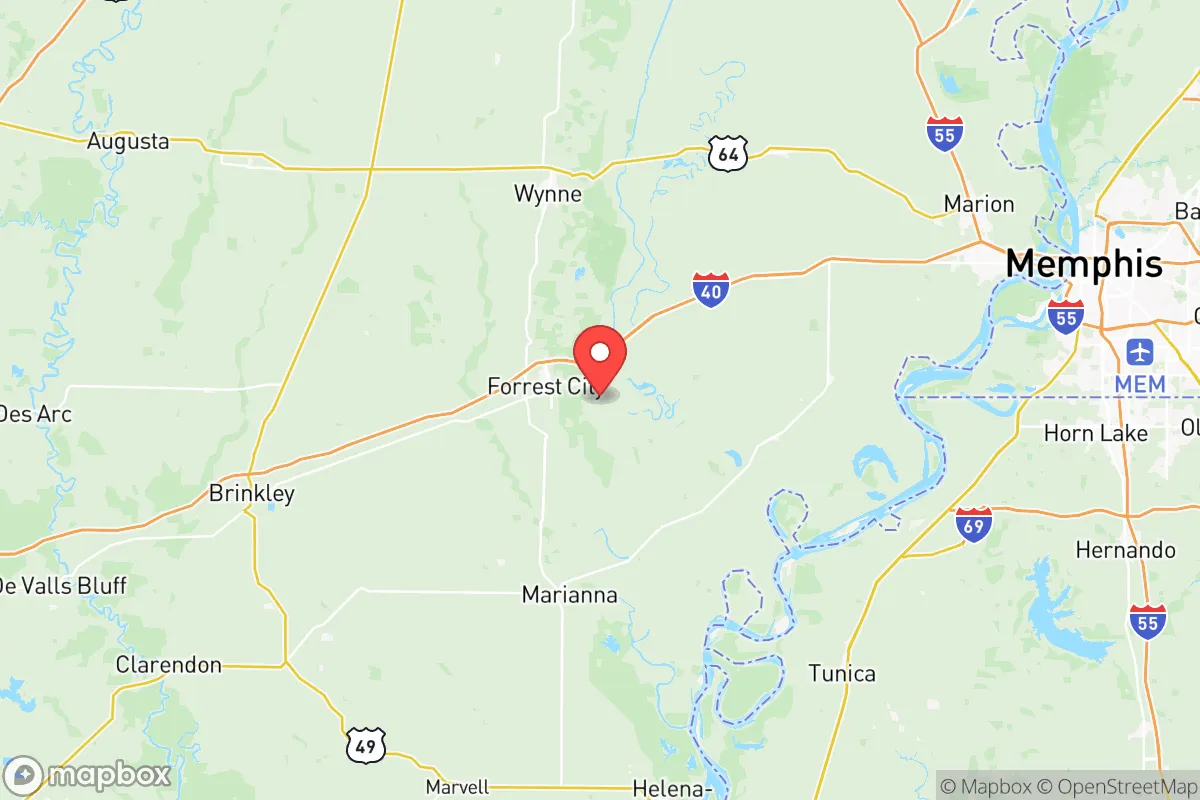
St Francis County, Arkansas, is a predominantly rural, majority-Black county in the Arkansas Delta with a population of 22,740, where the legacy of plantation agriculture and the Great Migration has shaped a deeply rooted, yet economically challenged, community. The county’s population is 54.8% Black and 39.5% White, with a very small foreign-born share of just 1.7% and a college attainment rate of 12.9%, reflecting a population that is historically insular and tied to the land. The county seat of Forrest City serves as the primary population and commercial center, while smaller communities like Marianna, Hughes, and Palestine anchor the surrounding agricultural landscape. This is a place where family histories often stretch back generations, and where the population is slowly declining as younger residents leave for job opportunities elsewhere.
Settlement & growth (pre-1960)
Before American settlement, the area that is now St Francis County was inhabited by the Quapaw and Osage nations, who used the region for hunting along the St. Francis River and the L'Anguille River. The land was part of the Louisiana Purchase and was initially claimed by Spain and France, but no permanent European settlements were established until after the 1820 Treaty of Doak's Stand, which forcibly removed the remaining Native peoples. The county was formed in 1827, and the first wave of American settlers were largely Scots-Irish and English yeoman farmers from Tennessee, Kentucky, and the Carolinas, who were drawn by the promise of cheap, fertile bottomland along the Mississippi River floodplain.
The defining demographic event of the 19th century was the forced migration of enslaved Black people to work the cotton plantations that dominated the county's economy. By 1860, enslaved people made up a majority of the county's population, a pattern that continued after emancipation. Following the Civil War, the county became a center of sharecropping and tenant farming, with newly freed Black families settling in rural communities like Madison, Caldwell, and Widener, where they worked land owned by white planters. The town of Forrest City, founded in 1866 as a railroad stop on the Memphis and Little Rock Railroad, grew as a commercial hub for this agricultural economy. A small number of German and Irish immigrants arrived in the late 19th century to work on the railroads and in the timber industry, but they never formed a large enclave. The early 20th century saw the Great Migration begin in earnest: between 1910 and 1950, thousands of Black residents left St Francis County for industrial jobs in Chicago, St. Louis, and Detroit, a pattern that would permanently reduce the county's population and shift its demographic balance.
Modern era (post-1965)
The post-1965 era in St Francis County has been defined not by new immigration, but by continued domestic out-migration and a slow, steady decline in total population. The Hart-Cellar Act of 1965 had virtually no impact here: the county's foreign-born population remains at just 1.7%, and there are no significant immigrant enclaves. Instead, the dominant demographic trend has been the ongoing departure of Black residents seeking better economic opportunities in Memphis (just 50 miles north), Little Rock, and other Southern cities, as well as continued migration to the North. The county's population peaked at around 40,000 in 1940 and has fallen steadily since, with the 2020 census showing 22,740 residents.
The white population has also declined, but at a slower rate, leading to a slight increase in the white share of the population from about 35% in 1990 to 39.5% today. The Hispanic population, while still small at 3.3%, has grown modestly since 2000, with a few families settling in Forrest City and Hughes to work in poultry processing and agriculture. The county's economy has shifted away from cotton and toward rice, soybeans, and catfish farming, as well as a few manufacturing plants, but job growth has been insufficient to stem population loss. The closure of the state prison in Forrest City in 2023 eliminated a major employer, further accelerating out-migration. The county remains deeply segregated residentially, with Black residents concentrated in the eastern part of the county and in the city of Marianna, while white residents are more dispersed in rural areas and the western part of the county.
The future
The population of St Francis County is projected to continue its slow decline over the next 10-20 years, as the county's limited economic base and low college attainment rate (12.9%) make it difficult to retain young adults. The county is becoming slightly less diverse in terms of Black-white composition, as Black out-migration continues and the small Hispanic population grows, but the overall trend is toward a smaller, older, and more economically stagnant population. There are no signs of significant new immigrant settlement, and the county's rural character is unlikely to change. The communities of Palestine and Wheatley may see further population loss, while Forrest City will likely remain the county's anchor, albeit with a shrinking tax base.
For someone moving in now, St Francis County offers a deeply rooted, slow-paced rural lifestyle with strong family and church ties, but it comes with significant economic challenges and limited opportunities for career growth. The county's future is one of managed decline, where the people who remain are those with deep generational roots or those who are priced out of more dynamic regions. It is not a place of rapid change or new diversity, but rather a community holding onto its history and identity in the face of demographic headwinds.

* Values derived from national, state, county, city and local statistics and may differ in a specific area. Last updated: 2026-07-24T14:55:44.000Z
Narrative content on this page is AI-generated and may contain mistakes. Verify any details that matter before acting on them.
ReloMaps may earn a commission from affiliate links at no extra cost to you.

