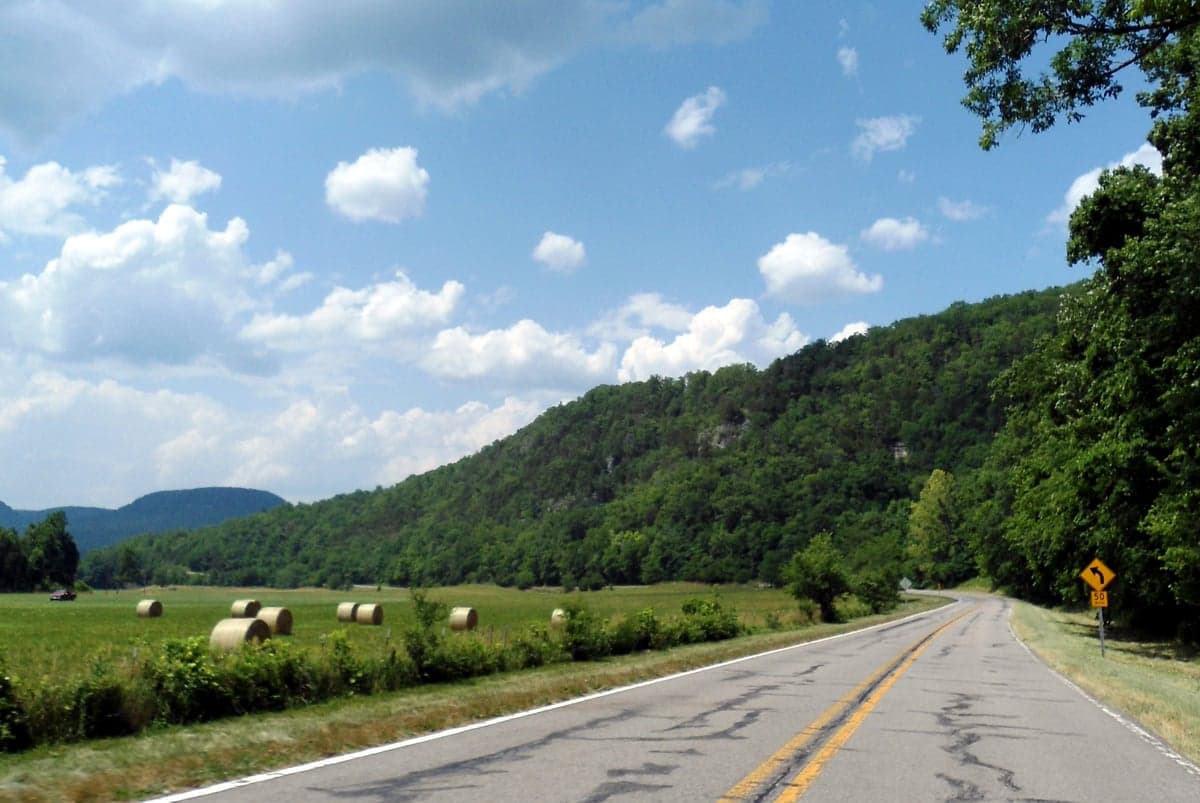
Photo: Wikipedia
Political ClimatePolitical Climate in Newton County
Showing county-level results — no local-only data available.
Lean and PVI are calculated from this county’s 2020 and 2024 presidential results, Cook-style.
Political rankings in Arkansas
- Most Conservative Cities in Arkansas
- Most Liberal Cities in Arkansas
- Best Liberal-Leaning Towns in the South
- Safest Liberal-Leaning Towns in the South
- Safest Conservative-Leaning Towns in the South
- Affordable Small Towns for Conservatives
- Most Affordable Liberal-Leaning Small Towns in the U.S.
- Safest Conservative-Leaning Cities in the U.S.
- Most Conservative Counties in Arkansas
- Most Liberal Counties in Arkansas
Local Political AnalysisPolitical Analysis of Newton County
Newton County is one of the most reliably Republican counties in Arkansas, carrying a Cook PVI of R+20 that puts it four points to the right of the state as a whole. The county has voted for the GOP presidential nominee in every election this century, often by margins exceeding 70 percent, and that trajectory shows no sign of reversing. But the political reality here is more textured than the raw partisan math suggests, especially when you look at the difference between the county seat of Jasper and the smaller mountain communities like Vendor and Parthenon.
How it compares
Arkansas as a whole carries a Cook PVI of R+16, meaning Newton County is a solid four points more conservative than the state average. That gap is modest compared to some of the deep-red counties in the eastern part of the state, but it still places Newton firmly in the top tier of Arkansas's Republican strongholds. The county's politics track closely with the Ozark region's cultural conservatism, but there are meaningful internal divisions. Jasper, the county seat and largest town, is the closest thing Newton has to a swing precinct — it still goes Republican, but by narrower margins, and it's the only place where you'll see a scattering of Democratic and independent yard signs during election season. The smaller communities like Marble Falls, Mount Judea, and Pelsor are where the GOP vote is most lopsided, often running 80 percent or higher for Republican candidates.
What this means for residents
For conservative residents, the political climate is comfortable and largely friction-free. The county's Republican lean means local offices — from the county judge to the quorum court — are almost always filled by Republicans, and the policy priorities of the area reflect that: minimal regulation, strong support for gun rights, and a general skepticism of federal land management, which matters a lot in a county that's nearly half national forest. For liberal residents, the reality is more about finding your niche than changing the outcome. Jasper is the most welcoming spot for progressives, with a small but visible community of artists, retirees, and remote workers who've moved in over the past decade. You won't find much organized Democratic infrastructure in the county, but you also won't find the kind of open hostility you might in some other rural areas — the Ozark ethos of live-and-let-live still holds some sway, especially in the more isolated hollows where people genuinely don't care what you do as long as you're self-sufficient.
What daily life is like for families
For families, the political climate shapes daily life in practical ways. School board races in the Jasper and Deer school districts are generally low-key and nonpartisan, though cultural flashpoints like library materials and curriculum choices have started to surface in recent years, mirroring statewide trends. The county's strong Republican lean also means that state-level policy — like the 2023 Arkansas LEARNS Act, which expanded school choice — is generally supported here, and you'll hear more talk about property taxes and road maintenance than about national politics at the local coffee shop in Jasper. The Buffalo National River, which runs through the county, is a rare point of bipartisan agreement: both conservative locals and liberal newcomers tend to oppose any development that would threaten the river's wild character, even if they frame that opposition in very different language.
Looking ahead, Newton County's political trajectory seems locked in for the near term. The county is aging, and while there's been a slow trickle of new residents drawn by the natural beauty and low cost of living, most of them are retirees or remote workers who lean conservative or libertarian rather than progressive. The one wildcard is the growing tension between long-time residents and newcomers over tourism and short-term rentals — a policy fight that doesn't break down neatly along party lines. In the long run, expect Newton County to stay solidly red, but with a slightly more libertarian flavor than the state average, and with Jasper remaining the one place where the political conversation is a little less predictable.

State Political ClimatePolitical Climate in Arkansas
State Political AnalysisPolitical Environment in the State
Arkansas has been a reliably Republican state for the past decade and a half, carrying a Cook Partisan Voting Index of R+16, but the texture of that conservatism is more complicated than the raw number suggests. The state’s current GOP dominance is a relatively recent phenomenon—as recently as 2008, Democrats held the governorship and both U.S. Senate seats, and the legislature was still competitive. The shift since then has been dramatic and durable: Donald Trump won the state by 27 points in 2024, and Republicans now hold every statewide constitutional office and supermajorities in both chambers of the General Assembly. What a new resident will find is a state where the old conservative Democratic tradition has been fully absorbed into the GOP, leaving a political landscape that is culturally Southern, economically populist, and increasingly shaped by the growth corridors of Northwest Arkansas.
Urban vs. rural divide
The political map of Arkansas breaks down into three distinct regions, and understanding them is key to understanding the state. The dominant Republican vote comes from the rural and small-town counties that cover most of the state’s 53,000 square miles—places like Harrison in Boone County, Searcy in White County, and the Arkansas River Valley towns of Russellville and Morrilton routinely deliver 70-80% Republican margins. These are culturally traditional areas where gun ownership, church attendance, and family farming remain the organizing principles of daily life.
The two metros that drive the state’s economy tell a more nuanced story. Northwest Arkansas—the corridor anchored by Fayetteville, Springdale, Rogers, and Bentonville—has become the state’s growth engine, powered by Walmart’s headquarters and the Tyson Foods and J.B. Hunt corporate campuses. Washington County, home to Fayetteville and the University of Arkansas, is the state’s most reliably Democratic county, voting for Joe Biden in 2020 and holding the line in 2024. But the neighboring counties of Benton and Washington are increasingly split: Benton County is solidly Republican but with a growing suburban professional class that votes more moderately, while the city of Fayetteville itself has a visible progressive activist scene. Little Rock and its Pulaski County suburbs are the other Democratic anchor, though the city’s influence has waned as the metro’s growth has pushed into the more conservative bedroom communities of Conway and Cabot. The Delta counties along the Mississippi River—historically the most Democratic part of the state due to the Black vote—have seen turnout collapse and now vote Republican at the local level even as they remain competitive in presidential races.
Policy environment
Arkansas’s policy posture is defined by a low-tax, low-regulation philosophy that has been in place since the 2015 tax reform package. The state has a flat 4.4% individual income tax rate (down from a top marginal rate of 7% a decade ago), a 6.5% corporate rate, and a sales tax that averages around 9.4% when local options are included—among the highest in the nation. There is no property tax on personal vehicles, and homestead exemptions keep residential property taxes modest. The regulatory climate is business-friendly, with a right-to-work law on the books and a tort reform package that has capped non-economic damages in medical malpractice cases. Education policy has moved toward school choice: the state’s LEARNS Act, passed in 2023, created universal school vouchers that any family can use for private or homeschool expenses, and it eliminated teacher tenure while raising minimum teacher pay to $50,000. Healthcare is the outlier—Arkansas expanded Medicaid under the private-option model in 2014, and roughly 300,000 residents remain on the program, making it one of the few red states that has not rolled back expansion. Election law is restrictive by national standards: voter ID is required, early voting runs for two weeks, and absentee voting requires an excuse, though the state has not followed Texas or Georgia in adding felony penalties for ballot assistance.
Recent policy direction
The last three legislative sessions have pushed Arkansas decisively toward the conservative end of the national spectrum on nearly every liberty axis a relocator might weigh. On guns, the state became a Second Amendment sanctuary in 2021, and a 2023 law eliminated the requirement for a permit to carry a concealed handgun—Arkansas is now a constitutional carry state with no training or background check requirement beyond the federal purchase check. On parental and education rights, the LEARNS Act’s voucher program is the headline, but the state also passed a 2023 law requiring schools to notify parents of any changes to a student’s “gender identity or pronoun usage,” and a 2021 law banned transgender girls from participating in female school sports. On speech and privacy, Arkansas passed Act 372 in 2023, which requires parental consent before minors can create social media accounts, and it has joined the national push to regulate TikTok and other foreign-owned platforms. On medical and bodily autonomy, the state has a near-total abortion ban with exceptions only for the life of the mother, rape, and incest, and a 2023 law restricts gender-affirming care for minors. Property rights remain strong—there is no statewide zoning mandate, and the state has a robust homestead protection law—but the most contentious recent fight has been over a 2023 law allowing the state to seize property owned by Chinese-linked entities near military installations. On taxation, the trajectory is clearly downward: the 2025 session passed another income tax cut that will bring the flat rate to 3.9% by 2027.
Civil unrest & political movements
Arkansas does not have a history of large-scale civil unrest, but it has visible political flashpoints. The most active organized movements are on the right: the state has a network of county-level Second Amendment sanctuary groups, and the Arkansas chapter of Moms for Liberty has been influential in school board races in Bentonville and Cabot. The left is concentrated in Fayetteville and Little Rock, where groups like Indivisible Arkansas and the Arkansas Public Policy Panel organize around voting rights and Medicaid expansion. Immigration politics are a live issue but not a crisis-level one—the state has a small foreign-born population (about 5%), and the 2023 legislative session passed a law requiring local law enforcement to cooperate with federal immigration authorities, though no sanctuary cities exist. The most visible recent flashpoint was the 2023 fight over the LEARNS Act, which drew thousands of teachers and parents to the state capitol in Little Rock for protests—the largest sustained political mobilization in the state in over a decade. Election integrity controversies have been muted compared to other Southern states; the 2022 and 2024 elections produced no major disputes, and the state’s vote-counting process is generally regarded as smooth.
Projection
Over the next five to ten years, Arkansas’s political trajectory points toward continued Republican dominance, but with a shifting internal coalition. The growth of Northwest Arkansas is the wild card: the region is adding 20,000-30,000 new residents per year, many of them professionals from California, Texas, and the Northeast who are drawn by the low cost of living and the corporate job market. These newcomers tend to be fiscally conservative but socially moderate, and they are already making Benton County more competitive—Trump’s margin there dropped from 35 points in 2020 to 28 points in 2024. The rural counties will remain deeply Republican, but their population is aging and slowly declining, which means the state’s political center of gravity is shifting toward the I-49 corridor. The Democratic Party is unlikely to become competitive statewide in this window, but the party could become relevant again in the Little Rock and Fayetteville metros and in a handful of state legislative districts. The more likely scenario is that Arkansas becomes a solidly red state with a growing moderate wing in its suburbs, similar to what Tennessee or South Carolina look like today.
For a new resident, the practical takeaway is that Arkansas offers a policy environment that is strongly aligned with conservative priorities—low taxes, school choice, constitutional carry, and minimal regulatory friction—while remaining tolerant of liberal enclaves in Fayetteville and Little Rock. The state is not a place where politics intrudes heavily on daily life; the culture is live-and-let-live, and the political fights that dominate the news cycle are mostly confined to the legislative session. If you are moving here, expect to pay less in taxes, have more freedom in how you educate your children, and encounter a political climate that is conservative but not aggressively ideological in day-to-day interactions. The growth in Northwest Arkansas is bringing new energy and new ideas, and the state is likely to become more suburban and more economically dynamic over the next decade—even as its politics remain firmly red.
* Values derived from national, state, county, city and local statistics and may differ in a specific area. Last updated: 2026-10-26T00:53:43.000Z
Narrative content on this page is AI-generated and may contain mistakes. Verify any details that matter before acting on them.
ReloMaps may earn a commission from affiliate links at no extra cost to you.

