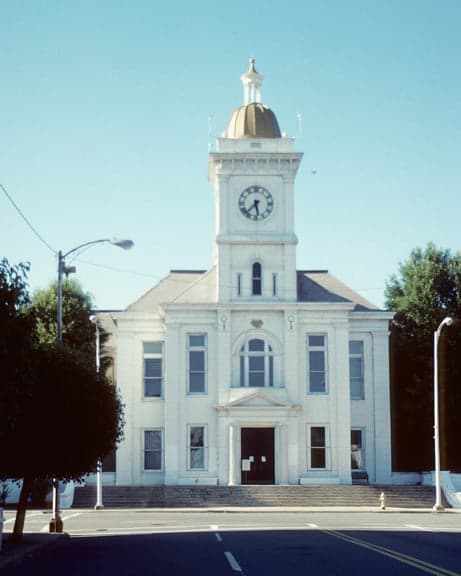
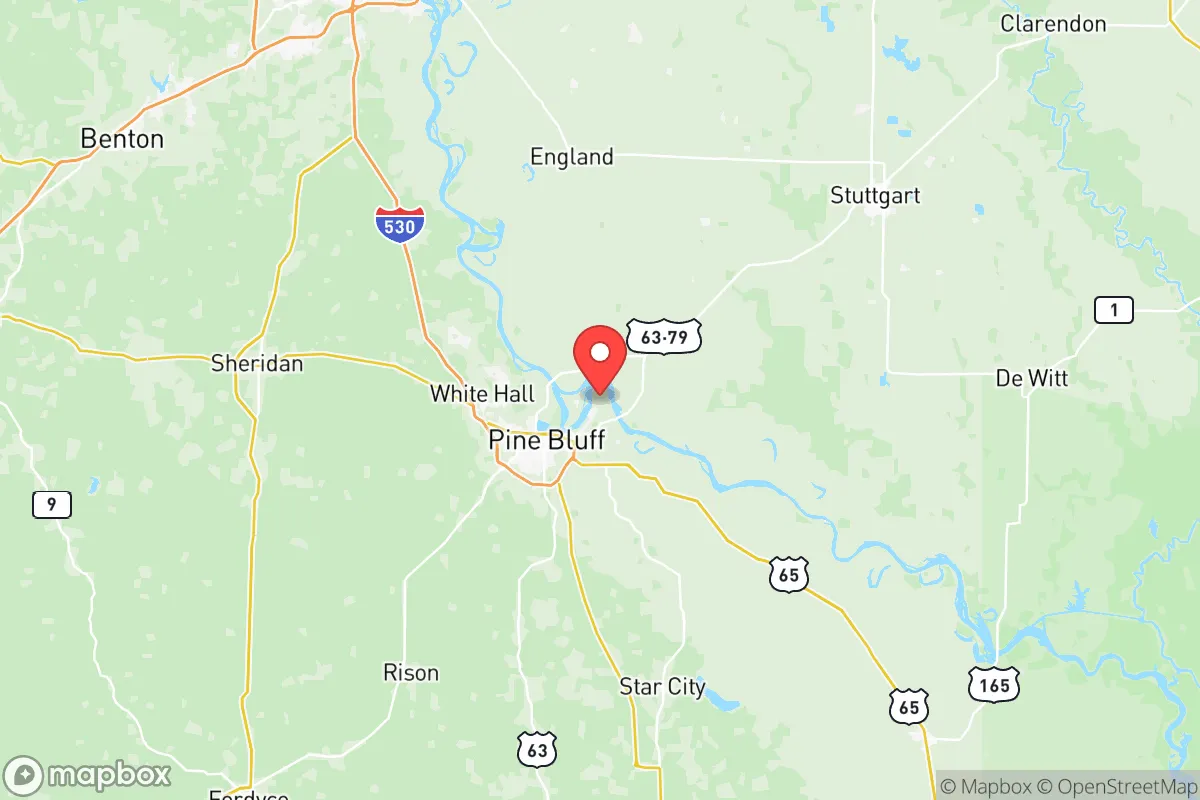
Photo: Wikipedia
Demographics of Jefferson County
Affluence Level in Jefferson County
A below-average socioeconomic profile. Incomes, home values, and educational attainment trail the U.S., with higher poverty and unemployment.
People of Jefferson County
Jefferson County, Arkansas, is a predominantly Black-majority county with a population of 65,780 residents, shaped by a deep agricultural and industrial history that has left a distinct cultural and economic footprint. The population is 56.1% Black, 37.2% White, and 2.5% Hispanic, with a very low foreign-born rate of 1.2% and a college-educated share of 20.6%. The county’s identity is anchored in the Arkansas Delta, with a legacy of plantation agriculture, the Civil War, and the rise and fall of the timber and railroad industries, creating a community that is both historically rooted and economically challenged.
Settlement & growth (pre-1960)
Before American settlement, the area now known as Jefferson County was inhabited by the Quapaw and Caddo peoples, who lived along the Arkansas River and its tributaries. French explorers and traders passed through in the late 17th century, but no permanent European settlement occurred until after the Louisiana Purchase in 1803. The county was officially formed in 1829, named after Thomas Jefferson, and its early growth was driven by cotton plantation agriculture, which relied on enslaved Black labor. By 1860, the county’s population was already majority Black, a pattern that would persist.
The primary settlement wave came from White planters and their enslaved workers from the Upper South (Kentucky, Tennessee, and Virginia) in the 1830s and 1840s. They established the county seat, Pine Bluff, as a river port on the Arkansas River, which became the commercial and political hub. Smaller communities like Altheimer, Wabbaseka, and Sherrill grew as plantation centers and later as railroad stops. After the Civil War and emancipation, freed Black families remained in the county, working as sharecroppers and tenant farmers, and forming the backbone of the rural population. The post-Reconstruction era saw the rise of a small Black middle class in Pine Bluff, centered on churches, schools, and businesses.
The early 20th century brought a second major wave: the expansion of the timber and railroad industries. The Cotton Belt Railroad and the St. Louis, Iron Mountain and Southern Railway connected Pine Bluff to national markets, attracting White and Black workers from across the South. The town of White Hall grew as a railroad and farming community, while Redfield became a stop on the rail line. The Great Migration (1910–1970) saw tens of thousands of Black residents leave Jefferson County for industrial jobs in Chicago, St. Louis, and Detroit, reducing the county’s population but also creating a diaspora that maintained strong ties to the area. By 1960, the county’s population peaked at around 81,000, with Pine Bluff as the dominant city and a Black population share of roughly 45%.
Modern era (post-1965)
The post-1965 era in Jefferson County has been defined by population decline, deindustrialization, and a slow demographic shift toward a Black majority. The Hart-Cellar Act of 1965 had almost no impact here: the foreign-born population remains at just 1.2%, with no significant immigrant enclaves forming. Instead, the county’s demographic story is one of domestic out-migration and racial concentration. The decline of the timber industry, the closure of the Pine Bluff Arsenal (a chemical weapons plant) in the 1990s, and the loss of manufacturing jobs led to a steady population drop from 81,000 in 1960 to 65,780 today.
The Black population share rose from about 45% in 1960 to 56.1% today, driven by White out-migration to suburban areas in central Arkansas, such as Little Rock and Benton, and a higher birth rate among Black families. The White population, now 37.2%, is concentrated in the more rural and suburban parts of the county, particularly around White Hall and Redfield, which have seen some growth as bedroom communities for workers commuting to Little Rock. The Hispanic population, at 2.5%, is a small but growing presence, primarily in Pine Bluff and White Hall, working in agriculture, poultry processing, and construction. The East/Southeast Asian population (0.3%) and Indian subcontinent population (0.5%) are tiny, mostly professionals associated with the University of Arkansas at Pine Bluff (UAPB) or the local medical sector.
Suburbanization has been limited but real: White Hall has grown from a small railroad town to a suburban enclave of about 5,000 residents, with newer housing and a lower crime rate than Pine Bluff. Pine Bluff itself has lost over 40% of its population since 1960, with abandoned storefronts and a struggling downtown. The county’s college-educated share of 20.6% is below the national average, reflecting the loss of higher-skilled jobs and the out-migration of educated residents to larger metro areas.
The future
The population of Jefferson County is likely to continue declining slowly, with a gradual homogenization into a Black-majority, low-immigration community. The Hispanic population may grow modestly as agricultural and construction jobs attract workers, but it will remain a small share. The White population will likely continue to shrink as older residents age out and younger families move to the Little Rock suburbs. The county is not tribalizing into distinct enclaves; rather, it is becoming more uniformly Black, with Pine Bluff as the core and White Hall as a small, predominantly White suburb.
In-migration is minimal and unlikely to change the cultural identity. The county’s identity remains rooted in its Delta heritage, with UAPB as a major institution, and a strong sense of local history. The next 10–20 years will likely see further population consolidation in Pine Bluff and White Hall, with rural communities like Altheimer and Wabbaseka continuing to shrink. The lack of economic diversification and the low college attainment rate are structural challenges that will limit any demographic rebound.
For someone moving in now, Jefferson County offers a low cost of living and a tight-knit, historically rich community, but with limited job opportunities and a shrinking population. It is a place where the past is still very present, and where the future is one of slow, steady decline rather than renewal. The county is becoming more homogeneous, not more diverse, and its character is defined by resilience in the face of economic hardship rather than by growth or change.

* Values derived from national, state, county, city and local statistics and may differ in a specific area. Last updated: 2026-05-17T23:35:16.000Z
Narrative content on this page is AI-generated and may contain mistakes. Verify any details that matter before acting on them.
ReloMaps may earn a commission from affiliate links at no extra cost to you.

