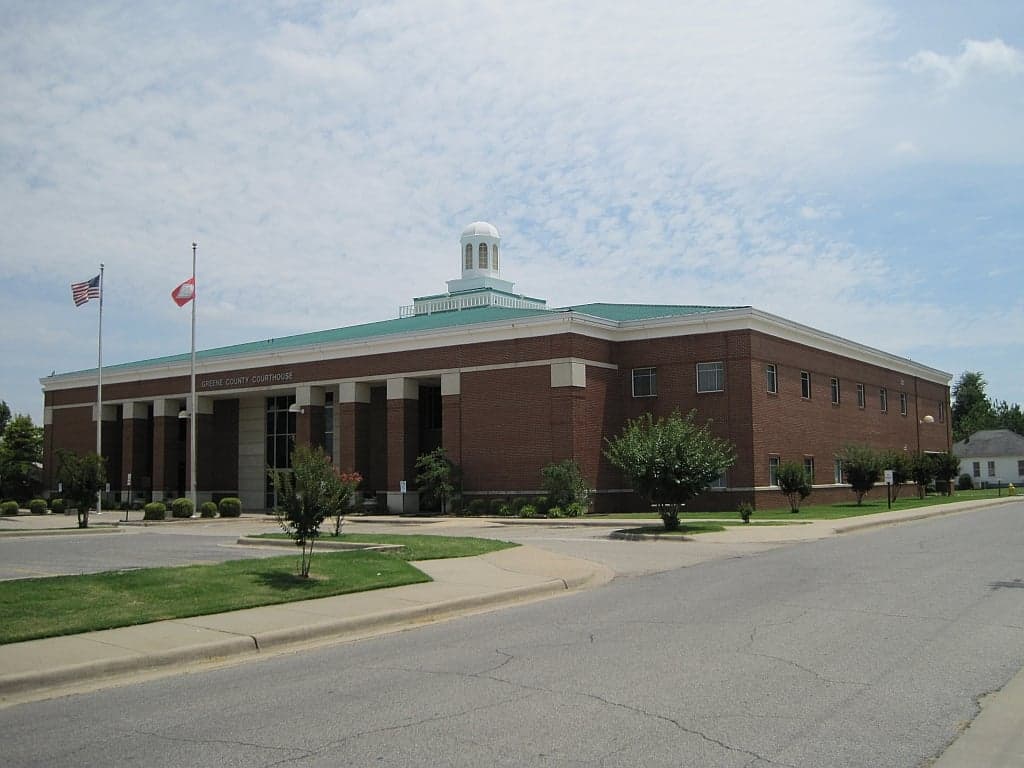
Photo: Wikipedia
Political ClimatePolitical Climate in Greene County
Showing district-level results — no local-only data available.
Local Political AnalysisPolitical Analysis of Greene County
Greene County, Arkansas, is a reliably Republican stronghold, carrying a Cook Partisan Voting Index (PVI) of R+23, which is significantly more conservative than the state of Arkansas as a whole (R+16). This means the county votes about seven points further right than the state average, a gap that has widened in recent cycles as the rural areas have moved rightward faster than the state's small cities. The county's political trajectory is one of deepening red, with the GOP's margins growing in every presidential election since 2012, driven by a combination of cultural conservatism, a strong local gun culture, and a population that is overwhelmingly white and non-college-educated.
How it compares
To put the R+23 PVI in perspective, Greene County is roughly as Republican as the most conservative districts in Texas or Tennessee. The state of Arkansas itself is already a deep-red state, but Greene County is in a different league. The difference is most visible in the rural precincts outside the county seat, Paragould. In Paragould itself, the city's precincts are still solidly red—typically voting 65-70% Republican—but they are the "blue" part of the county. The truly deep-red precincts are in the unincorporated areas and smaller towns like Marmaduke and Rector, where Republican candidates often pull 80% or more of the vote. There are no swing precincts in Greene County; the closest thing to a competitive race is a Republican primary. The only precincts that ever show a Democratic lean are a handful of precincts in the city of Paragould that include the campus of Arkansas State University-Newport (Paragould location) and the surrounding neighborhoods, but even those are only about 55-45 Republican.
What this means for residents
For conservative residents, the political climate is a comfortable fit. Local government, the county sheriff's office, and the school boards are all dominated by Republicans, and policy debates tend to center on tax cuts, Second Amendment rights, and opposition to state-level mandates from Little Rock. For liberal residents, the reality is more isolating. There is no organized Democratic Party presence in the county, and progressive viewpoints are rarely heard in public forums. Socially, it means that a liberal resident might feel pressure to keep their political views private, especially in smaller towns like Marmaduke or Rector, where community ties are tight and political conformity is the norm. That said, the county is not hostile in a personal sense—people are generally polite and neighborly—but the political culture is so one-sided that it can feel like a monolith.
Culturally, Greene County is distinct from the rest of Arkansas in a few ways. It sits in the northeastern corner of the state, close to the Missouri bootheel, and its economy is tied to agriculture (rice, soybeans, and cotton) and manufacturing (especially automotive parts and food processing). This gives it a more Midwestern, pragmatic conservatism compared to the more evangelical, culture-war-driven politics of central and western Arkansas. There is less emphasis on church-based politics here than in, say, Benton County or Faulkner County. Policy-wise, the county is a stronghold for local control: residents are deeply skeptical of federal and state intervention, whether it's on land use, school curriculum, or health mandates. The practical upshot for anyone moving here is that you will live in a place where the political conversation is overwhelmingly conservative, but it's a conservatism rooted in self-reliance and localism rather than ideological purity. If you're conservative, you'll feel right at home. If you're not, you'll find a quiet, respectful community that simply doesn't share your views—and you'll likely keep your politics to yourself.

State Political ClimatePolitical Climate in Arkansas
State Political AnalysisPolitical Environment in the State
Arkansas is a deeply red state with a Cook PVI of R+16, meaning it votes about 16 points more Republican than the nation as a whole. The state has shifted sharply rightward over the past two decades, driven by the realignment of rural white voters and the collapse of the once-dominant "Blue Dog" Democratic tradition. While Democrats held the governorship as recently as 2014, the GOP now holds every statewide office, supermajorities in both legislative chambers, and all four U.S. House seats, making Arkansas one of the most reliably Republican states in the country.
Urban vs. rural divide
The political map of Arkansas is a textbook study in the urban-rural split. The state's two major population centers — Little Rock (Pulaski County) and Fayetteville/Springdale (Washington and Benton counties in Northwest Arkansas) — are the only real Democratic strongholds. Pulaski County, home to the capital, voted for Joe Biden by about 10 points in 2020, driven by a diverse population and a concentration of government workers and professionals. Northwest Arkansas, anchored by the University of Arkansas and corporate headquarters like Walmart and Tyson Foods, has become a purple-to-blue island, with Fayetteville and Bentonville voting Democratic in recent cycles. Outside these two metro areas, the state is overwhelmingly Republican. The Arkansas Delta — counties like Lee, St. Francis, and Phillips — was once a Democratic bastion due to its large Black population, but those counties now vote Republican by double digits as white rural voters have realigned. The Ozark and Ouachita mountain regions, including Harrison and Mena, are among the most conservative areas in the country. A notable exception is Pine Bluff (Jefferson County), which remains a Democratic holdout due to its majority-Black population, but it's an island in a sea of red.
Policy environment
Arkansas's policy environment is defined by low taxes, limited regulation, and a strong conservative social agenda. The state has a flat income tax rate of 4.4% (down from 7% in 2015), a state sales tax of 6.5% (with local add-ons), and no estate or inheritance tax. Property taxes are among the lowest in the nation, averaging about 0.6% of assessed value. The regulatory posture is business-friendly, with right-to-work laws and minimal zoning restrictions in most areas. Education policy is a flashpoint: the state has a robust school choice program, including the LEARNS Act (2023), which created universal Education Freedom Accounts (vouchers) for private school tuition. Public school funding is per-pupil, but teacher pay has lagged, leading to ongoing debates. Healthcare is a mixed bag: Arkansas expanded Medicaid under the private option model (Arkansas Works), but the state has also imposed work requirements and strict abortion bans. Election laws have tightened: voter ID is required, early voting is limited to 15 days, and absentee voting requires an excuse. The state has no ballot initiative process for constitutional amendments (only legislative referrals), making it harder for grassroots movements to change policy directly.
Recent policy direction
The last five years have seen Arkansas move aggressively on a range of liberty-related issues. On gun and self-defense law, the state enacted permitless carry (Act 777, 2021), allowing any law-abiding adult to carry a concealed firearm without a license. Stand-your-ground laws are on the books. On parental and education rights, the LEARNS Act (2023) banned "critical race theory" and "indoctrination" in schools, required schools to post curriculum online, and created the voucher program. The state also passed a law (Act 372, 2021) requiring schools to notify parents of any "sexually explicit" instructional materials. On speech and privacy, Arkansas passed Act 689 (2023), which restricts social media platforms from "censoring" users based on viewpoint, though it's tied up in court. On medical and bodily autonomy, the state has a near-total abortion ban (Act 180, 2019, triggered by Roe's overturn), with exceptions only for the life of the mother. Gender-affirming care for minors is banned (Act 626, 2021). On property rights, Arkansas is a "Dillon's Rule" state, meaning local governments have only powers explicitly granted by the state, limiting local zoning and rent control. On taxation, the trend is toward further cuts: the 2023 session reduced the top income tax rate from 4.9% to 4.4%, with a goal of reaching 3.9% by 2027. On voting and ballot access, the state has made it harder for third parties and independents to get on the ballot, and absentee ballots must be notarized or witnessed by two adults.
Civil unrest & political movements
Arkansas has seen relatively little large-scale civil unrest compared to coastal states, but there are notable flashpoints. The Black Lives Matter protests in Little Rock in 2020 were significant, with several nights of demonstrations and some property damage, but they were smaller than in larger cities. The state's Confederate monument debate has been active: the "Silent Sam" statue on the Capitol grounds was removed in 2020 after years of controversy. On the right, the Arkansas Sovereignty Project and other nullification groups have pushed for state-level resistance to federal gun laws and vaccine mandates, though these efforts have been mostly rhetorical. Immigration politics are less heated than in border states, but Springdale and Rogers have seen tensions over growing Marshallese and Hispanic populations. There are no sanctuary cities in Arkansas; in fact, Act 1165 (2023) requires local law enforcement to cooperate with federal immigration authorities. Election integrity controversies have been minimal, though the 2020 election saw some local GOP activists question Dominion voting machines, leading to a state audit that found no irregularities. A new resident would notice that political signs and flags are common in rural areas, but open conflict is rare — most people keep their politics to themselves in daily life.
Projection
Over the next 5-10 years, Arkansas is likely to become even more Republican, but with a growing urban-liberal counterweight. In-migration is concentrated in Northwest Arkansas, which is attracting young professionals and remote workers from blue states. This area will continue to trend purple, potentially flipping Washington County (Fayetteville) to reliably Democratic and making Benton County (Bentonville) competitive. Meanwhile, the rural Delta and Ozarks will remain deeply red, but population loss will reduce their electoral weight. The state's Republican supermajority will likely push for further tax cuts, expanded school choice, and additional restrictions on abortion and transgender rights. The biggest wildcard is the state's Medicaid expansion: if federal funding is cut, the state may face a crisis, as the private option covers about 300,000 low-income Arkansans. A new resident moving in now should expect a state that is politically stable but increasingly polarized between the two metro areas and the vast rural expanse. The culture war issues that dominate state politics — education, gender, guns — will remain front and center, with little appetite for compromise.
For a new resident, the bottom line is this: if you're conservative, you'll find Arkansas deeply aligned with your values on taxes, guns, education, and social issues. If you're liberal, you'll find a state where your vote carries little weight in statewide elections, but where you can find like-minded communities in Little Rock, Fayetteville, and Bentonville. The practical takeaway is that Arkansas offers a low-cost, low-regulation environment with a strong sense of community, but the political climate is unapologetically red and likely to stay that way for the foreseeable future. You won't face much political friction in daily life, but you should be prepared for a state government that actively pursues a conservative agenda on nearly every front.
* Values derived from national, state, county, city and local statistics and may differ in a specific area. Last updated: 2026-07-03T05:03:46.000Z
Narrative content on this page is AI-generated and may contain mistakes. Verify any details that matter before acting on them.
ReloMaps may earn a commission from affiliate links at no extra cost to you.

