Photo: Wikipedia
Demographics of Greene County
Affluence Level in Greene County
A below-average socioeconomic profile. Incomes, home values, and educational attainment trail the U.S., with higher poverty and unemployment.
People of Greene County
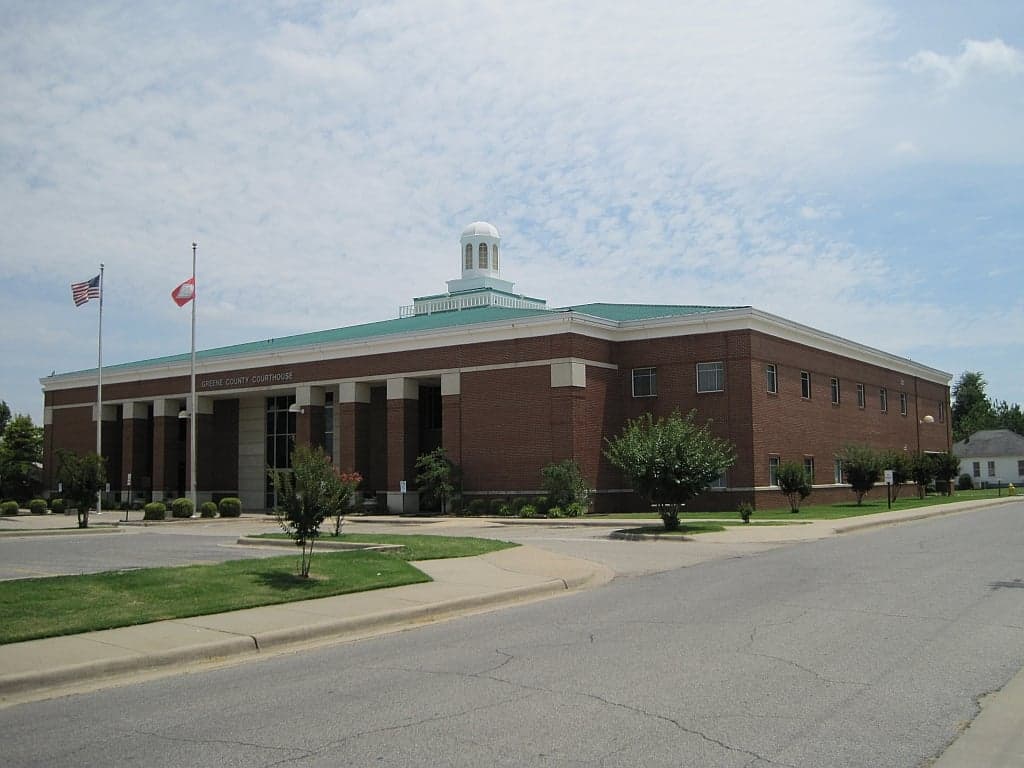
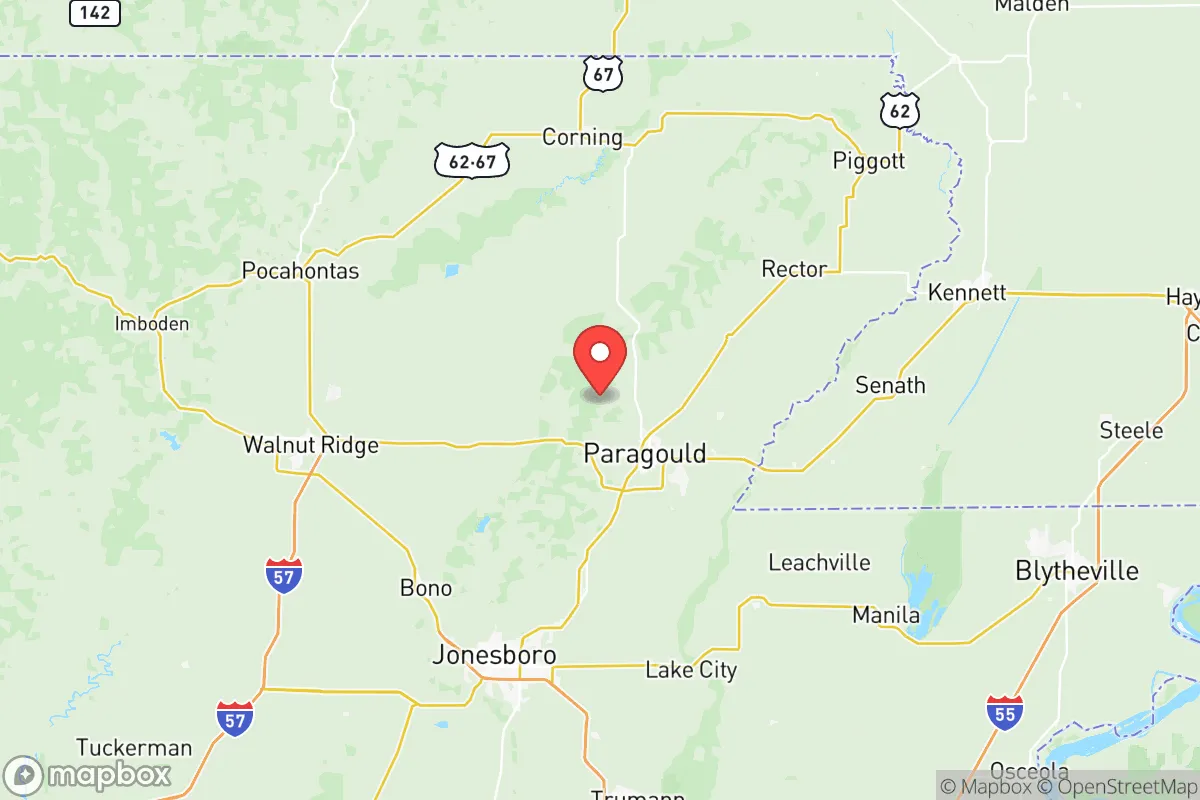
Greene County, Arkansas, is a predominantly white, working-class region of roughly 46,000 residents, defined by its deep rural roots and a small-town, family-oriented culture. The county seat of Paragould serves as the economic and social hub, with a population that is 89.1% white, 3.6% Hispanic, and 2.2% Black, while foreign-born residents make up less than 1% of the total. The area’s character is marked by a strong sense of local tradition, conservative political leanings, and a slower pace of life that appeals to those seeking affordable living and a connection to the land. Despite its modest size, Greene County’s population has grown steadily in recent decades, driven largely by domestic migration from other parts of Arkansas and the surrounding region.
Settlement & growth (pre-1960)
The land that is now Greene County was originally inhabited by the Osage and Quapaw Native American nations, who used the region for hunting grounds along the St. Francis River and its tributaries. European contact began with French and Spanish explorers in the 17th and 18th centuries, but no permanent European settlements emerged until after the Louisiana Purchase in 1803. The U.S. government forced the removal of indigenous peoples from the area through a series of treaties and removals in the 1820s and 1830s, culminating in the Trail of Tears, which passed just to the south of what would become Greene County.
The first permanent American settlers arrived in the 1820s and 1830s, mostly Scots-Irish and English families migrating from Kentucky, Tennessee, and the Upper South. These pioneers were drawn by the promise of cheap, fertile land in the Mississippi Alluvial Plain, and they established small farming communities along Crowley’s Ridge and the St. Francis River. The county was officially formed in 1833, and the earliest settlements included Benjamin P. H. Gaines’s homestead at what is now Gainesville, and the town of Marmaduke, named after a prominent local planter. By the 1850s, cotton cultivation had become the economic backbone, with enslaved African Americans making up roughly 20% of the population. The Civil War brought devastation, but Reconstruction saw a slow recovery.
The late 19th and early 20th centuries brought a new wave of domestic migration. The completion of the St. Louis, Iron Mountain and Southern Railway (later the Missouri Pacific) in the 1870s transformed the county’s economy, allowing farmers to ship timber, cotton, and later rice and soybeans to national markets. The railway spurred the founding of Paragould in 1883, named as a merger of the surnames of two railroad executives, J.W. Paramore and Jay Gould. Paragould quickly overtook older towns like Gainesville and Stanley as the county’s commercial center. Meanwhile, the town of Rector grew as a railroad and farming hub, and Oak Grove Heights developed as a small agricultural community. The Dust Bowl and Great Depression of the 1930s pushed a modest number of displaced farm families from Oklahoma and Texas into Greene County, where they found work in cotton fields and timber camps. World War II brought further changes, as local men enlisted in large numbers and women entered factory work in Paragould and nearby Jonesboro, but the county remained overwhelmingly agricultural and overwhelmingly white. The post-war boom of the 1950s saw improved roads, rural electrification, and the gradual mechanization of farming, which reduced the need for farm labor and encouraged a slow consolidation of farmland.
Modern era (post-1965)
The 1965 Hart-Cellar Act had a negligible direct effect on Greene County, as the region did not attract the large-scale immigration seen in coastal or urban areas. The foreign-born population remains just 0.7%, and the county’s racial composition has changed only modestly. The most significant demographic shifts in the past 50 years have been driven by domestic migration patterns: the decline of manufacturing in the industrial Midwest and the rise of right-to-work states contributed to a steady influx of families from Missouri, Illinois, and Ohio, who were drawn by lower housing costs and a perceived lower crime rate. This migration has been overwhelmingly white, reinforcing the county’s existing demographic profile.
The Hispanic population, which now stands at 3.6%, began to grow noticeably in the 1990s and 2000s, primarily as workers moved to the region from Texas and Mexico for jobs in poultry processing (especially at the Tyson Foods plant in Paragould) and in the agricultural sector. These families have concentrated in Paragould and Walcott, where a small but visible Hispanic community supports a handful of Mexican grocery stores and a Spanish-language church service. The Black population remains small at 2.2%, concentrated in central Paragould and in the rural community of Lorado, which historically had a higher Black share before the post-war depopulation of the Delta. East/Southeast Asian residents make up just 0.2%, largely comprising a few families associated with academic or medical jobs at Arkansas State University in nearby Jonesboro. The Indian-subcontinent population is similarly tiny at 0.2%.
Suburbanization has been minimal by national standards but noticeable locally. The city of Paragould has annexed surrounding rural land to accommodate new subdivisions, and the unincorporated community of Brookings has seen modest development as a bedroom community for workers commuting to Jonesboro. The college-educated share of the population is just 16.5%, well below the national average, reflecting the county’s continued reliance on blue-collar employment in manufacturing, agriculture, and transportation.
The future
Demographic projections suggest Greene County will remain predominantly white and native-born for the foreseeable future, with the Hispanic share likely growing slowly to 5-7% over the next 20 years as the poultry and agricultural industries continue to draw immigrant labor. The East/Southeast Asian and Indian populations are expected to remain minuscule, barring a major employer recruiting international workers. The county’s overall population is projected to increase modestly, driven by continued domestic in-migration from the Midwest and from more costly parts of Arkansas, such as central Arkansas and Fayetteville. Older towns like Marmaduke and Rector are likely to see further population decline as younger residents move to Paragould or to Jonesboro for jobs and services, while Paragould itself will absorb most new growth. The cultural identity of the county will remain rooted in its rural, conservative, church-going traditions, though the growing Hispanic presence may bring gradual changes to local cuisine, religious congregations, and school demographics.
For a family or individual moving into Greene County now, this is a place where the past still shapes daily life: neighbors know each other, churches anchor communities, and the pace is unhurried. The county’s demographic stability means that newcomers should expect a highly homogeneous environment, with limited racial and cultural diversity compared to national averages. Those seeking a quiet, affordable corner of the rural South with a strong sense of local identity will find Greene County welcoming; those looking for a vibrant mix of cultures or rapid urban amenities may find the area too static. The next decade will likely see a subtle blending of the old agricultural economy with new light manufacturing, but the people of Greene County—overwhelmingly white, native-born, and family-oriented—will remain the region’s most defining feature.

* Values derived from national, state, county, city and local statistics and may differ in a specific area. Last updated: 2026-07-03T05:03:46.000Z
Narrative content on this page is AI-generated and may contain mistakes. Verify any details that matter before acting on them.
ReloMaps may earn a commission from affiliate links at no extra cost to you.

