Photo: Wikipedia
Political ClimatePolitical Climate in Crawford County
Showing district-level results — no local-only data available.
Local Political AnalysisPolitical Analysis of Crawford County
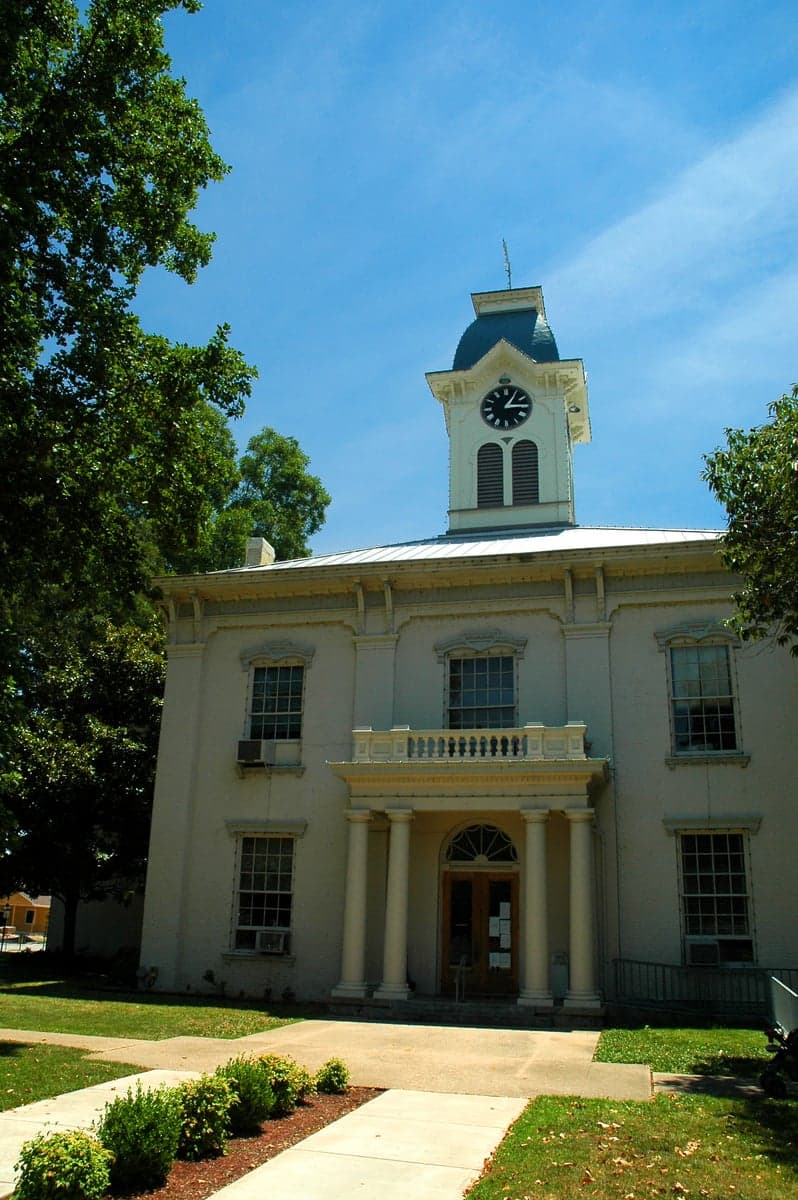
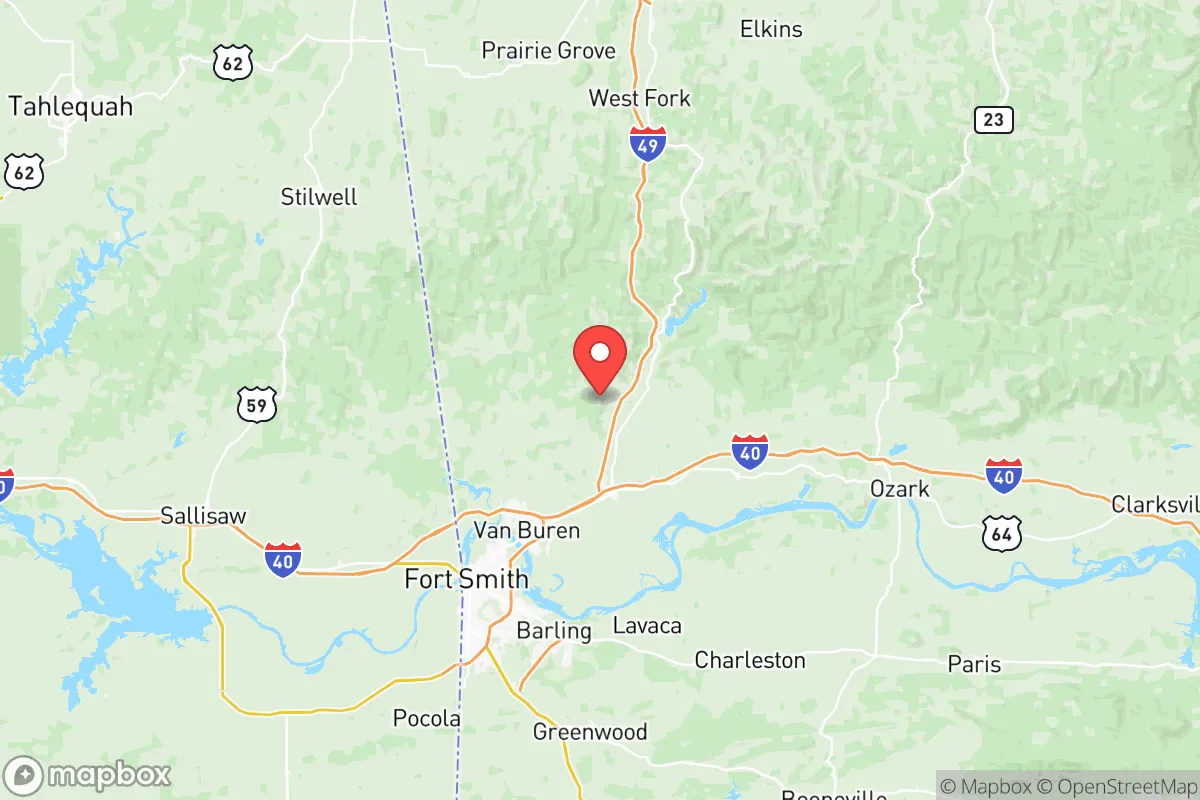
Crawford County, Arkansas, is about as reliably Republican as it gets in the Natural State, though it's actually a hair to the left of the statewide average. The county carries a Cook Partisan Voting Index of R+13, meaning in presidential elections it votes about 13 points more Republican than the national average. That's a solid red vote, and even with state-level growth in GOP dominance, Crawford County's tilt has been stable and deep for decades. The 2024 election results saw the county break heavily for Trump, though the margins in specific towns tell a more nuanced story. Van Buren, the county seat and largest city, has historically had a small but persistent Democratic-leaning core, especially in its older downtown precincts and among long-time union-affiliated families tied to the old railroad and manufacturing base. Meanwhile, communities like Alma, Cedarville, and Mulberry are reliably deep red, often pushing 70-80% Republican in contested races. The swing precincts that exist are mostly on the fringes of Van Buren and in the more populated corridor along I-40; even there, the "swing" has shifted steadily right over the past decade, but those areas remain the most competitive if a Democrat were to pour significant resources in.
How it compares
It might surprise newcomers that Crawford County's R+13 is actually a few points bluer than Arkansas as a whole, which sits at R+16. That difference comes from the county's historic Democratic lean, a legacy of the pre-2000s "Blue Dog" South where Crawford County routinely voted for conservative Democrats like the late Senator David Pryor and Governor Mike Beebe. Even now, a few precincts in Van Buren still split tickets at the local level — you'll occasionally see a county judge or sheriff race that's not a foregone conclusion. The surrounding region — Sebastian County to the west (Fort Smith) — is similarly GOP-leaning but with slightly more competitive pockets around Fort Smith proper. Up in Washington County (Fayetteville), the dynamic is completely different, trending left as the state's university hub. So Crawford County sits in a red corridor, but it's not the deepest red in the state; that honor goes to rural counties farther south and east where PVI scores push toward R+30 or more. Over the long term, the county's trajectory is toward redder, pulled by in-migration from retirees and conservative-leaning newcomers from places like California and Colorado, but it's still catching up to the state's overall GOP intensity.
What this means for residents
For conservative residents, Crawford County is a comfortable environment where local government, school boards, and law enforcement tend to reflect their values. Republican primaries are the de facto general elections in most races, and voter turnout for GOP contests is strong. For liberal or independent residents, the reality is more isolating — there's no real organized progressive infrastructure outside of scattered activist groups in Van Buren. Local news and community discourse tilt heavily conservative; a Democratic voter will find few neighbors willing to discuss politics openly. That said, the county's small size means personal relationships still outweigh party labels in many local offices. A well-known moderate independent who runs for quorum court or school board can win if they've shoveled snow for neighbors and coached Little League. But for state and federal races, the result is effectively predetermined. Over the next decade, as the county's population grows along the I-49 corridor, the political center of gravity will drift further toward the outer suburbs of Alma and the rural exurbs, likely deepening the GOP tilt before any reversal could happen.
Culturally, Crawford County residents often point to two things that set them apart from the rest of Arkansas: a strong firearms-ownership culture that predates the modern gun debate (it's normal to see pickup trucks with rifle racks even at school drop-off), and a notable Catholic presence in Van Buren thanks to the area's German and Irish immigrant history — a bit more religious diversity than the typical Southern Baptist stronghold. Local ordinances on everything from noise complaints to zoning reflect a "stay out of my business" attitude that both conservatives and libertarian-leaning residents appreciate. The county's current pushback against any state-mandated COVID restrictions or mask requirements in 2020-2021 reinforced that independent streak. For anyone moving here, the practical takeaway is that community fit matters more than party ID — join a church, volunteer at the annual Crawford County Fair, and you'll be welcomed regardless of who you vote for, as long as you don't make it the first thing people know about you.

State Political ClimatePolitical Climate in Arkansas
State Political AnalysisPolitical Environment in the State
Arkansas is a deeply Republican, solidly red state with a Cook PVI of R+16, meaning it votes about 16 points more Republican than the national average in presidential elections. Over the past 20 years, the state has undergone a dramatic partisan transformation: as recently as 2000, Arkansas was a swing state that twice voted for Bill Clinton for president and elected a Democratic governor and legislature; today, Republicans control every statewide office, both U.S. Senate seats, all four U.S. House seats, and supermajorities in both chambers of the state legislature. This shift has been driven by the realignment of rural white voters away from the old conservative Democratic tradition and toward the GOP, while the state’s small but growing urban centers have become more Democratic, creating a sharp political geography.
Urban vs. rural divide
The political map of Arkansas is defined by a stark urban-rural split. The state’s two major population centers—Little Rock in central Arkansas and Fayetteville in the northwest—are the only reliably blue areas. Pulaski County (Little Rock) and Washington County (Fayetteville) have voted Democratic in every presidential election since 2008, with Pulaski County going for Joe Biden by about 25 points in 2020. The surrounding suburbs of Little Rock—places like Benton, Bryant, and Cabot—lean Republican but are less conservative than rural areas. Northwest Arkansas, home to Walmart and the University of Arkansas, has a significant population of out-of-state transplants; the city of Fayetteville itself is a progressive college town, but the rest of the region, including Bentonville and Rogers, votes Republican. The rest of the state—the Delta counties east of Little Rock, the Ozarks, and the south Arkansas timber and farm country—votes Republican by margins of 30 to 60 points. There are no competitive U.S. House districts; the 2nd District (Little Rock suburbs) is the most competitive but still leans R+9.
Policy environment
Arkansas’s policy environment reflects its solidly conservative legislature and governor (GOP Governor Sarah Huckabee Sanders, elected in 2022). The state has a flat income tax rate of 4.9%, which is being phased down to 4.7% by 2027, with no state estate or inheritance tax. Sales tax is relatively high—the state rate is 6.5%, but local add-ons can push the combined rate over 10% in cities like Little Rock and Fayetteville. Property taxes are low, with the median effective rate around 0.5% of assessed value, though they vary widely by county. Arkansas is a right-to-work state with weak unions and few employment regulations. On education, the state has a school voucher program (the LEARNS Act, passed in 2023) that allows state funds to follow students to private schools, and a ban on teaching certain concepts related to race and gender in K-12 classrooms. Healthcare policy is conservative: Arkansas has not expanded Medicaid under the traditional ACA model, though it has a unique “private option” that uses federal funds to buy private insurance for low-income adults. Abortion is heavily restricted—the state has a near-total ban (trigger law) with exceptions only to save the life of the mother, with no exceptions for rape or incest. Election laws are moderately restrictive: voter ID is required, and the state enacted new limits on absentee voting in 2021, though early voting remains available for two weeks before elections.
Recent policy direction
Arkansas has accelerated a rightward policy march over the past four years, driven by the Sanders administration and legislative supermajorities. The most significant recent law is the LEARNS Act (2023), which expanded school choice, raised teacher minimum pay to $50,000, and restricted classroom discussions of race and sexuality. On gun rights, Arkansas became a permitless carry state in 2021, allowing anyone over 21 to carry a concealed handgun without a license or training. The legislature also passed a “Second Amendment Sanctuary” resolution in 2021, though it is symbolic. On parental and education rights, Act 372 (2023) requires school districts to adopt policies barring transgender students from using bathrooms matching their gender identity, and Act 626 (2023) limits medical care for transgender minors. On privacy and surveillance, the state passed a data privacy law (the Arkansas Data Privacy Act, 2023) that gives residents some control over how businesses use their personal data, but it is weaker than laws in California or Colorado. On medical and bodily autonomy, the state passed a law in 2023 banning gender-affirming care for minors, which has been challenged in court. On property rights, Arkansas has no statewide rent control, and there is a relatively strong statewide property rights law (Act 1009 of 2005) limiting the use of eminent domain. On voting, the state enacted Act 316 (2023) that shortened the timeline for returning absentee ballots and made it a crime for election officials to send out unsolicited absentee ballot applications.
Civil unrest & political movements
Political activism in Arkansas is relatively low-key compared to states like Oregon or Georgia. There have been small but persistent protests in Little Rock and Fayetteville over abortion rights since the Dobbs decision, and some protests against the transgender healthcare ban. On the right, the most organized movements are around Second Amendment advocacy and school choice; Arkansas has a strong state chapter of Moms for Liberty, which has been active in school board races in Bentonville and Rogers. There is no significant secession or nullification movement, though some rural county Republican parties have passed symbolic “sanctuary” resolutions objecting to federal gun laws. Immigration politics are less visible than in border states—Arkansas has a relatively small immigrant population (about 5% foreign-born), but there have been flashpoints over the resettlement of refugees in Springdale and Fort Smith. There were no major election integrity controversies in 2020 or 2022; Arkansas’s election administration is generally seen as smooth, though some rural counties saw long lines during early voting in 2020.
Projection
Over the next 5 to 10 years, Arkansas’s political trajectory is likely to stay deeply red, but the nature of the state’s Republicanism may shift as the state continues to attract conservative migrants from California and the Northeast, especially to northwest Arkansas. This in-migration, combined with the growing population of the Fayetteville-Springdale-Rogers corridor, could make the 3rd Congressional District slightly more moderate on some issues (economic growth, infrastructure, corporate tax policy) while remaining culturally conservative. However, the rural Delta counties will continue to lose population, amplifying the political weight of the northwest. The Democratic Party’s base will remain confined to the Little Rock area and the university towns. The biggest wild card is whether national polarization will soften or harden state-level positions—if a Democrat wins the presidency in 2028, expect Arkansas’s legislature to push back hard on federal mandates regarding transgender rights, abortion, and environmental regulation. A new resident moving into the state now should expect a stable, conservative policy environment for at least the next decade, with little chance of a Democratic breakthrough at the state level.
For a new resident, the bottom line is straightforward: Arkansas offers a low-tax, low-regulation environment with solid cultural conservatism and reliable GOP rule, but with real internal variety—you can live in a liberal college town like Fayetteville or a deep-red rural county like Baxter or Faulkner. A conservative will feel completely at home politically statewide, while a liberal will find supportive communities in Little Rock and Fayetteville but will have little influence on state-level policy. The practical takeaway is to choose your county carefully—your day-to-day experience will vary more by local jurisdiction (especially on school funding, library policies, and local law enforcement) than the state’s overall red hue suggests.
* Values derived from national, state, county, city and local statistics and may differ in a specific area. Last updated: 2026-06-22T06:15:14.000Z
Narrative content on this page is AI-generated and may contain mistakes. Verify any details that matter before acting on them.
ReloMaps may earn a commission from affiliate links at no extra cost to you.

