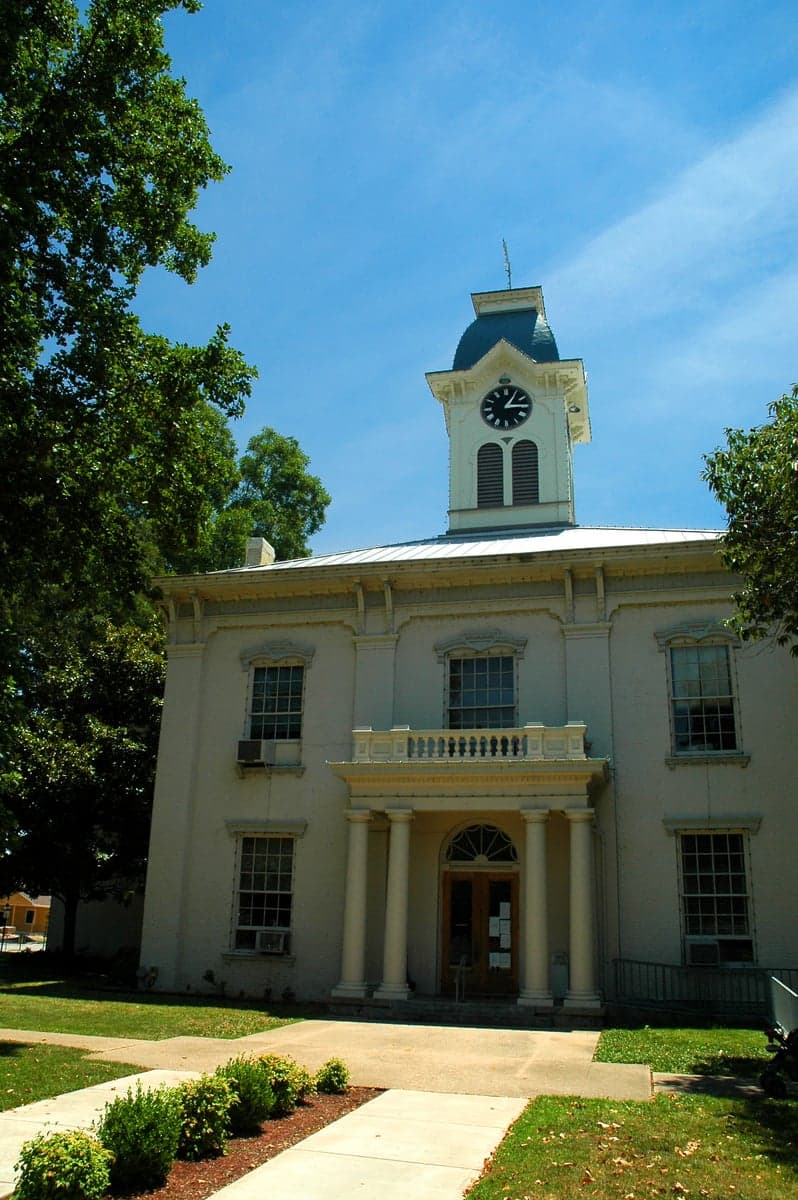
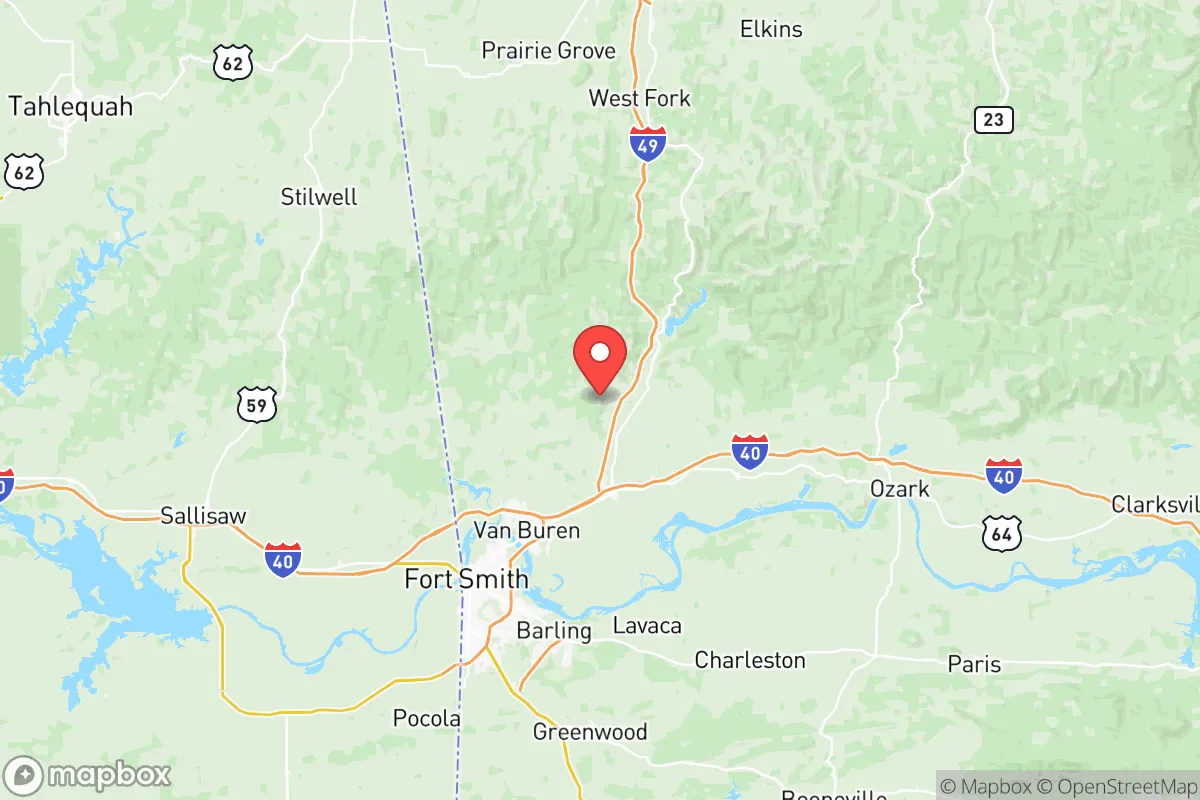
Photo: Wikipedia
Demographics of Crawford County
Affluence Level in Crawford County
A middle-class area roughly in line with national averages across income, home values, education, and employment.
People of Crawford County
Today, Crawford County, Arkansas is a predominantly white, family-oriented population of nearly 61,000 people, characterized by a distinctly rural-suburban blend that leans conservative. With an 80.2% white, non-Hispanic population and a foreign-born share of just 2.1%, the county remains far less diverse than Arkansas as a whole or the nearby urban core of Fort Smith. Residents are concentrated along the I-40 corridor in cities like Van Buren and Alma, while the southern and eastern parts of the county retain a deep agricultural and small-town character. The county’s identity is rooted in its historic role as a gateway to the Ozarks and its continued reliance on manufacturing, logistics, and local government employment.
Settlement & growth (pre-1960)
Before American settlement, the area now known as Crawford County was home to Osage and Caddo tribes, who used the Arkansas River valley for hunting and seasonal encampments. Spanish and French explorers passed through in the 1600s and 1700s, but no permanent European settlements took hold until after the Louisiana Purchase. The first wave of American settlers arrived in the 1820s and 1830s, primarily Scots-Irish and English migrants from Tennessee, Kentucky, and the upper South. They were drawn by cheap land offered under the federal land grant system and the promise of fertile bottomlands along the Arkansas River. These early families established farms near Lee Creek and the riverfront, founding the settlements of Van Buren (1831) and Alma (1832), which remain the county's primary population centers today.
The county was officially formed in 1820 from part of Arkansas County and named for Secretary of War William H. Crawford. Van Buren became the county seat in 1831 and quickly grew as a steamboat landing and trading post. A second smaller wave of settlers came in the 1840s and 1850s, including a modest number of German and Irish immigrants, who worked as laborers on riverboats and in early sawmills. However, the vast majority of the county's early population remained native-born white Americans of British Isles descent, with enslaved African Americans making up about 15% of the population by 1860, concentrated on larger plantations near the Arkansas River in what is now the Chestnut Prairie area south of Van Buren.
After the Civil War, Reconstruction brought a slow economic recovery. The arrival of the Little Rock and Fort Smith Railroad in the 1870s opened the county to timber and coal mining, drawing a small influx of laborers from the Ozarks and the Midwest. By 1900, the population had reached just over 18,000. The early 20th century saw little new immigration; the county was already settled, and most growth came from natural increase. The Dust Bowl and Great Depression had a limited effect on Crawford County compared to the Plains states, though some displaced families from Oklahoma did relocate to the area during the 1930s, settling near Mountainburg and Cedarville in the county's western hills. World War II brought a small but lasting change: the opening of the Fort Chaffee training camp just across the river in Sebastian County drew new residents and workers to the region, and a number of those families chose to settle in Van Buren and Alma after the war.
Modern era (post-1965)
The post-1965 period, shaped nationally by the Hart-Cellar Act, brought only modest demographic change to Crawford County. The county's foreign-born population remains just 2.1% today—far lower than the national average and lower than most of Arkansas’s other growing counties. The largest new immigrant group has been Hispanic, now at 8.1% of the total, up from under 2% in 1990. Much of this growth came during the 1990s and 2000s as Mexican and Central American laborers arrived to work in poultry processing plants in the Rogers-Bentonville corridor to the north, with some spillover into Crawford County's job market. Today, the county’s Hispanic community is dispersed rather than concentrated in a single enclave, though a visible presence exists in Van Buren and in rural agricultural areas around Mulberry and Dyer.
Domestic migration has been far more significant than international immigration. Beginning in the 1970s and accelerating after 2000, Crawford County has absorbed a steady stream of white, working-class and middle-class families relocating from the Rust Belt—particularly industrial cities in Illinois, Indiana, and Ohio—as well as from California and Texas. These relocations have been driven by lower housing costs, a slower pace of life, and a perceived better environment for raising children. The population of the county grew by 18% between 2000 and 2010, and by another 7% between 2010 and 2020, nearly all of it from domestic white migration. Van Buren has absorbed much of this growth, with suburban-style subdivisions appearing along Highway 59 and Highway 64 in the northern part of the city. Alma has also grown significantly, adding large tracts of single-family homes near the I-40 interchange, while Cedarville and Mountainburg have seen smaller but steady growth as commuter-satellite towns for people working in Fort Smith or Fayetteville.
Black and Asian populations remain very small (1.2% and 1.0% respectively). The African American community, historically centered in Van Buren and the rural Chestnut Prairie area, has seen outmigration to larger cities, and its share has declined from about 5% in 1970 to just over 1% today. East/Southeast Asian residents (primarily of Chinese, Vietnamese, and Filipino ancestry) are concentrated in Van Buren and Alma, often employed in the health care and manufacturing sectors. Indian-subcontinent residents number fewer than 100 and are almost entirely located in the Van Buren area, working in professional fields such as engineering and medicine.
The future
Projections through 2040 suggest Crawford County will continue to grow at roughly 0.5% to 1% annually, driven almost entirely by domestic migration of white families from outside Arkansas. The foreign-born share is unlikely to rise above 4% within the next decade, given the region's limited economic pull for new immigrants and the county’s distance from major immigrant gateway cities. The Hispanic population will increase gradually as children of existing families age and a small number of new arrivals come for construction and agricultural work, but it will remain below 12-15% of the total. The county’s cultural identity will remain overwhelmingly white, conservative, and family-oriented. New subdivisions are most likely to develop along the I-40 corridor between Van Buren and Alma, and in the northern outskirts of Van Buren near the Washington County line, as Fayetteville's suburban sprawl pushes southward. Rural areas like Westville, Liberty, and Natural Dam will likely see slower growth, retaining their small-farm and hunting-cabin character.
For a potential mover, Crawford County in 2026 is a place where demographic change happens slowly and where the population is becoming slightly more diverse but remains predominantly white and native-born. The county offers affordable housing, low crime, and a strong local school system in Van Buren and Alma, but lacks the ethnic variety or professional job base of a larger metro area. Anyone moving here should expect a community shaped by its Scots-Irish and German-American heritage, with a growing but still conservative Hispanic presence, and little likelihood of dramatic cultural change in the coming decades.

* Values derived from national, state, county, city and local statistics and may differ in a specific area. Last updated: 2026-06-22T06:15:14.000Z
Narrative content on this page is AI-generated and may contain mistakes. Verify any details that matter before acting on them.
ReloMaps may earn a commission from affiliate links at no extra cost to you.

