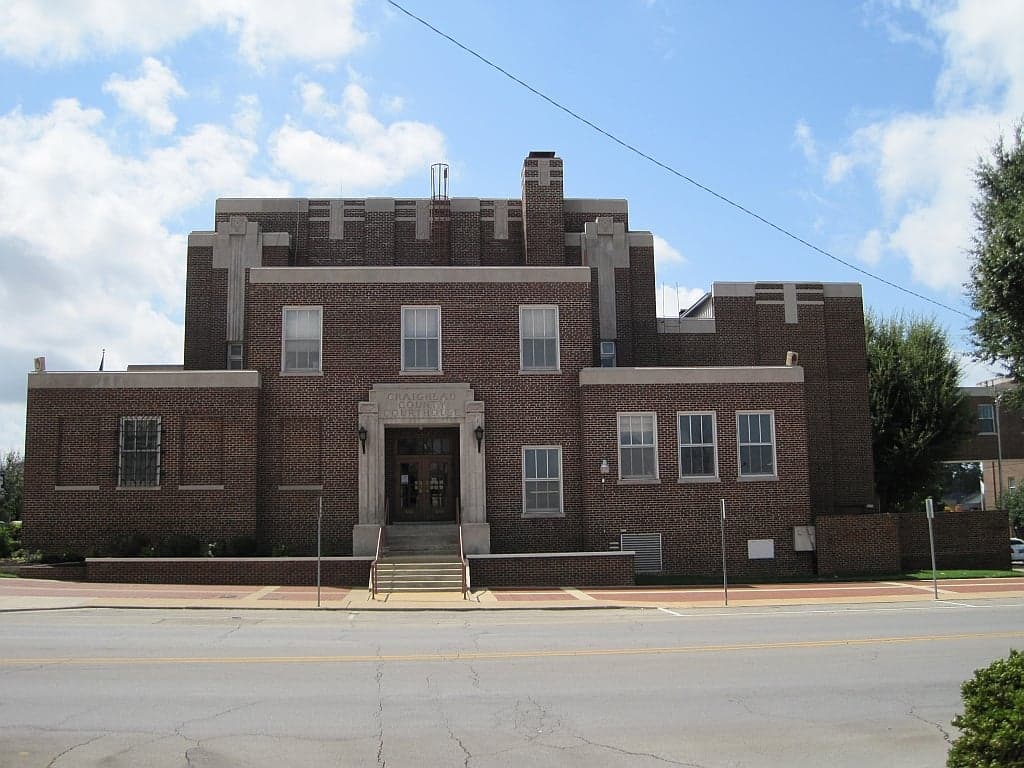
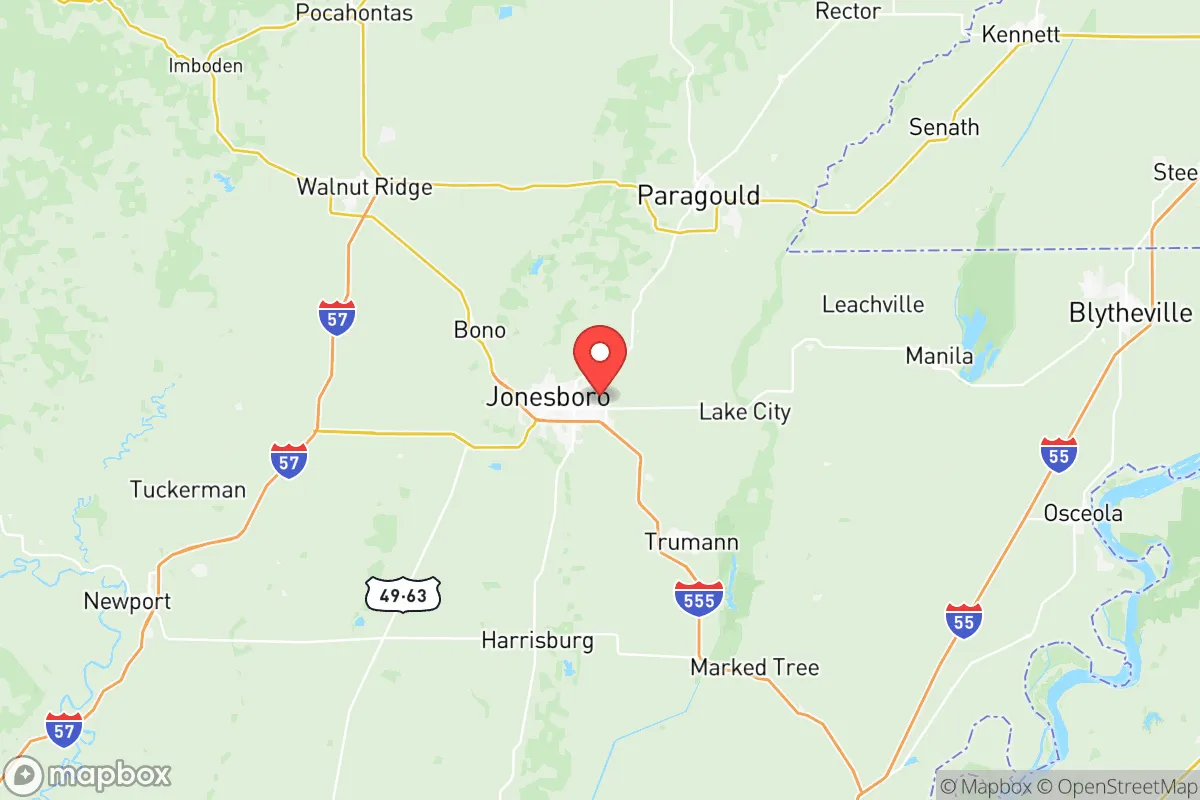
Photo: Wikipedia
Political ClimatePolitical Climate in Craighead County
Showing district-level results — no local-only data available.
Local Political AnalysisPolitical Analysis of Craighead County
Craighead County is reliably Republican, with a Cook PVI of R+23 that makes it significantly more conservative than Arkansas as a whole (R+16). The county has been trending rightward for decades, and while Jonesboro’s growth has introduced some suburban moderation, the rural precincts outside the city keep the overall lean deep red. In the 2024 presidential race, the county voted roughly 68% Republican, a margin that has held steady since 2016.
How it compares
The R+23 PVI means Craighead County is about seven points more Republican than the state average. That gap shows up in local elections too: the county commission and most municipal offices are held by Republicans, and Democratic candidates rarely crack 35% countywide. The political geography breaks down by town. Jonesboro, the county seat and home to Arkansas State University, is the most competitive area — its central precincts near campus and downtown lean blue, with Democratic votes hitting 45-48% in some wards. Bay, Brookland, and Bono are solidly red, often voting 75%+ Republican. Lake City and Monette in the southern part of the county are also reliably conservative, though with slightly more ticket-splitting in local races. The swing precincts are in Jonesboro’s newer subdivisions on the west and south sides, where transplants from Memphis and other parts of the state have made races for county judge and state legislature closer than in the rural areas.
What this means for residents
For conservative residents, the political climate is comfortable and affirming. Local government is aligned with their values on taxes, gun rights, and development policy — the county has no zoning in unincorporated areas, and property taxes are among the lowest in the state. Republican primary elections are the real contests, and turnout in those primaries is high, especially in the rural precincts. For liberal residents, the reality is more about finding community within a minority. Jonesboro’s university district and the downtown area near the Craighead County Courthouse are the most welcoming spaces, with a handful of progressive-leaning coffee shops, a local Democratic club that meets monthly, and a visible LGBTQ+ presence at Arkansas State. State-level policies — like the near-total abortion ban and permitless carry law — are popular countywide, but they can feel isolating for those who oppose them. The practical effect is that liberal residents often focus on local issues like school board races and city council seats, where the margins are tighter and a few hundred votes can shift policy on things like sidewalk funding or police oversight.
Culturally, Craighead County is more Southern Baptist and rural in character than the state as a whole. The county has a higher percentage of residents who attend church weekly than the Arkansas average, and faith-based nonprofits play a large role in social services. Politically, this translates to strong support for school choice and opposition to expanded gambling — the county voted against a 2024 casino measure by a 2-to-1 margin, even as the state narrowly approved it. The trajectory is toward continued Republican dominance, but with a slowly growing Democratic foothold in Jonesboro as the city diversifies and attracts younger professionals. For now, the county’s politics are best understood as a stable, deeply conservative environment with a small but resilient liberal pocket in the urban core.

State Political ClimatePolitical Climate in Arkansas
State Political AnalysisPolitical Environment in the State
Arkansas is a deeply conservative state, with a Cook PVI of R+16 that has only hardened over the past two decades. The state hasn’t voted for a Democratic presidential candidate since Bill Clinton’s 1996 re-election, and the GOP now holds every statewide office, supermajorities in both legislative chambers, and all four U.S. House seats. This wasn’t always the case — Arkansas was a reliably Democratic state through the 1990s, but a combination of cultural realignment, rural population loss, and the nationalization of politics flipped it decisively red by 2010. For a conservative relocator, this means your vote will be in the majority, but for a liberal resident, it can feel like living in a one-party state where your voice is rarely reflected in policy.
Urban vs. rural divide
The political map of Arkansas is a classic story of a few blue islands in a vast red sea. The state’s two major metros — Little Rock (Pulaski County) and Fayetteville-Springdale-Rogers (Washington and Benton counties) — are the only areas that consistently vote Democratic, and even they are not uniformly blue. Pulaski County, home to the state capital and a sizable Black population, went for Biden by about 12 points in 2020, but the surrounding bedroom communities like Maumelle and Sherwood are more purple. Northwest Arkansas, driven by the corporate headquarters of Walmart, Tyson Foods, and J.B. Hunt, has seen an influx of college-educated professionals and younger families; Washington County (Fayetteville) voted for Biden by a slim margin, while Benton County (Bentonville, Rogers) is still red but trending purple. Outside these two corridors, the state is overwhelmingly Republican. Jonesboro in the northeast, Fort Smith on the western border, and Texarkana in the southwest are all reliably conservative. The rural Delta counties along the Mississippi River — places like Lee County and Phillips County — are the only remaining Democratic strongholds outside the metros, driven by a high concentration of Black voters, but their populations are shrinking fast. The real story is the suburban and exurban expansion around Little Rock and Northwest Arkansas, which is slowly shifting the political center of gravity, but not fast enough to challenge the state’s overall red tilt.
Policy environment
Arkansas’s policy environment is a textbook example of a low-tax, low-regulation, culturally conservative state. There is no state income tax on capital gains, and the top marginal income tax rate was cut from 6.9% to 4.9% in 2023, with a path to 4.4% by 2025. Sales tax is around 6.5% at the state level, but local add-ons can push it over 10% in some cities. Property taxes are among the lowest in the country, with a median effective rate of about 0.6%. The state is a right-to-work state with no state minimum wage above the federal floor, though a 2024 ballot initiative to raise it to $15/hour is gathering signatures. On education, Arkansas has a robust school choice program: the LEARNS Act, passed in 2023, created universal Education Savings Accounts (ESAs) worth roughly $6,600 per student, usable for private school tuition, homeschooling expenses, or tutoring. The state also bans nearly all abortions, with no exceptions for rape or incest, and has a trigger law that took effect immediately after Dobbs. Election laws are moderately restrictive: voter ID is required, early voting is available for 15 days, and absentee voting requires an excuse. There are no sanctuary city policies — in fact, a 2023 law requires local law enforcement to cooperate with federal immigration authorities.
Recent policy direction
The last three years have seen a dramatic acceleration of conservative policy in Arkansas. The LEARNS Act (2023) is the biggest — it not only created universal ESAs but also banned “critical race theory” in K-12 classrooms, restricted how teachers can discuss gender identity, and raised starting teacher salaries to $50,000. On gun rights, Arkansas became a permitless carry state in 2021, meaning any law-abiding adult can carry a concealed firearm without a license. The state also passed a “Second Amendment Sanctuary” resolution in 2021, though it’s largely symbolic. On medical and bodily autonomy, the state enacted a near-total abortion ban in 2022 (Act 180) and in 2023 passed a law banning gender-affirming care for minors, including puberty blockers and hormone therapy. Property rights are strong: Arkansas is a “Dillon’s Rule” state, meaning local governments have only the powers explicitly granted by the state, which limits local zoning and rent control experiments. On privacy and surveillance, the state passed a data privacy law in 2023 (the Arkansas Data Privacy Act) that gives residents the right to access, correct, and delete personal data held by large companies, but it’s weaker than California’s. Voting access has tightened: a 2021 law shortened the absentee ballot application window and banned ballot drop boxes. The overall direction is unmistakably toward expanding individual liberty in the conservative sense — lower taxes, more school choice, fewer gun restrictions — while restricting it in areas like reproductive rights and transgender care.
Civil unrest & political movements
Arkansas is not a hotbed of civil unrest, but there have been visible flashpoints. The most notable in recent years was the 2020 Black Lives Matter protests in Little Rock, which saw several nights of demonstrations and some property damage, but no widespread violence. The state’s response was relatively restrained compared to Portland or Seattle. On the right, the Arkansas Freedom Fund and local gun rights groups are active, and there was a significant “Stop the Steal” rally at the state capitol in January 2021, but it was small compared to other states. Immigration politics are a low-boil issue: the 2023 law requiring local cooperation with ICE has been controversial in Northwest Arkansas, where the Latino population has grown rapidly (about 20% of Springdale’s population is Hispanic). There is no serious secession or nullification movement — Arkansas is solidly within the Union. Election integrity controversies have been minimal; the 2020 and 2022 elections ran smoothly, with no major fraud allegations from either side. The most visible political movement is probably the school choice advocacy group “Arkansas Families for School Choice,” which successfully pushed the LEARNS Act. A new resident would notice that political yard signs are common in rural areas, but the overall atmosphere is calm — people are polite about politics in person, even if they disagree.
Projection
Over the next 5-10 years, Arkansas will likely remain solidly red, but the margins may narrow slightly in the Northwest Arkansas corridor. The state is growing — about 1% per year — and most of that growth is in Benton and Washington counties, which are becoming more diverse and more educated. If that trend continues, you could see a scenario where Northwest Arkansas becomes a swing region, similar to the suburbs of Atlanta or Dallas. However, the rural Delta and southern Arkansas are losing population, which will keep the overall state lean red. The biggest wildcard is in-migration: if the state continues to attract conservative-leaning families from California and the Northeast (drawn by low taxes and school choice), the GOP majority could actually strengthen. For a new resident, the practical takeaway is that Arkansas will not become a purple state in the next decade, but the political conversation will become more nuanced in the growing metros. Expect continued battles over education funding (the ESAs are expensive and may face budget pressure), abortion access (there will be attempts to add exceptions), and transgender rights (the ban on care for minors is being litigated). The state’s tax-cutting trajectory will likely continue, but at a slower pace as revenue growth moderates.
For a new resident, the bottom line is this: if you are conservative, you will find a state that aligns with your values on taxes, guns, education, and cultural issues, and you will be in the majority. If you are liberal, you will find a state where your vote rarely matters in statewide elections, but you can still find like-minded communities in Little Rock and Fayetteville. The practical reality is that Arkansas is a place where politics is less in-your-face than in swing states — people tend to live and let live, even if the laws lean heavily one way. The key is to choose your location carefully: Northwest Arkansas offers a more moderate, growing environment, while rural areas are deeply traditional. Either way, you’ll pay low taxes, have access to school choice, and enjoy a relatively low-stress political atmosphere compared to the national headlines.
* Values derived from national, state, county, city and local statistics and may differ in a specific area. Last updated: 2026-06-16T04:00:27.000Z
Narrative content on this page is AI-generated and may contain mistakes. Verify any details that matter before acting on them.
ReloMaps may earn a commission from affiliate links at no extra cost to you.

