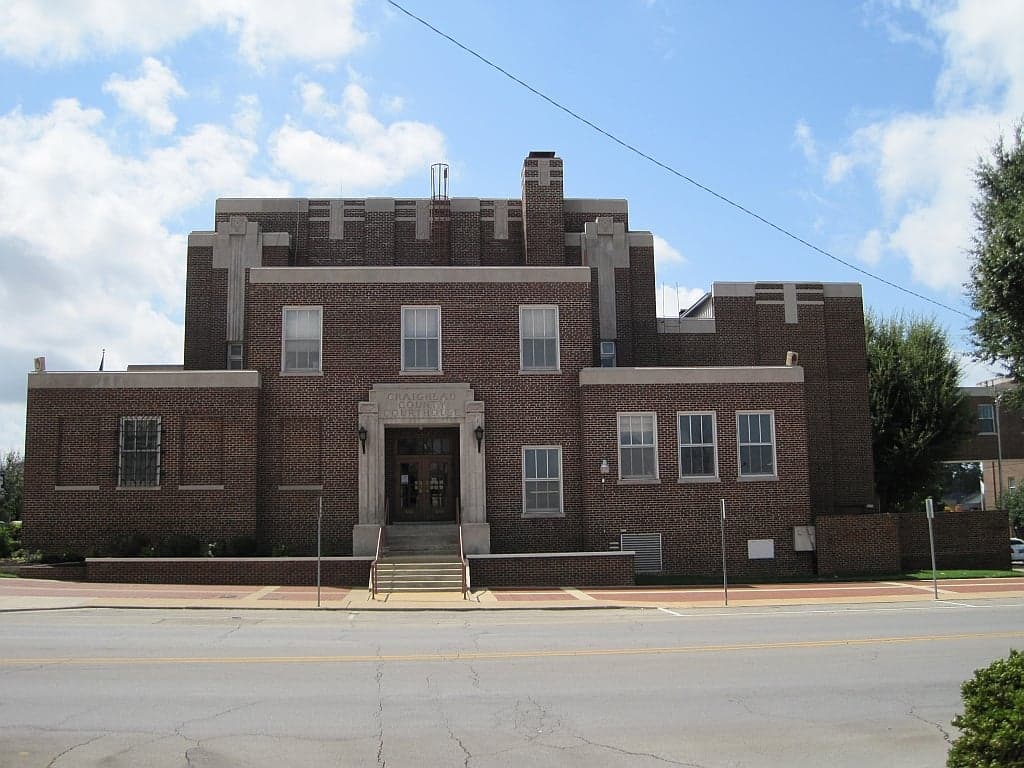
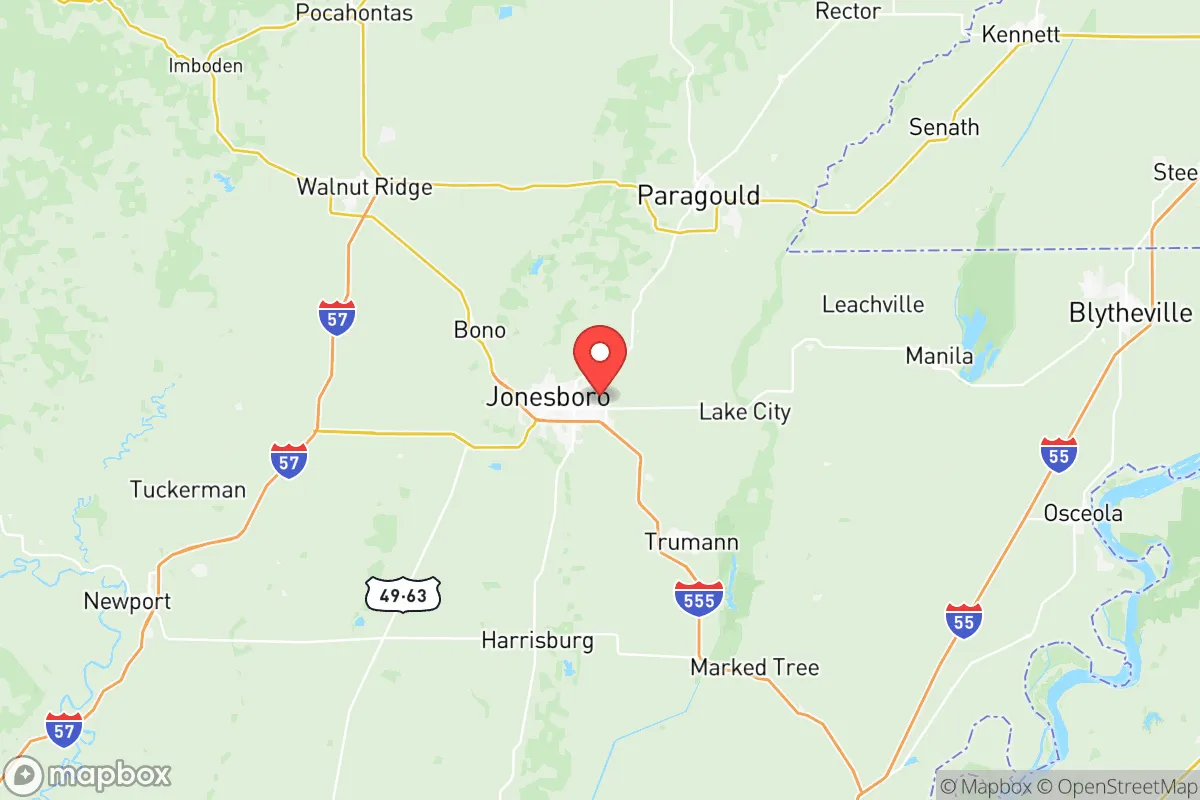
Photo: Wikipedia
Demographics of Craighead County
Affluence Level in Craighead County
A middle-class area roughly in line with national averages across income, home values, education, and employment.
People of Craighead County
The people of Craighead County, Arkansas today number 112,097, forming a population that is predominantly white (71.7%) with a significant Black minority (16.6%) and a growing Hispanic community (6.2%). The county is anchored by the twin cities of Jonesboro and Bay, with a character that blends Deep South agricultural roots with a modern, increasingly suburban identity shaped by Arkansas State University and regional healthcare employment. Distinctive markers include a low foreign-born share (2.3%) and a college-educated rate of 27.8%, reflecting a population that is largely native-born and rooted in the region’s historical settlement patterns.
Settlement & growth (pre-1960)
Before American settlement, the area now known as Craighead County was part of the ancestral homeland of the Quapaw and Osage nations, who used the region for hunting and seasonal camps along the St. Francis River and its tributaries. The first European presence was sparse—French trappers and traders passed through in the 17th and 18th centuries, but no permanent colonial settlements took root. The land was acquired by the United States in the 1803 Louisiana Purchase and remained a frontier wilderness for decades.
Organized American settlement began in earnest after the 1819 Missouri Compromise and the subsequent removal of Native nations in the 1830s. The first wave was overwhelmingly Scots-Irish and English yeoman farmers from Tennessee, Kentucky, and the Carolinas, who arrived between 1830 and 1850. They cleared timber along Crowley’s Ridge, a unique geological formation running north-south through the county, and established small subsistence farms. The town of Jonesboro, founded in 1859 as the county seat, became the commercial hub for these early settlers. Nearby Lake City (originally called “St. Francis”) and Monette grew as trading posts for the same population.
The post-Civil War period brought a second major wave: freed African Americans who migrated from deeper in the Mississippi Delta during Reconstruction (1865–1880). They settled primarily in rural areas south and east of Jonesboro, working as sharecroppers and tenant farmers on cotton plantations. The town of Brookland became a notable Black settlement, with its own schools and churches. By 1900, Black residents made up roughly 30% of the county’s population, a share that would decline over the 20th century due to outmigration.
A third wave arrived with the railroad boom of the 1880s and 1890s. The St. Louis–San Francisco Railway (the “Frisco”) and the Cotton Belt Railroad laid tracks through the county, connecting Jonesboro to Memphis and St. Louis. This brought a modest influx of German and Irish immigrants who worked as railroad laborers and settled in railroad towns like Bono and Caraway. Unlike the German enclaves of central Texas, these immigrants assimilated quickly and left little distinct ethnic footprint beyond a few Lutheran churches.
The Dust Bowl and Great Depression of the 1930s drove a fourth wave: white tenant farmers and sharecroppers from Oklahoma and the Arkansas Delta who moved into the county seeking work. Many settled in the western part of the county around Cash and Egypt, where cotton and rice farming expanded with New Deal irrigation projects. This group reinforced the county’s white, rural, Protestant character. By 1960, Craighead County’s population had reached 47,000, with Jonesboro as the dominant urban center and a Black population that had fallen to about 18% due to the Great Migration northward.
Modern era (post-1965)
The 1965 Hart-Cellar Act had a minimal direct impact on Craighead County, as the region did not attract the large-scale immigration seen in coastal or Sun Belt metros. The foreign-born share remains just 2.3% in 2026, far below the national average. However, the post-1965 era brought two significant domestic shifts that reshaped the county’s population.
The first was the expansion of Arkansas State University (ASU) in Jonesboro, which grew from a teachers’ college to a comprehensive regional university after 1965. This drew a steady stream of students and faculty from across Arkansas and the Mid-South, diversifying the county’s educational and professional base. ASU’s growth also attracted a small but visible East/Southeast Asian community (0.9% of the county population), primarily Vietnamese and Filipino families who came as faculty, medical professionals, or through refugee resettlement programs in the 1970s and 1980s. These families concentrated in Jonesboro’s west side near the university campus.
The second shift was suburbanization and Sun Belt migration from the 1990s onward. As manufacturing and logistics jobs grew—led by companies like Hytrol Conveyor and Post Foods—white professionals from Memphis, St. Louis, and Chicago moved into new subdivisions in Jonesboro’s southwest corridor and the town of Bay. This domestic in-migration has been overwhelmingly white and has reinforced the county’s white majority. At the same time, the Black population stabilized at 16.6%, with many Black families moving from rural areas into Jonesboro’s north and east neighborhoods, where historically Black institutions like First Baptist Church of Brookland remain active.
The Hispanic population (6.2%) grew rapidly after 2000, driven by labor demand in poultry processing (Tyson Foods has a plant in nearby Monette) and construction. This community is predominantly Mexican and Central American, with families settling in Jonesboro’s south side and in mobile home parks around Bono and Caraway. The Indian-subcontinent population (0.3%) is tiny but growing, consisting mostly of doctors and engineers recruited by St. Bernards Medical Center and ASU, and they live primarily in Jonesboro’s newer subdivisions.
The future
Craighead County is projected to become slightly more diverse but remain majority white over the next 10–20 years. The Hispanic share is expected to rise to 8–10% by 2040, driven by continued labor demand and family reunification, while the Black share may hold steady or decline slightly as younger Black residents move to larger metros like Memphis or Atlanta. The East/Southeast Asian and Indian communities will likely grow slowly, tied to university and healthcare employment, but will remain small enclaves rather than forming large ethnic neighborhoods.
The most significant demographic trend is continued suburbanization around Jonesboro. New subdivisions are spreading south toward Bay and west toward Brookland, drawing white families from rural areas and out-of-state transplants. This is creating a more politically and culturally moderate county, though it remains conservative-leaning overall. The rural population in towns like Cash and Egypt is aging and shrinking, while Jonesboro absorbs most growth. The county’s cultural identity is evolving from a cotton-and-rice farming community to a regional service and education hub, but the change is gradual—Craighead County is not experiencing the rapid transformation seen in Northwest Arkansas or the Dallas suburbs.
For someone moving in now, Craighead County offers a stable, affordable, and predominantly native-born community where change comes slowly. The population is becoming more suburban and slightly more diverse, but the core identity—rooted in Scots-Irish and African American heritage, with a growing Hispanic presence—remains intact. New arrivals will find a place where family, church, and university life still anchor daily existence, and where the pace of demographic change is measured in decades, not years.

* Values derived from national, state, county, city and local statistics and may differ in a specific area. Last updated: 2026-06-16T04:00:27.000Z
Narrative content on this page is AI-generated and may contain mistakes. Verify any details that matter before acting on them.
ReloMaps may earn a commission from affiliate links at no extra cost to you.

