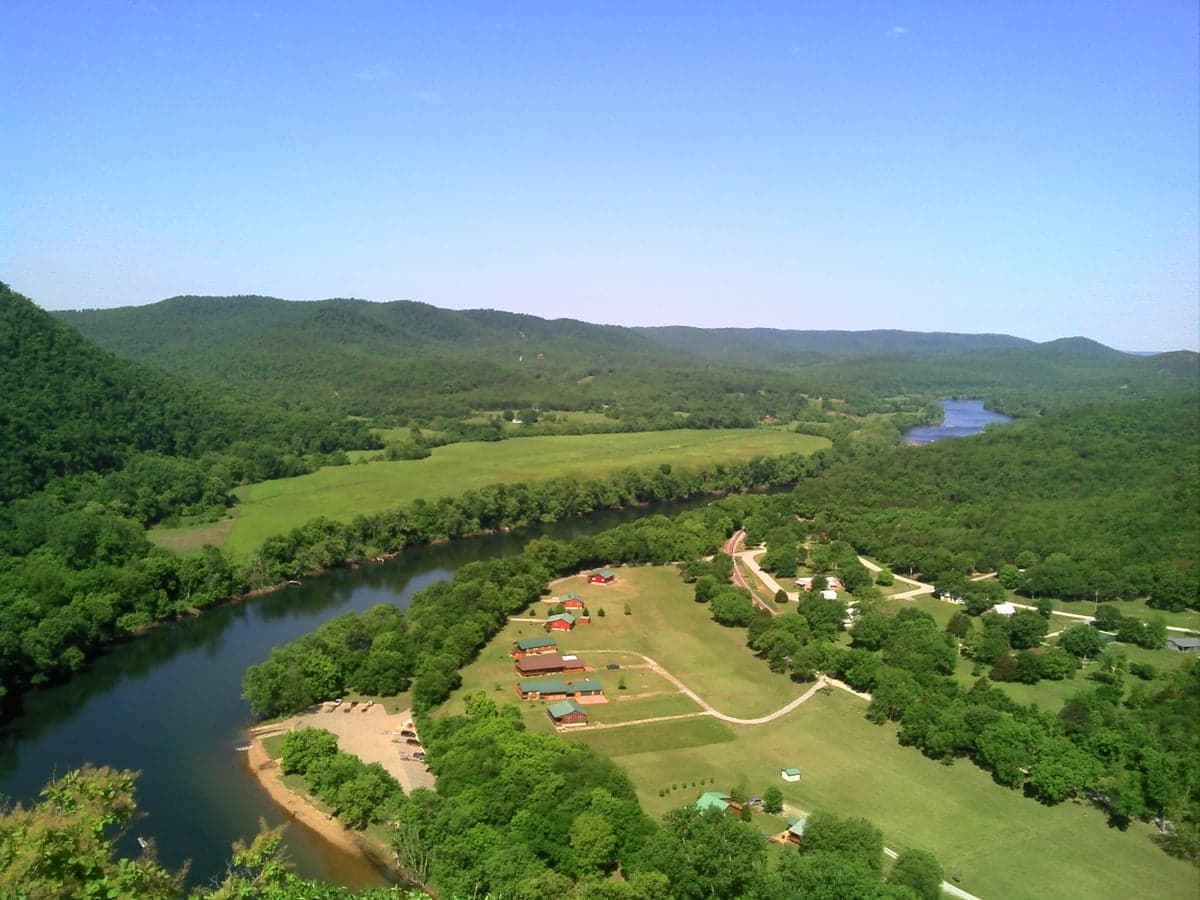
Photo: Wikipedia
Political ClimatePolitical Climate in Baxter County
Showing district-level results — no local-only data available.
Local Political AnalysisPolitical Analysis of Baxter County
Baxter County is one of the most reliably Republican counties in Arkansas, carrying a Cook Partisan Voting Index (PVI) of R+23, which is significantly redder than the state’s overall R+16 rating. This isn’t a new development—the county has voted for the GOP presidential candidate in every election since 2000, and the margin has only widened. In 2024, Donald Trump carried Baxter County by roughly 40 points, a shift that reflects a broader trend of rural and exurban Arkansas moving further right. The county’s politics are shaped by its demographics: a predominantly white, older population (median age around 50) with a heavy concentration of retirees in and around Mountain Home, the county seat and largest city.
How it compares
Compared to Arkansas as a whole, Baxter County is about 7 points more conservative on the PVI scale, which places it in the same league as neighboring Marion County (R+24) and Stone County (R+22), but notably redder than more urbanized areas like Pulaski County (D+8) or Washington County (R+12). Within Baxter County itself, the political geography isn’t monolithic. Mountain Home’s core precincts, especially around the Baxter Regional Medical Center and the downtown area, tend to be slightly more moderate, occasionally swinging within 5-10 points of the county average. In contrast, the rural precincts in the southern part of the county—around the towns of Gassville and Cotter—are deep red, often voting 70-80% Republican. The only precincts that lean blue are the small, unincorporated communities near the Marion County line, like Norfork, where a handful of lakefront property owners and seasonal residents from more liberal states create a tiny Democratic pocket. But these are outliers; the county’s overall trajectory is solidly rightward, with no signs of flipping.
What this means for residents
For conservative residents, Baxter County feels like home. The local Republican Party is well-organized, with active precinct committees and a strong presence at county commission meetings. Policy debates here are less about whether to cut taxes or regulations, and more about how much to cut them. For liberal residents, the reality is more isolating. There is no organized Democratic Party infrastructure to speak of—the county party is essentially dormant—and progressive viewpoints are rarely represented in local media or public forums. That said, the area’s politics are generally low-drama. Most local elections are decided in the Republican primary, and the general election is a formality. The county’s conservative lean means that issues like gun rights, property rights, and opposition to federal land management (especially around the Buffalo National River) are deeply ingrained in local culture. There’s little appetite for new taxes or spending, which keeps the county’s budget lean but also limits public services.
Culturally, Baxter County’s politics are intertwined with its identity as a retirement and outdoor recreation destination. The influx of retirees from the Midwest and West Coast has actually reinforced the conservative tilt, as many newcomers are drawn by the low taxes and limited government. One notable policy distinction: Baxter County is a Second Amendment sanctuary, having passed a resolution in 2021 opposing any state or federal infringement on gun rights. This is a point of pride for many residents, though it occasionally creates friction with the more moderate state-level GOP leadership in Little Rock. For anyone moving here, the political climate is straightforward: if you lean right, you’ll find a welcoming community; if you lean left, you’ll need to be comfortable being in the minority. The county’s trajectory suggests this dynamic will persist for the foreseeable future, with no major demographic or economic shifts on the horizon that would alter its political DNA.

State Political ClimatePolitical Climate in Arkansas
State Political AnalysisPolitical Environment in the State
Arkansas is a deeply red state with a Cook PVI of R+16, meaning it votes about 16 points more Republican than the national average in presidential elections. The state hasn’t backed a Democrat for president since Bill Clinton’s 1996 re-election, and the GOP has held every statewide office and both chambers of the legislature since 2015. Over the past 20 years, the shift has been dramatic — Democrats controlled the legislature and most statewide offices as recently as 2010, but a combination of national polarization, rural realignment, and conservative Democratic incumbents retiring or switching parties flipped the state decisively. Today, the dominant coalition is a mix of rural and suburban conservatives, with the northwest corner (Bentonville, Rogers, Fayetteville) providing the GOP’s biggest margins, while the Delta and central Arkansas (Little Rock, Pine Bluff) remain the last Democratic strongholds.
Urban vs. rural divide
The political map of Arkansas is a classic urban-rural split, but with a twist. The state’s two largest metro areas — Little Rock and Northwest Arkansas — vote very differently. Little Rock (Pulaski County) is the only reliably blue county in the state, voting for Biden by 18 points in 2020, driven by a large African American population and a professional-class liberal base. Surrounding suburbs like Conway and Benton are purple-to-light-red, trending right as they grow. Meanwhile, Northwest Arkansas (Benton and Washington counties) is the engine of the state’s GOP dominance. Benton County, home to Walmart’s headquarters in Bentonville, voted +30 points for Trump in 2020, and Washington County (Fayetteville) is a bit more moderate but still solidly red. The rural Delta counties — Lee, Phillips, St. Francis — are poor, majority-Black, and vote heavily Democratic, but their populations are small and shrinking. The Ozarks and Ouachita regions (e.g., Boone County, Polk County) are among the most conservative in the nation, often voting 80%+ Republican. The divide is stark: if you live in Little Rock or the Delta, you’re in a blue bubble; anywhere else, you’re surrounded by deep red.
Policy environment
Arkansas’s policy environment is consistently conservative, with low taxes and limited regulation as the baseline. The state has a flat income tax rate of 4.4% (down from 7% in 2015), a 6.5% sales tax, and no estate or inheritance tax. Property taxes are among the lowest in the country, averaging about 0.6% of home value. The regulatory posture is business-friendly, with right-to-work laws and minimal zoning restrictions outside of a few cities. Education policy is a flashpoint: the state has a robust school choice program (the Succeed Scholarship Program) and a 2023 law (Act 237) that restricts how race and gender can be taught in public schools. Healthcare is a mixed bag — Arkansas expanded Medicaid under the private-option model (Arkansas Works), but the state has some of the strictest abortion laws in the nation (a near-total ban with no exceptions for rape or incest, passed in 2019 and triggered by the Dobbs decision). Election laws are restrictive: voter ID is required, early voting is 15 days, and absentee voting requires an excuse. The state also passed a 2021 law (Act 249) that made it a felony to collect absentee ballots for others, a measure critics call voter suppression.
Recent policy direction
The last five years have seen Arkansas move aggressively on a range of liberty-related issues, mostly in a conservative direction. On gun and self-defense law, the state enacted permitless carry (Act 777) in 2021, allowing any adult who can legally possess a firearm to carry it concealed without a license. On parental and education rights, the 2023 LEARNS Act (Act 237) created a universal school voucher program, banned “critical race theory” and “indoctrination” in classrooms, and required schools to notify parents of any changes to a student’s health or well-being — effectively a “parental rights” bill that has been controversial with LGBTQ+ advocates. On speech and privacy, the state passed a 2023 law (Act 611) requiring social media platforms to verify the ages of users and obtain parental consent for minors, and a 2021 law (Act 1100) that prohibits public schools from requiring students to use pronouns that don’t match their biological sex. On medical and bodily autonomy, the near-total abortion ban is the headline, but the state also passed a 2023 law (Act 199) banning gender-affirming care for minors, including puberty blockers and hormone therapy. On property rights, Arkansas is a strong “right-to-farm” state, with laws protecting agricultural operations from nuisance lawsuits. On taxation, the trend is toward lower rates: the 2023 tax cut package (Act 1) accelerated the income tax reduction to 4.4% and cut the corporate rate to 4.8%. On voting and ballot access, the state has tightened rules: Act 249 (2021) criminalizes ballot harvesting, and a 2023 law (Act 416) shortened the absentee ballot application window. The overall direction is toward more conservative governance, with a focus on parental control, gun rights, and tax reduction, while restricting abortion and transgender care.
Civil unrest & political movements
Arkansas has not seen the large-scale protests of states like Oregon or Georgia, but there have been notable flashpoints. In 2020, Black Lives Matter protests in Little Rock and Fayetteville drew hundreds, with some clashes with police, but they were smaller and less violent than in many other states. The most visible political movement in recent years has been the “Moms for Liberty” and conservative parent groups, which have been highly active in school board meetings, particularly in Bentonville and Rogers, pushing for book bans and curriculum restrictions. On the left, the Arkansas Public Policy Panel and Indivisible groups organize around voting rights and healthcare access, but they are outmatched by the GOP’s dominance. Immigration politics are relatively quiet — Arkansas has a small foreign-born population (about 5%), and there are no sanctuary cities. There is a small but vocal secessionist/nullification movement in the Ozarks, with groups like the Arkansas Sovereignty Project advocating for state nullification of federal laws, but it has no real political power. Election integrity controversies flared in 2020 and 2022, with the state GOP pushing for audits and tighter rules, but no major fraud was found. For a new resident, the most visible political activity will be yard signs and bumper stickers — you’ll see far more Trump and “Don’t Tread on Me” flags than any progressive messaging, especially outside of Little Rock.
Projection
Over the next 5-10 years, Arkansas is likely to stay deeply red, but with some interesting shifts. The biggest demographic trend is the rapid growth of Northwest Arkansas, which is attracting young professionals and families from blue states (California, Illinois, Colorado) due to lower costs and the booming economy around Walmart, Tyson Foods, and JB Hunt. This in-migration is moderately conservative — these newcomers tend to be fiscally conservative but socially moderate, which could push the region slightly toward the center over time. However, the rural areas are shrinking and aging, which means the GOP’s base is getting older and more conservative. The Delta will continue to lose population, reducing the Democratic vote share. The net effect is that Arkansas will likely remain R+16 to R+20, with the GOP holding a supermajority in the legislature for the foreseeable future. The policy direction will continue to be conservative — expect further tax cuts, more school choice expansion, and possibly a push for a state constitutional amendment to ban abortion outright (currently it’s a statute). The wild card is the 2026 gubernatorial race, as Governor Sarah Huckabee Sanders is term-limited after 2026; her successor will likely be a Republican, but the style could shift. For a new resident, the state will feel politically stable and predictable — no major flips, no dramatic policy reversals, just a steady conservative drift.
For a new resident, the bottom line is straightforward: if you’re conservative, Arkansas will feel like home — low taxes, gun-friendly, parental rights prioritized, and a government that shares your values. If you’re liberal, you’ll find a small but active community in Little Rock and Fayetteville, but you’ll be in the minority in most of the state, and you’ll need to accept that state policy will often run counter to your views. The practical takeaway is that Arkansas is a place where your vote matters less in statewide races (they’re decided in the GOP primary) but can still swing local elections, especially in growing suburbs like Conway or Bentonville. The state is politically stable, with no major unrest, and the culture is generally polite and neighborly, even across political lines. Just don’t expect the politics to change anytime soon.
* Values derived from national, state, county, city and local statistics and may differ in a specific area. Last updated: 2026-06-16T02:27:40.000Z
Narrative content on this page is AI-generated and may contain mistakes. Verify any details that matter before acting on them.
ReloMaps may earn a commission from affiliate links at no extra cost to you.

