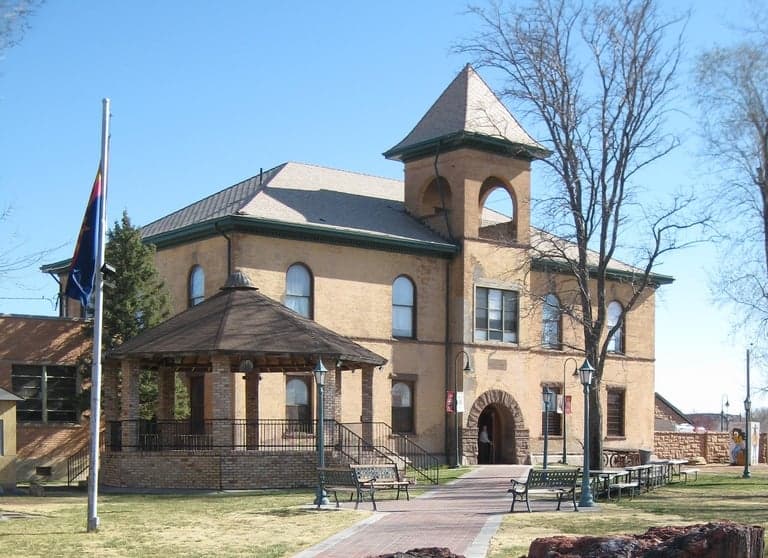
Photo: Wikipedia
Personal Sovereignty in Navajo County
Viable for self-reliance. Generally workable, though some barriers may limit total independence.
What does Personal Sovereignty tell us?
Personal Sovereignty measures your capacity for self-reliance and independence with minimal government friction. Higher scores mean fewer barriers between you and the way you want to live... but it assumes you have the space you need and good neighbors.
What does this tell us?
Personal Sovereignty measures your capacity for self-reliance and independence with minimal government friction. Higher scores mean fewer barriers between you and the way you want to live... but it assumes you have the space you need and good neighbors.
State Policy
Energy independence: Importer (20% of energy produced in-state)
Personal Liberty
Homesteading

Personal Liberty Analysis
Navajo County, Arizona, offers a notably high degree of personal sovereignty, particularly for those seeking to live with minimal government interference in daily life. The county’s regulatory posture is light, its tax burden is low, and its culture strongly emphasizes self-reliance, making it a distinct alternative to the more heavily governed urban corridors of Phoenix or Tucson. For single individuals and families who prioritize autonomy—whether in self-defense, property use, or personal lifestyle choices—this region of the High Country presents a compelling environment where local governance tends to defer to individual judgment.
Tax burden and regulatory posture: How light is the government touch?
Arizona is a low-tax state overall, and Navajo County operates within that framework with no additional county-level income tax. The state’s flat income tax rate of 2.5% and a sales tax rate of 5.6% (with local additions varying by municipality) keep the annual cost of government modest. Property taxes are among the lowest in the nation, with effective rates around 0.62% of assessed value—meaning a $250,000 home carries roughly $1,550 in annual property tax. This is a fraction of what homeowners pay in states like Texas or New York. The regulatory environment is similarly restrained. There is no county-wide building code in unincorporated areas, though incorporated towns like Show Low and Pinetop-Lakeside enforce their own zoning and permit requirements. For those seeking maximum freedom from permitting, the unincorporated expanses around Heber-Overgaard or Holbrook offer the lightest touch, where you can build a structure without county inspection as long as it meets basic state health and safety standards. The county’s planning and zoning department is small and generally responsive, but its reach is limited outside town limits. This creates a bifurcated landscape: inside city limits, you’ll encounter standard subdivision rules; outside them, you’re largely left to your own devices.
Self-defense and gun law specifics: What are the carry and use-of-force rules?
Arizona is a constitutional carry state, meaning no permit is required to carry a concealed firearm for anyone legally allowed to possess one. Navajo County fully aligns with this, and local law enforcement—including the Navajo County Sheriff’s Office—is known for a pro-Second Amendment stance. The county has no additional firearm ordinances beyond state law; you can carry openly or concealed in most public spaces, including restaurants that serve alcohol (unless posted). Use-of-force laws are among the most protective in the nation. Arizona’s “stand your ground” statute (ARS 13-405) removes any duty to retreat before using deadly force if you are lawfully present and reasonably believe it is necessary to prevent death or great bodily harm. Castle doctrine protections extend to your vehicle and workplace. In practice, this means a homeowner in Snowflake or Taylor who confronts an intruder has broad legal latitude. The county sheriff has publicly stated he will not enforce federal firearm restrictions he deems unconstitutional, a stance that resonates with the conservative-leaning population. For those moving from states with magazine capacity limits or waiting periods, the transition is seamless—no background checks for private sales, no registration, and no permit needed to purchase rifles or handguns.
Self-reliance and homesteading viability: Lot sizes, zoning, and off-grid feasibility
Navajo County is one of the most homestead-friendly regions in Arizona, particularly in its vast unincorporated areas. Minimum lot sizes in the county’s rural zoning districts start at 1 acre, but many parcels in areas like Heber-Overgaard and Pinedale are sold in 2.5- to 5-acre increments, providing ample space for gardens, livestock, and workshops. Off-grid living is entirely feasible, though not without some constraints. The county does not require connection to municipal water or sewer; wells and septic systems are standard. Solar power is common, and the county’s building department does not mandate grid-tied electrical systems. However, the Arizona Department of Environmental Quality does require permits for wells and septic, and the county enforces a 200-foot setback from property lines for structures. For those wanting to live completely off-grid, the area around Holbrook and the remote stretches near the Petrified Forest National Park offer the least oversight. In contrast, the more developed towns of Show Low and Pinetop-Lakeside have stricter zoning—including minimum square footage requirements for homes and restrictions on RVs as primary residences. The county’s agricultural zoning allows for livestock (horses, cattle, goats) without special permits, and many residents keep chickens and bees as a matter of course. Water rights are a critical consideration: most parcels come with grandfathered groundwater rights, but new wells in some basins require a permit from the Arizona Department of Water Resources. Overall, the regulatory burden for a self-sufficient lifestyle is low, especially compared to the West Coast or Northeast.
Personal liberties: Parental rights, medical autonomy, speech, and property
Navajo County reflects Arizona’s broader commitment to personal liberties in several key areas. Parental rights are strongly protected under state law (ARS 1-601), which affirms that parents have the fundamental right to direct their children’s education, healthcare, and religious upbringing. The county’s school districts—including Show Low Unified and Snowflake Unified—are responsive to parental input, and school board meetings often see robust community engagement. Medical autonomy is similarly broad. Arizona does not have a state vaccine mandate, and the county health department does not enforce mask or quarantine orders beyond state guidance. Alternative medicine practitioners operate with minimal licensing friction, and the county has a number of direct-primary-care clinics that operate outside insurance networks. Freedom of speech and assembly are robustly protected; the county has no noise or protest ordinances that would restrict peaceful assembly on private property. Property rights are a cornerstone of the local ethos. The county’s zoning code explicitly states that it is not intended to “unduly restrict the use of private property,” and variance requests are generally granted if they don’t create a public nuisance. Eminent domain is rarely used, and the county’s assessor’s office is transparent about valuation. For those who value the ability to use their land as they see fit—whether for a home business, a shooting range, or a family compound—Navajo County offers one of the most permissive environments in the Southwest.
Overall, Navajo County ranks among the top-tier areas in Arizona for personal sovereignty, comparable to rural counties like Mohave or Yavapai. Its combination of low taxes, minimal regulation, strong self-defense laws, and a culture of self-reliance makes it a natural fit for individuals and families who prioritize independence over convenience. The trade-off is distance from urban amenities and a slower pace of life, but for those who value the freedom to live on their own terms, the county delivers a level of autonomy that is increasingly rare in the modern United States.

* Values derived from national, state, county, city and local statistics and may differ in a specific area. Last updated: 2026-08-27T20:32:06.000Z
Narrative content on this page is AI-generated and may contain mistakes. Verify any details that matter before acting on them.
ReloMaps may earn a commission from affiliate links at no extra cost to you.

