
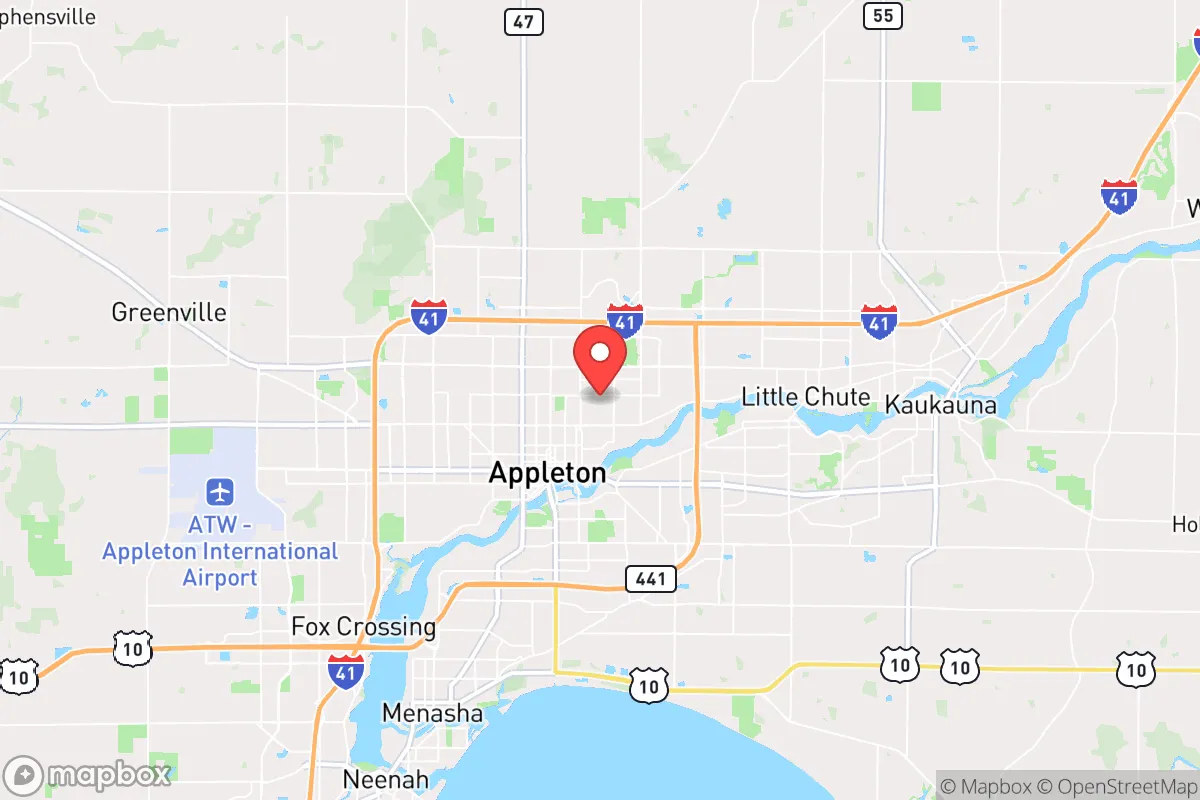
Photo: Wikipedia
Personal Sovereignty in Appleton, WI
Moderate friction. Expect trade-offs in some aspect of personal liberty and independence.
What does Personal Sovereignty tell us?
Personal Sovereignty measures your capacity for self-reliance and independence with minimal government friction. Higher scores mean fewer barriers between you and the way you want to live... but it assumes you have the space you need and good neighbors.
What does this tell us?
Personal Sovereignty measures your capacity for self-reliance and independence with minimal government friction. Higher scores mean fewer barriers between you and the way you want to live... but it assumes you have the space you need and good neighbors.
State Policy
Energy independence: Importer (15% of energy produced in-state)
Personal Liberty
Homesteading

Personal Liberty Analysis
Appleton, Wisconsin, offers a mixed but generally favorable environment for personal sovereignty, particularly when viewed through a survivalist or prepper lens. While the state leans purple and has seen some encroachments on individual liberties, Appleton’s local governance, tax structure, and cultural norms provide a solid foundation for self-reliance and autonomy. The city sits in a region where conservative values still hold significant sway, and the practical realities of daily life—from property rights to self-defense—tend to reward those who are prepared and proactive. For a single individual or family looking to maximize personal freedom while maintaining access to essential infrastructure, Appleton represents a strategic middle ground, not a libertarian paradise but far from the overreach found in coastal or deep-blue jurisdictions.
Tax burden and regulatory posture in Appleton
Wisconsin’s tax burden is moderate compared to high-tax states like New York or California, but it’s not negligible. The state income tax is progressive, with rates from 3.54% to 7.65% for top earners, and sales tax in Appleton is 5.5% (state plus local). Property taxes are the real story: Outagamie County’s effective rate hovers around 1.8% of assessed value, which is above the national average but typical for the Midwest. For a $300,000 home, that’s roughly $5,400 annually—a significant but manageable cost. The regulatory posture in Appleton is business-friendly relative to larger cities, with a streamlined permitting process for home-based enterprises and modest zoning restrictions. However, the state’s Department of Natural Resources (DNR) enforces environmental regulations that can impact land use, especially near waterways or wetlands. For a prepper, the key takeaway is that Appleton’s tax and regulatory environment is not oppressive, but it requires careful budgeting and compliance—especially if you plan to run a small farm or workshop from your property. The city’s recent trend toward modest tax increases (about 2-3% annually) suggests a slow creep rather than a sudden squeeze, which is manageable with proper planning.
Self-defense and gun law specifics in Wisconsin
Wisconsin is a shall-issue state for concealed carry, meaning permits are issued to any qualified applicant without discretionary denial. Appleton itself has no additional local gun restrictions beyond state law, which is a significant plus for personal sovereignty. The state preempts local firearm ordinances, so you won’t find the patchwork of bans seen in places like Colorado or Illinois. Open carry is legal without a permit for anyone 18 or older, and concealed carry requires a permit (issued after a background check and training course). Stand-your-ground laws are in effect—no duty to retreat in any place you have a legal right to be. Magazine capacity is unrestricted, and there is no state-level assault weapons ban. For a survivalist, this means you can legally own and carry the tools you need for self-defense without bureaucratic hurdles. The only notable limitation is that private firearm sales between individuals do require a background check through a licensed dealer (a state-level requirement passed in 2015), which adds a minor friction point. Overall, Appleton’s gun laws are among the most permissive in the Midwest, and local law enforcement generally respects the Second Amendment. The sheriff’s office in Outagamie County is known for issuing permits promptly, often within 30 days.
Self-reliance and homesteading viability in Appleton
Appleton’s zoning and lot sizes offer real opportunities for self-reliance, but with caveats. Within city limits, standard residential lots range from 0.15 to 0.5 acres, which is enough for a substantial vegetable garden, a few fruit trees, and small livestock like chickens (allowed with a permit, up to 6 hens, no roosters). Beekeeping is also permitted with registration. For larger-scale homesteading, you’ll need to look at the surrounding townships—Grand Chute, Greenville, or rural Outagamie County—where lot sizes of 1-5 acres are common and zoning allows for goats, pigs, and even small-scale farming. Off-grid feasibility is limited in Appleton proper due to building codes requiring grid connection for new construction, but rural areas are more flexible. Solar panels are allowed and net metering is available through the local utility (Wisconsin Public Service), though the state’s net metering cap (20 kW for residential) is restrictive for serious off-grid setups. Rainwater collection is legal but regulated—you can capture runoff for gardening, but not for potable use without treatment. The growing season (USDA Zone 5a) runs from late April to early October, which is adequate for most vegetables but short for long-season crops. For a prepper, the best strategy is to buy a property just outside Appleton’s urban service area, where you can have a well, septic, and more land without fighting city ordinances. The soil in the Fox River Valley is fertile loam, ideal for gardening, and the area has abundant water resources.
Personal liberties: parental rights, medical autonomy, speech, and property
Wisconsin has a strong track record on parental rights, with a 2023 law requiring school districts to notify parents of any changes to a student’s health or emotional well-being (including gender-related matters). Appleton’s school board has been relatively moderate, avoiding the extreme policies seen in Madison or Milwaukee. Medical autonomy is a mixed bag: Wisconsin did not impose broad vaccine mandates during the pandemic, and the state legislature has pushed back against federal health overreach, but the medical licensing board retains significant power. For a prepper, the ability to stockpile medications or use alternative treatments is limited by prescription laws, but there are no state-level restrictions on owning medical supplies or equipment. Free speech is protected under the state constitution, and Appleton has no local hate speech ordinances or public assembly restrictions that would chill political expression. Property rights are generally respected, with no statewide rent control or forced inclusionary zoning. However, eminent domain has been used for infrastructure projects (e.g., the recent I-41 expansion), so it’s wise to avoid properties directly in the path of planned developments. The city’s historic preservation commission can impose restrictions on exterior modifications in designated districts, but this is limited to a few blocks downtown. For a conservative individual, the key concern is the slow erosion of local control through state-level mandates—but Appleton’s city council has been consistently conservative-leaning, resisting progressive overreach on issues like housing density and environmental regulations.
Compared to other areas in the Midwest, Appleton offers a solid balance of personal sovereignty and practical infrastructure. It’s not a free-zone like rural Idaho or Montana, but it’s far more accommodating than Illinois or Minnesota. The tax burden is manageable, gun laws are strong, homesteading is viable on the outskirts, and personal liberties are largely intact. The biggest threats to sovereignty here are the slow creep of state-level regulations and the potential for future federal overreach, but Appleton’s local culture and governance provide a buffer. For a survivalist or prepper looking to maintain a low profile while building self-reliance, this city is a strategic choice—not perfect, but workable with the right mindset and property selection.

* Values derived from national, state, county, city and local statistics and may differ in a specific area. Last updated: 2026-04-21T10:10:59.000Z
Narrative content on this page is AI-generated and may contain mistakes. Verify any details that matter before acting on them.
ReloMaps may earn a commission from affiliate links at no extra cost to you.

