Photo: Wikipedia
Demographics of Appleton, WI
Affluence Level in Appleton, WI
A middle-class area roughly in line with national averages across income, home values, education, and employment.
People of Appleton, WI
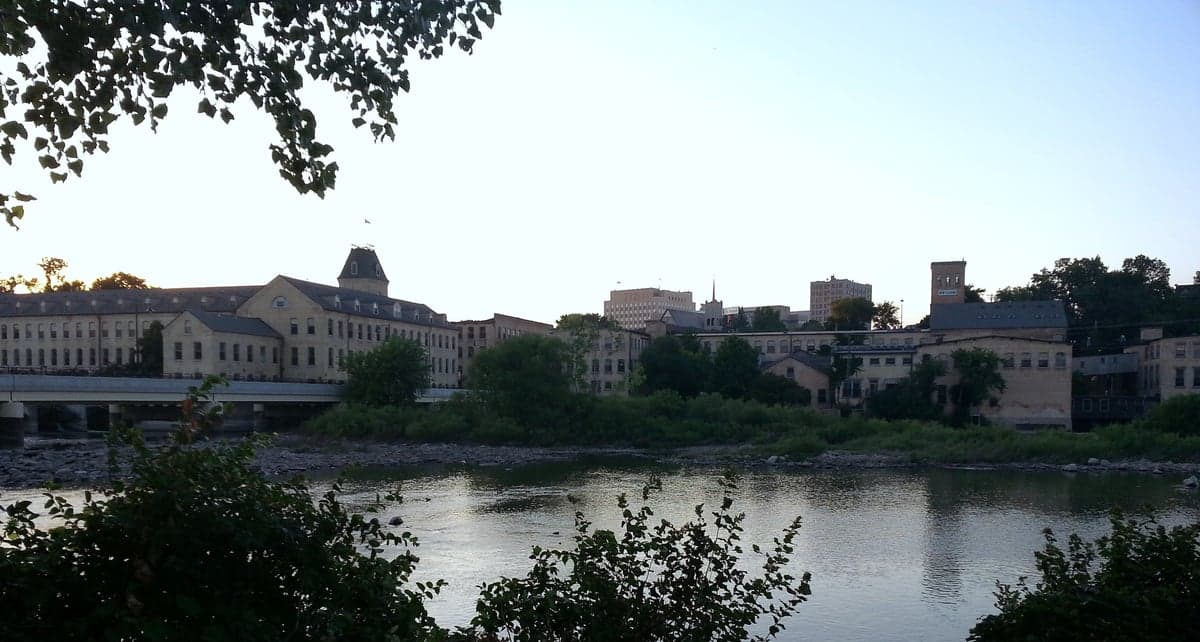
The people of Appleton, Wisconsin today form a predominantly white, family-oriented community of 74,873 residents, characterized by a strong local identity rooted in paper-industry heritage and a notably low foreign-born share of just 3.1%. The city is 79.4% white, with a Hispanic population of 6.9%, East and Southeast Asian communities at 5.7%, a Black population of 2.8%, and an Indian-subcontinent population of 1.1%. With 37.0% of adults holding a college degree, Appleton is an educated but demographically stable Midwestern city, where the population is slowly diversifying while retaining a distinctly homogeneous, family-centric character.
How the city was settled and grew
Appleton’s population history begins with the Menominee and Ho-Chunk peoples, who ceded the land through treaties in the 1830s and 1840s. The first permanent white settlers arrived in the late 1840s, drawn by the water power of the Fox River and the promise of the lumber industry. The city was formally incorporated in 1857, and its early growth was driven by German, Irish, and Scandinavian immigrants who built the sawmills, paper mills, and railroads that defined the local economy. The original German and Irish settlers concentrated in the Old Third Ward (now part of downtown), while Scandinavian immigrants—particularly Norwegians and Swedes—settled in the East End near the river, where they worked in the mills and established Lutheran churches. By 1900, the paper industry had become dominant, attracting a second wave of Polish and Czech immigrants who formed tight-knit communities in the South Side neighborhoods around the mills. These ethnic enclaves remained distinct through the mid-20th century, with Catholic parishes and ethnic social clubs reinforcing neighborhood boundaries.
Modern era (post-1965)
After the 1965 Immigration and Nationality Act, Appleton did not experience the large-scale immigration seen in larger Midwestern cities. Instead, the post-1965 era was defined by domestic in-migration from rural Wisconsin and the suburbanization of the existing white population. The North Side neighborhoods, particularly around the Fox River Mall area, saw rapid development of single-family homes in the 1970s and 1980s, drawing families from older city neighborhoods. The city’s Hispanic population, now 6.9%, began growing in the 1990s, primarily with Mexican-origin families settling in the South Side near the industrial corridors, where affordable housing and entry-level manufacturing jobs were available. The East and Southeast Asian community (5.7%) is largely a product of professional migration tied to the regional healthcare and education sectors, with many families settling in the Grand Chute area (a town adjacent to Appleton) and the newer subdivisions on the city’s west side. The Indian-subcontinent population (1.1%) is smaller and more dispersed, often concentrated in the College Avenue corridor near Lawrence University and the medical district. The Black population (2.8%) remains small and is scattered across the city, with no single dominant neighborhood. Overall, Appleton’s modern demographic shifts have been gradual, with the white share declining from over 90% in 1990 to 79.4% today, but the city remains far less diverse than the national average.
The future
Appleton’s population is heading toward slow, incremental diversification rather than rapid change. The foreign-born share (3.1%) is well below the national average of 13.7%, and the city lacks the large immigrant gateway infrastructure—ethnic grocery stores, religious institutions, legal aid—that drives chain migration. The Hispanic and East/Southeast Asian communities are growing steadily but from a small base, and they are likely to plateau rather than explode, as the local economy (dominated by paper manufacturing, healthcare, and education) offers moderate but not abundant entry-level jobs. The Indian-subcontinent population is expected to grow modestly, tied to the expansion of the regional healthcare system (ThedaCare and Ascension hospitals) and Lawrence University. The white population is aging, with a median age of 36.5, and younger white families are increasingly choosing outer-ring suburbs like Kimberly and Little Chute over the city proper. This suggests Appleton will become slightly more diverse but will not experience the ethnic enclave formation seen in larger cities. The city is homogenizing in the sense that older ethnic neighborhoods (German, Polish, Scandinavian) are fading into a generic Midwestern identity, while new immigrant groups are too small to create distinct, lasting enclaves.
For someone moving in now, Appleton is becoming a stable, moderately educated, and predominantly white city where diversity is present but not transformative. The population is not tribalizing into rival ethnic enclaves, nor is it homogenizing into a monoculture—it is slowly, quietly diversifying in a way that reflects the regional economy’s moderate pull. New residents will find a community where the paper-industry past still shapes the social fabric, and where the future looks much like the present: gradual, predictable, and family-focused.

* Values derived from national, state, county, city and local statistics and may differ in a specific area. Last updated: 2026-04-21T10:10:59.000Z
Narrative content on this page is AI-generated and may contain mistakes. Verify any details that matter before acting on them.
ReloMaps may earn a commission from affiliate links at no extra cost to you.

