Photo: Wikipedia
Political ClimatePolitical Climate in Altoona, PA
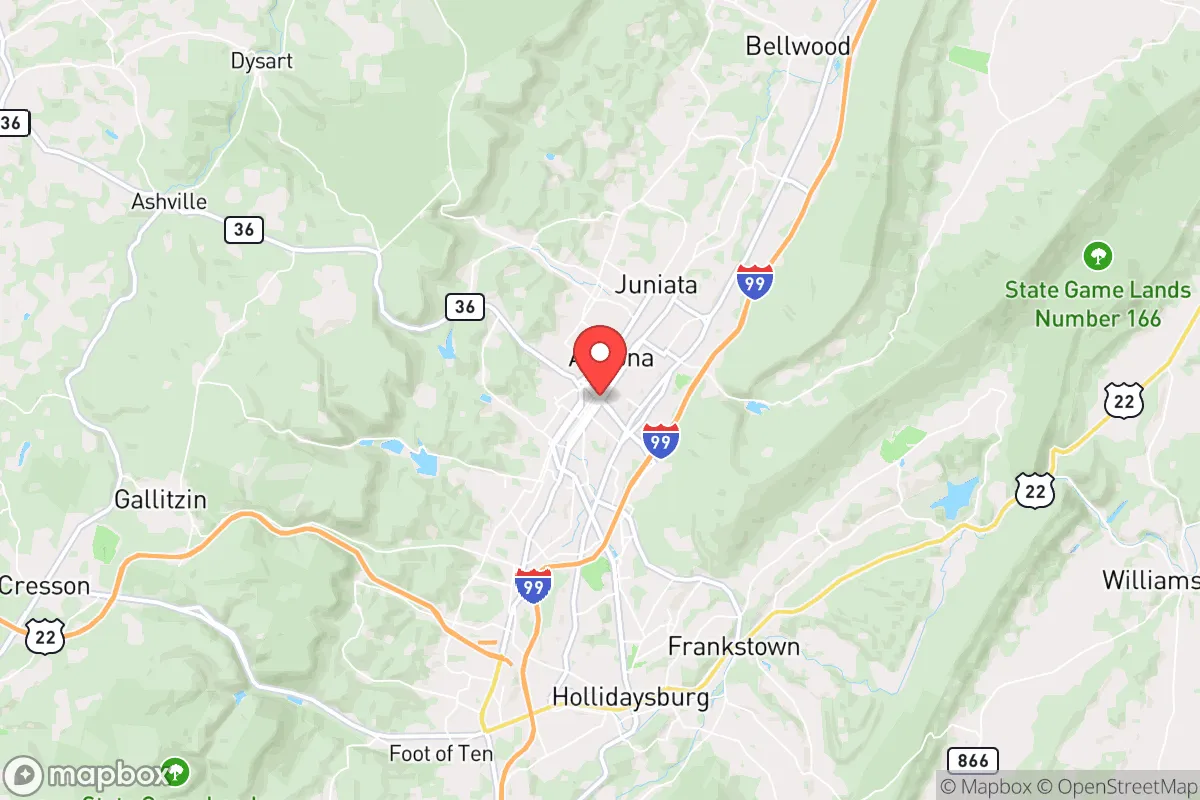
District shown is the primary district for this city’s centroid. Cities may span multiple districts.
Local Political AnalysisPolitical Analysis of Altoona, PA
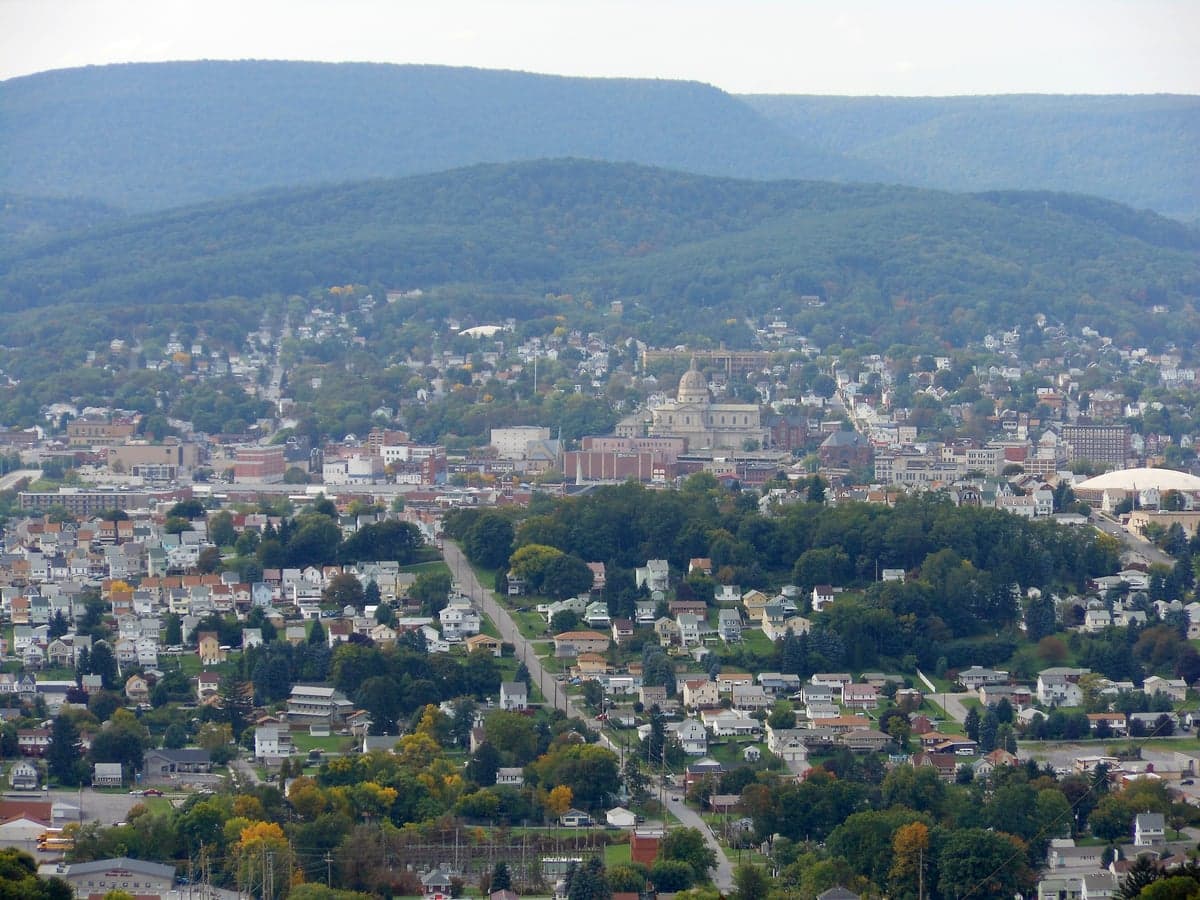
Altoona leans heavily Republican, with a Cook PVI of R+23 that places it among the most conservative small cities in Pennsylvania. This isn't a recent shift—it's been a bedrock for decades, rooted in the working-class values of the railroad and manufacturing families who built this town. The political trajectory here has been remarkably stable, with local elections consistently favoring candidates who prioritize limited government, Second Amendment rights, and local control over schools and zoning. If you're looking at a map of blue dots in a red sea, Altoona is the anchor.
How it compares
Drive 40 miles east to State College, and you'll hit a stark contrast—Centre County leans blue, driven by Penn State's academic and student population. That's the closest progressive pocket, and it feels like a different world. To the south, Bedford County is even redder than Altoona, while Johnstown to the west shares a similar conservative bent but with a more struggling economy. Within Blair County itself, Altoona is the political engine—the surrounding townships like Logan and Antis are reliably Republican, but the city itself has a grittier, more independent streak. You won't find the same suburban Republicanism here; it's more of a "leave us alone" conservatism that distrusts both parties when they get too big for their britches.
What this means for residents
For daily life, this political climate means fewer layers of government meddling. Property taxes are relatively low compared to Philadelphia suburbs, and there's little appetite for new regulations on small businesses or homeowners. The school board here has been a battleground in recent years, but the conservative majority has held firm on curriculum transparency and parental rights—no critical race theory or gender ideology creeping into elementary classrooms. You can carry a firearm without a permit in Pennsylvania, and Altoona's local enforcement generally respects that. The downside? If you're hoping for rapid public transit expansion or aggressive climate initiatives, you'll be waiting a long time. The city council tends to focus on potholes and police funding, not social engineering.
What to watch for in the near future
The biggest concern among locals is the slow creep of state-level progressive policies from Harrisburg and Philadelphia. With the state legislature often gridlocked, there's always a risk that a governor's executive order or a court ruling could override local preferences—like the recent push for mail-in ballot expansions or vaccine mandates for state workers. Altoona's best defense is its strong civic organizations and churches, which keep the community informed and mobilized. Long-term, the demographic trend is aging—young people leave for college and often don't return—which could dilute the conservative base if new residents from bluer areas move in for cheaper housing. But for now, the political culture here remains stubbornly, proudly traditional. You won't find a pride flag on city hall, but you will find a "Support Our Troops" banner on Main Street. That's Altoona.

State Political ClimatePolitical Climate in Pennsylvania
State Political AnalysisPolitical Environment in the State
Pennsylvania is a classic purple state that has been drifting leftward over the past two decades, though it still retains a strong conservative backbone in its rural and exurban regions. The state’s 19 electoral votes have gone Democratic in every presidential election since 1992 except 2016 and 2004, but the margins are razor-thin — Biden won by just 1.2% in 2020, and Trump carried it by 0.7% in 2016. The real story is the slow erosion of the old Reagan Democrat coalition in the industrial west and northeast, replaced by a growing progressive base in the Philadelphia and Pittsburgh metros, while the central and northern counties remain deeply red. For a conservative considering relocation, the picture is mixed: you’ll find like-minded communities in places like Lancaster County and the Poconos, but the state government in Harrisburg has been trending toward one-party control by Democrats, with all three branches held by the left since 2023.
Urban vs. rural divide
The political map of Pennsylvania is a textbook study in the urban-rural chasm. Philadelphia and its collar counties — Montgomery, Delaware, Chester, and Bucks — are the engine of the Democratic vote, delivering margins of 80-85% in the city itself and 55-65% in the inner suburbs. Pittsburgh and Allegheny County are similarly blue, though the surrounding southwestern counties like Washington and Westmoreland have been flipping red as the old union vote realigns. The real conservative strongholds are the vast rural stretches: Franklin County (Chambersburg), York County, Lebanon County, and the entire northern tier from Bradford County to Tioga County routinely vote 65-75% Republican. The Lehigh Valley (Allentown, Bethlehem, Easton) is a true bellwether — it voted for Obama twice, then Trump, then Biden, and is now a toss-up. The Wyoming Valley around Scranton and Wilkes-Barre is the most watched swing region in the state, where working-class voters of Irish and Italian descent have been slowly breaking right on cultural issues even as the Democratic machine holds on locally.
Policy environment
Pennsylvania’s policy landscape is a tug-of-war between a Republican-leaning legislature and a Democratic governor (Josh Shapiro, elected 2022). The state income tax is a flat 3.07%, which is relatively low, but property taxes are among the highest in the nation — averaging about 1.5% of home value, with no homestead exemption for primary residences. There is no state sales tax on clothing or groceries, but the overall sales tax is 6%. On education, the state has a school choice program (the Educational Improvement Tax Credit) that funds scholarships for low-income students, but Governor Shapiro has not expanded it and has pushed for more funding to traditional public schools. Election laws are a flashpoint: Pennsylvania has no voter ID requirement for in-person voting (though first-time voters must show ID), and mail-in voting was expanded in 2019 under Act 77, which Republicans have tried to repeal. The state also has a 72-hour window for mail ballots to arrive after Election Day, which has been a source of litigation. On gun rights, Pennsylvania is a “shall issue” state for concealed carry permits, but there is no permitless carry, and the state has a universal background check law for handgun purchases. The state also has a preemption law that prevents local municipalities from enacting their own gun ordinances, though Philadelphia and Pittsburgh have repeatedly tried to challenge it.
Trajectory & freedom
On the freedom scale, Pennsylvania is trending in the wrong direction for conservatives. The most concerning recent development is the passage of Act 12 of 2023, which stripped local school boards of the ability to opt out of the state’s new “Fairness in Education” curriculum that includes LGBTQ+ content in K-5 health classes — a direct blow to parental rights. The state also expanded its hate crimes law in 2022 to include “gender identity” and “sexual orientation,” which has been used to prosecute speech deemed offensive. On medical freedom, Pennsylvania did not pass any COVID-19 vaccine mandate bans, and the state health department still retains emergency powers that were not rolled back after the pandemic. Property rights are under pressure from the Pennsylvania Department of Environmental Protection, which has aggressively enforced new stormwater regulations that require homeowners to pay for runoff mitigation on their own land. The state’s Redevelopment Assistance Capital Program has been used to fund “transit-oriented development” in cities, effectively forcing higher-density zoning in suburban areas. On the positive side, the state legislature passed a constitutional carry bill in 2023 that would have allowed permitless concealed carry, but Governor Shapiro vetoed it. The Second Amendment Preservation Act has been introduced but not passed, meaning local police can still enforce federal gun laws that violate the state constitution.
Civil unrest & political movements
Pennsylvania has seen its share of political turbulence. The 2020 election integrity controversy centered on Philadelphia, where Republican poll watchers were allegedly restricted from observing ballot counting, leading to a state senate investigation that found “serious irregularities” but no widespread fraud. The Pennsylvania Freedom Caucus in the state house has been a vocal force, pushing for election audits and parental rights bills. On the left, the Pennsylvania Interfaith Impact Network and Power Interfaith have organized protests for police reform and affordable housing, particularly in Pittsburgh. The Stand Up to Racism coalition has held rallies in Harrisburg and Philadelphia. Immigration politics are relatively quiet compared to border states, but the City of Philadelphia is a sanctuary city, and the state has a law that prohibits local police from asking about immigration status unless it’s part of a criminal investigation. The Pennsylvania State Police have been criticized by conservatives for not cooperating with ICE detainers. There have been no serious secession movements, but the Northern Tier counties have discussed joining a “Greater Idaho” style movement to break away from the Philadelphia-dominated state government.
Projection
Over the next 5-10 years, Pennsylvania is likely to become more Democratic at the state level due to continued in-migration to the Philadelphia suburbs from New Jersey and New York, and the retirement of older conservative voters in the rural areas. The 2024 census showed the state losing population in the west and gaining in the southeast, which will shift congressional districts further left. The Pennsylvania Supreme Court currently has a 5-2 Democratic majority, and that is unlikely to change soon. The state’s Clean Energy mandate (Act 129) will continue to drive up electricity costs, and the Regional Greenhouse Gas Initiative (RGGI) membership, which the state joined in 2022, will add a carbon tax that hits rural homeowners hard. The Pennsylvania Turnpike tolls are set to increase 5% annually through 2050, making travel more expensive. On the bright side, the Marcellus Shale natural gas industry remains a powerful economic force, and the state’s Act 13 impact fee on drilling has generated billions for local communities. The 2026 gubernatorial election will be critical — if a Republican wins, they could veto the worst of the progressive agenda, but the legislature is likely to remain Republican-controlled through the next redistricting cycle.
For a conservative moving to Pennsylvania, the bottom line is this: you can find a great life in the rural and exurban areas, especially in the Lancaster and York regions, where the culture is still traditional and the schools are strong. But you need to be aware that the state government in Harrisburg is increasingly hostile to your values, and the tax burden is high. If you’re looking for a state that is trending toward freedom, Pennsylvania is not it — but if you’re willing to fight for your rights at the local level, there are still plenty of communities where you can make a stand.
* Values derived from national, state, county, city and local statistics and may differ in a specific area. Last updated: 2026-05-01T08:07:23.000Z
Narrative content on this page is AI-generated and may contain mistakes. Verify any details that matter before acting on them.
ReloMaps may earn a commission from affiliate links at no extra cost to you.

