

Photo: Wikipedia
Political ClimatePolitical Climate in Alexandria, KY
District shown is the primary district for this city’s centroid. Cities may span multiple districts.
Local Political AnalysisPolitical Analysis of Alexandria, KY
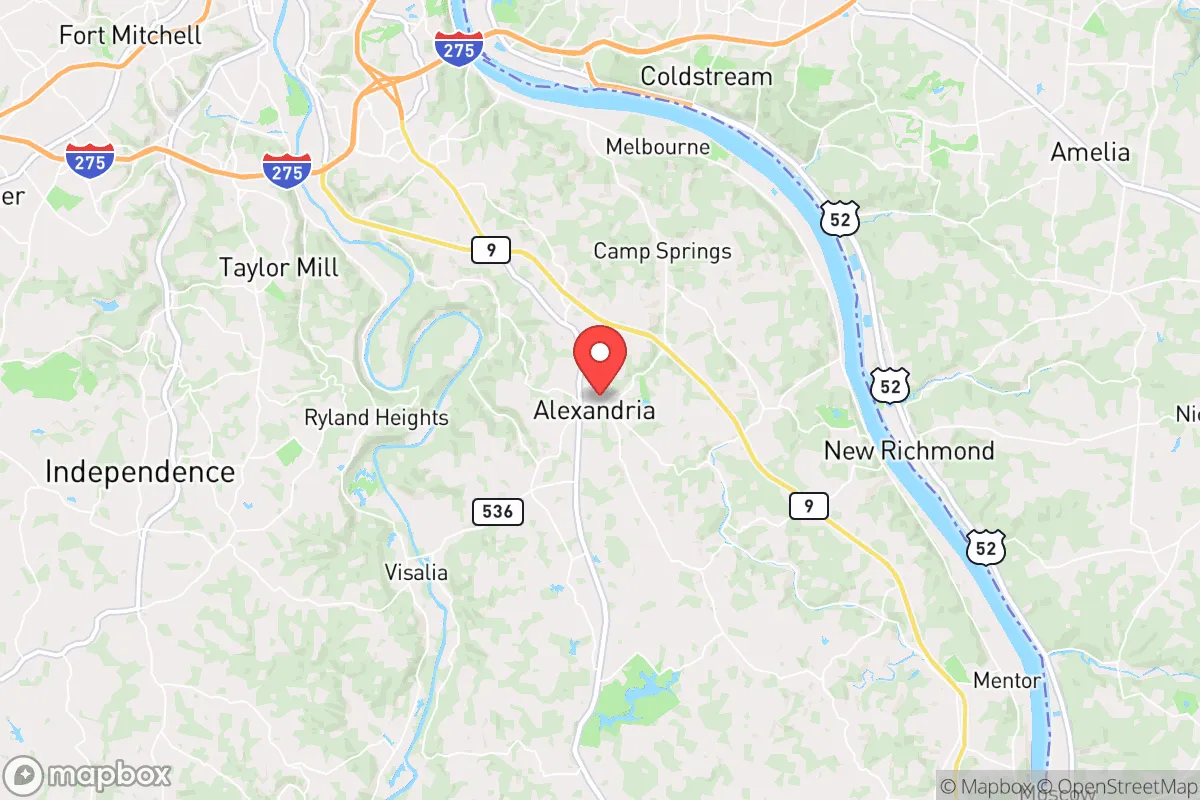
Alexandria, Kentucky, sits in the heart of Campbell County, and for as long as anyone around here can remember, it’s been a reliably conservative stronghold. The Cook PVI clocks it at R+18, which means the area votes about 18 points more Republican than the national average. That’s not just a number—it reflects a deep-rooted preference for limited government, personal responsibility, and a healthy skepticism of federal overreach. You see it in local elections, where school board and city council races tend to favor candidates who talk about fiscal restraint and keeping government out of your backyard. The trajectory here is steady, though there’s a quiet undercurrent of concern as some of the more progressive ideas from Cincinnati, just across the river, start to trickle down I-471.
How it compares
Drive ten minutes north into Newport or Covington, and you’ll feel the shift. Those river cities have a more mixed political vibe—Newport’s downtown has seen a wave of younger, left-leaning transplants, and Covington’s city council has flirted with policies that raise eyebrows here, like sanctuary city talk and higher density zoning that feels like a backdoor to more government control. Contrast that with Alexandria, where the county commission and local officials still hold the line on property rights and Second Amendment protections. Head south toward Dry Ridge or Williamstown, and you’ll find even deeper red territory, but Alexandria sits in a sweet spot: conservative enough to feel safe, but close enough to the metro area that you’re not totally isolated. The real contrast is with the urban core of Cincinnati itself, where progressive tax policies and social experiments are the norm. Alexandria residents watch that with a wary eye, knowing that what starts in Hamilton County often ends up debated in Frankfort.
What this means for residents
For the people who live here, the political climate translates into a few concrete realities. First, property taxes stay relatively low because the local government isn’t keen on expanding its footprint. You won’t see the kind of overreach you get in blue cities—no mask mandates that drag on for years, no heavy-handed business closures. Second, the schools in Campbell County still emphasize traditional values and parental input, which is a big deal for families who don’t want the state dictating what their kids learn. Third, there’s a growing unease about the long-term trend. As more people flee high-tax states like California and Illinois, they bring their voting habits with them. New subdivisions are popping up along Route 9, and some of those newcomers don’t share the local mindset. If you’ve been here a decade or more, you’ve noticed the shift—it’s slow, but it’s real. The concern is that Alexandria could start to mirror the political battles of the river cities if enough of those transplants settle in.
Culturally, Alexandria still feels like a place where people wave from their trucks and leave their doors unlocked. The biggest policy distinction is the strong local support for gun rights and a general distrust of any state-level mandates that try to override local control. There’s a palpable resistance to the kind of progressive ideology that’s taken hold in Louisville and Lexington—things like defunding police or radical environmental regulations that hurt small farmers. The local paper and community boards still reflect a “live and let live” attitude, but with a clear boundary: don’t try to impose your agenda on us. Looking ahead, the next five to ten years will be telling. If Alexandria can keep its local government accountable and resist the pressure to adopt urban-style policies, it’ll stay the conservative haven it’s always been. But if the influx of new residents tilts the balance, you might see the same fights over zoning, school curriculum, and taxes that have already soured other parts of the state. For now, though, it’s still a place where common sense and personal freedom come first.

State Political ClimatePolitical Climate in Kentucky
State Political AnalysisPolitical Environment in the State
Kentucky has been a reliably red state for decades, but don’t let the presidential map fool you — it’s a deeply layered place where the partisan lean is more about cultural conservatism than a unified ideological bloc. The state has voted Republican in every presidential election since 2000, with Donald Trump winning by 26 points in 2020 and 30 points in 2024, but the real story is the slow, steady shift of suburban and exurban areas away from the GOP while rural counties dig in harder. Over the last 20 years, the state has moved from a competitive purple-ish battleground to a solid red stronghold, driven by the collapse of Democratic support in rural coal country and the rise of a more populist, culturally conservative Republican Party that now dominates the state legislature and all statewide offices.
Urban vs. rural divide
The political map of Kentucky is a textbook case of the urban-rural chasm. Louisville (Jefferson County) and Lexington (Fayette County) are the two blue anchors, with Louisville voting about 60% Democratic and Lexington around 55% — both have grown more liberal over the past decade, especially on social issues like abortion and LGBTQ rights. But these two metros are islands surrounded by a sea of red. Northern Kentucky, including Covington and Florence, used to be a swing area but has shifted right as the Cincinnati suburbs have become more conservative on cultural issues. The real engine of the state’s red lean is the vast rural expanse: Eastern Kentucky (Pikeville, Hazard, Prestonsburg) is now among the most Republican regions in the country, with counties like Martin and Magoffin routinely giving 80%+ to GOP candidates. The Bowling Green area (Warren County) has also trended right, driven by a growing manufacturing base and a strong evangelical presence. The Paducah region in the west remains conservative but with a more moderate, old-school Southern Democrat streak that’s fading fast. The key takeaway: if you’re moving to Louisville or Lexington, you’re in a blue bubble; anywhere else, you’re in deep red territory.
Policy environment
Kentucky’s policy environment is aggressively conservative on most fronts, but with some notable wrinkles. The state has a flat income tax that’s been cut from 5% to 4% as of 2024, with a scheduled phase-down to 3.5% by 2026 — a clear pro-growth posture. There’s no state property tax, but local property taxes are moderate. The regulatory climate is business-friendly, with right-to-work laws and a tort reform system that caps non-economic damages. On education, Kentucky has a robust school choice movement: the state passed a charter school law in 2017 (though implementation has been slow) and expanded the Education Opportunity Account program in 2022, which allows tax-credit scholarships for private school tuition. However, the state’s public school system is underfunded and has seen teacher strikes in 2018 and 2019 over pension reform — a flashpoint that still resonates. Healthcare is a mixed bag: Kentucky expanded Medicaid under the Affordable Care Act in 2014, but the state has since imposed work requirements (currently tied up in court). The state also passed a near-total abortion ban in 2022 (trigger law) with no exceptions for rape or incest, only to save the mother’s life. Election laws have tightened: voter ID is required, and the state has purged inactive voters from rolls. Overall, the policy environment is friendly to traditional values and economic freedom, but the Medicaid expansion and lingering pension liabilities create a fiscal tension that hasn’t been resolved.
Trajectory & freedom
Kentucky is moving in a direction that expands personal freedom in several key areas, but with some concerning countercurrents. On the plus side, the state passed constitutional carry (permitless concealed carry) in 2019, and in 2023 expanded gun rights further by prohibiting local governments from enacting their own firearm restrictions — a strong preemption law that protects gun owners from patchwork local ordinances. Parental rights have been bolstered: the state passed a Parents’ Bill of Rights in 2022, requiring schools to notify parents about curriculum changes and allowing them to opt their children out of sex education. On medical freedom, Kentucky banned COVID-19 vaccine mandates for state employees and contractors in 2023, and the legislature has been hostile to mask and vaccine mandates generally. However, there are red flags: the state’s medical marijuana program was only legalized in 2023 (with dispensaries expected by 2025), and it’s heavily restricted — no home grow, no smokable flower, only oils and edibles. Sports betting was legalized in 2023, but that’s more about revenue than freedom. The biggest concern for liberty-minded residents is the state’s eminent domain and property rights record, particularly around the Louisville-Southern Indiana Ohio River Bridges Project, which saw aggressive use of eminent domain. Also, the state’s blue laws (restrictions on Sunday alcohol sales) remain in many counties, though they’re slowly eroding. Overall, Kentucky is trending toward more personal freedom on guns, education, and medical choices, but it’s still a state where local government can be intrusive on property and commerce.
Civil unrest & political movements
Kentucky has seen its share of political flashpoints, but they’re more localized and less chaotic than in some states. The Breonna Taylor protests in Louisville in 2020 were the most significant civil unrest in modern state history, with months of demonstrations, property damage, and a heavy police response. That event reshaped Louisville politics, leading to the election of a more progressive mayor (Craig Greenberg) and a push for police reform, but it also hardened conservative sentiment in the rest of the state. The teacher strikes of 2018-2019 were a major political movement, with thousands of educators descending on Frankfort to protest pension changes — it was a rare moment of cross-partisan anger that ultimately led to the resignation of the state’s pension chief. On the right, the Kentucky Freedom Coalition and local Moms for Liberty chapters have been active in school board races, particularly in suburban areas like Oldham County and Boone County, pushing for parental oversight and against critical race theory. Immigration politics are less heated than in border states, but there’s a growing concern about illegal immigration in the Louisville meatpacking and logistics sectors. There’s no serious secession or nullification movement, but the state’s Second Amendment Sanctuary movement is strong — over 70 counties have passed resolutions declaring themselves sanctuaries from state or federal gun laws. Election integrity has been a hot topic since 2020, with the state GOP pushing for stricter voter ID laws and audits, though no major fraud has been proven. A new resident would notice the political tension mostly in Louisville and Lexington; elsewhere, it’s a quieter, more homogeneous conservative culture.
Projection
Over the next 5-10 years, Kentucky is likely to become more Republican at the state level but with growing internal friction. The in-migration pattern is key: people moving to Kentucky are mostly coming from the Midwest (Ohio, Indiana, Illinois) and the South (Tennessee, Florida), and they tend to be conservative-leaning, especially those settling in the Bowling Green and Northern Kentucky suburbs. However, Louisville and Lexington will continue to drift left, driven by younger professionals and university populations. The state’s demographic shift is slow — Kentucky is aging and has low birth rates among native-born whites, but Hispanic and Asian populations are growing in the Louisville and Lexington metros, which could introduce more political diversity. The biggest wildcard is the state’s fiscal health: the pension system is still underfunded by about $30 billion, and the income tax cuts will reduce revenue. If the economy slows, the state may face pressure to raise taxes or cut services, which could trigger a backlash. On social issues, expect more battles over school choice, transgender rights, and abortion — the legislature will likely push for further restrictions on abortion access and expand school choice, but the courts may intervene. The 2027 gubernatorial election will be a bellwether: if a Republican wins the governorship (currently held by Democrat Andy Beshear), the state will likely accelerate its conservative agenda. For someone moving in now, expect a state that’s solidly red but with blue islands, where your experience depends heavily on where you live.
For a conservative-leaning individual or family, Kentucky offers a strong alignment with traditional values, low taxes, and a growing economy, but you need to pick your location carefully. If you want a deep-red, rural lifestyle with strong gun rights and minimal government interference, Eastern Kentucky or the Bowling Green area are excellent choices. If you need urban amenities but want to stay in a conservative bubble, the suburbs of Louisville (like Prospect or Anchorage) or Lexington (like Nicholasville) offer a mix of convenience and cultural comfort. The state’s trajectory is broadly positive for personal freedom, but keep an eye on the pension crisis and the potential for local government overreach in the blue cities. Bottom line: Kentucky is a safe bet for conservatives who want a low-tax, culturally traditional environment, but it’s not a libertarian paradise — the state still has its share of bureaucratic headaches and local control issues. If you’re okay with that trade-off, you’ll find a welcoming, affordable, and increasingly free place to call home.
* Values derived from national, state, county, city and local statistics and may differ in a specific area. Last updated: 2026-10-10T16:26:23.000Z
Narrative content on this page is AI-generated and may contain mistakes. Verify any details that matter before acting on them.
ReloMaps may earn a commission from affiliate links at no extra cost to you.

