Photo: Wikipedia
Demographics of Alexandria, KY
Affluence Level in Alexandria, KY
An upper-middle-class area. Household wealth, education levels, and homeownership run ahead of national benchmarks.
People of Alexandria, KY
Alexandria, Kentucky, is a predominantly white, family-oriented city of 10,430 residents where nearly 91% of the population identifies as non-Hispanic white, and the foreign-born share sits at just 2.9%. The city’s character is shaped by its role as a stable, middle-class bedroom community in Campbell County, with a college attainment rate of 36.5% and a modest but growing Indian-subcontinent population of 2.5% that stands apart from the negligible East/Southeast Asian presence of 0.1%. Residents value the small-town feel, low crime, and proximity to Cincinnati, and the population is gradually diversifying through professional in-migration rather than large-scale immigration.
How the city was settled and grew
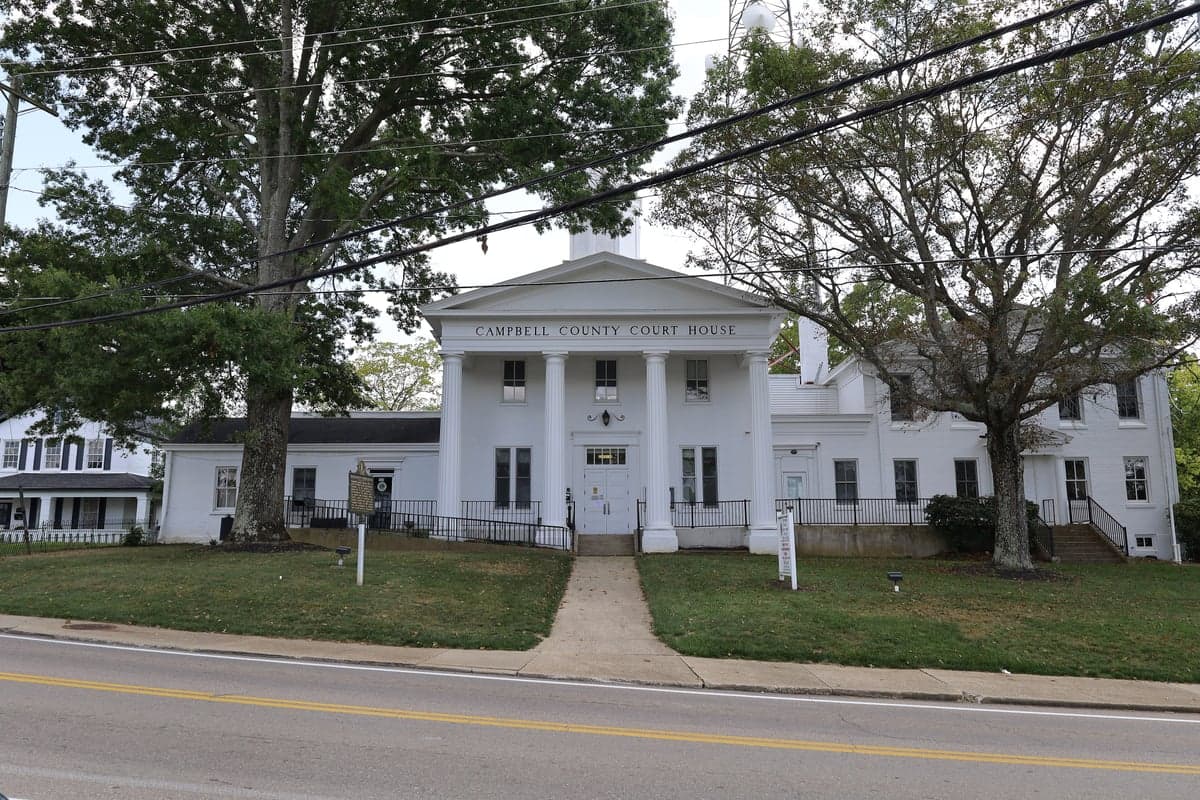
Alexandria was founded in 1793 as the seat of Campbell County, drawing its earliest settlers from Pennsylvania, Virginia, and Maryland via the Ohio River corridor. These were largely Scots-Irish and German farmers who took up land grants in the surrounding hills, establishing a rural, Protestant, and politically conservative community. The original town grid centered on the courthouse square, with early homes and businesses clustering along what is now Pleasant Ridge and Main Street. Through the 19th and early 20th centuries, the population grew slowly, sustained by tobacco farming, livestock, and small-scale milling. The arrival of the Louisville & Nashville Railroad in the 1880s spurred modest growth, but Alexandria remained a quiet county seat well into the 1950s, with most residents living in detached single-family homes on large lots in neighborhoods like Fairview Heights and Oakwood.
Modern era (post-1965)
The post-1965 period brought suburbanization as Cincinnati’s metropolitan area expanded southward. The completion of Interstate 275 in the 1970s made Alexandria a viable commuter suburb, and the city’s population more than doubled between 1970 and 2000. New subdivisions such as Alexandria Woods and Heritage Trails attracted white, middle-class families from Northern Kentucky and Ohio, drawn by lower taxes, newer schools, and larger homes. The foreign-born population remained minimal through the 1990s, but the 2000s saw a small but notable influx of Indian-subcontinent professionals—engineers, doctors, and IT workers—who settled in newer developments like Stonegate and Village Green. This group now accounts for 2.5% of the population, while East/Southeast Asian communities remain virtually absent at 0.1%. The Black population (2.6%) and Hispanic population (1.4%) have grown only slightly, reflecting the city’s limited rental housing stock and lack of large employers that attract diverse labor pools.
The future
Alexandria’s population is projected to continue growing slowly, likely reaching 12,000–13,000 by 2040, driven by continued suburban spillover from Cincinnati and the expansion of the Alexandria Pike corridor. The city is not homogenizing into a single enclave but rather developing distinct zones: older, established neighborhoods like Pleasant Ridge and Fairview Heights remain overwhelmingly white and aging, while newer subdivisions like Stonegate and Heritage Trails are attracting younger families and a slightly more diverse mix, including Indian-subcontinent professionals. The Indian-subcontinent community is likely to grow modestly as professional networks expand, but it will probably plateau at 4–5% of the population rather than becoming a major enclave. The East/Southeast Asian, Black, and Hispanic shares are expected to remain low, as the city lacks the rental housing, transit access, and entry-level jobs that typically attract these groups. Alexandria is becoming a slightly more diverse, professionally oriented suburb, but its core identity as a white, conservative, family-focused community will persist.
For someone moving in now, Alexandria offers a stable, low-crime environment with good schools and a strong sense of community, but little ethnic or cultural diversity. The population is trending toward a two-tier structure: long-established white families in older neighborhoods and newer, college-educated professionals—including a small Indian-subcontinent cohort—in the subdivisions. This is not a city undergoing rapid demographic transformation, but rather a gradual, managed diversification that aligns with its conservative, family-first character.

* Values derived from national, state, county, city and local statistics and may differ in a specific area. Last updated: 2026-10-10T16:26:23.000Z
Narrative content on this page is AI-generated and may contain mistakes. Verify any details that matter before acting on them.
ReloMaps may earn a commission from affiliate links at no extra cost to you.

