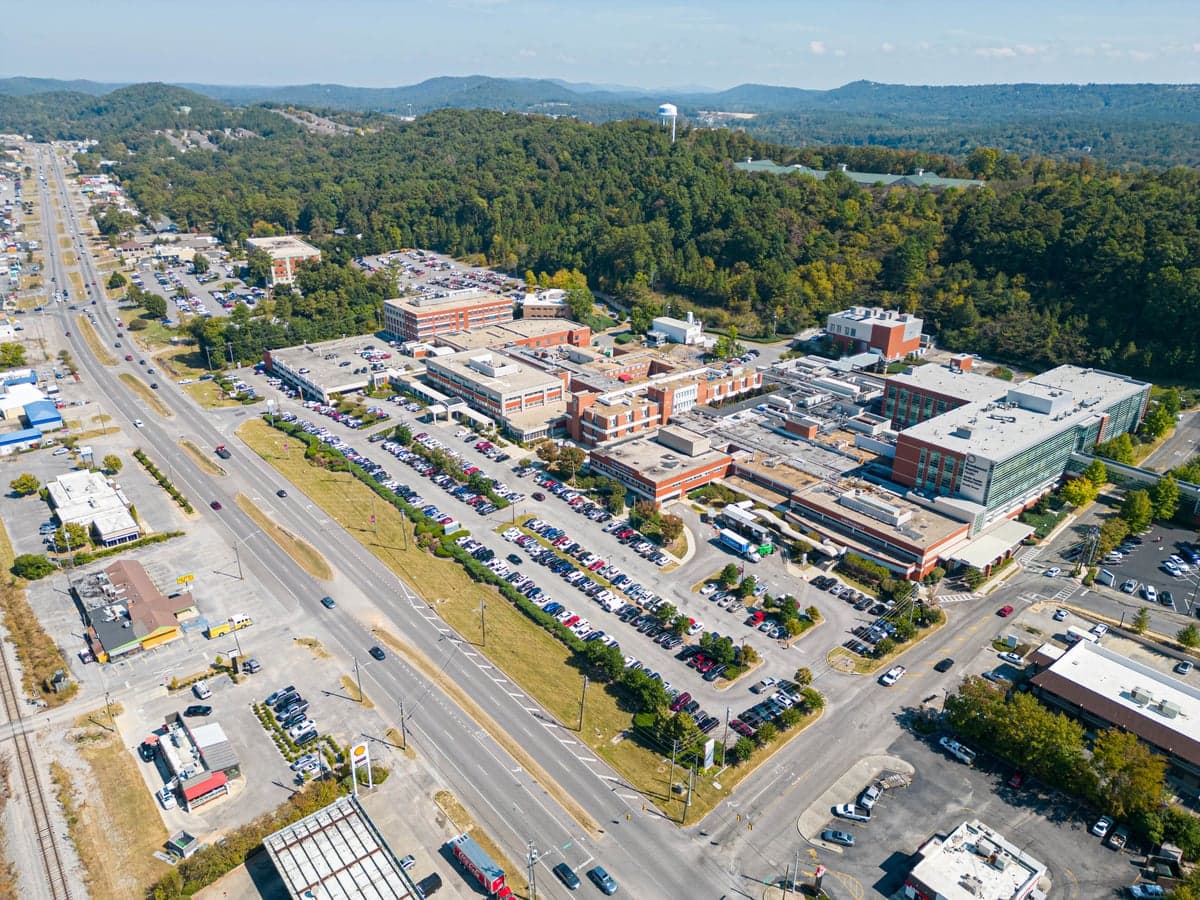
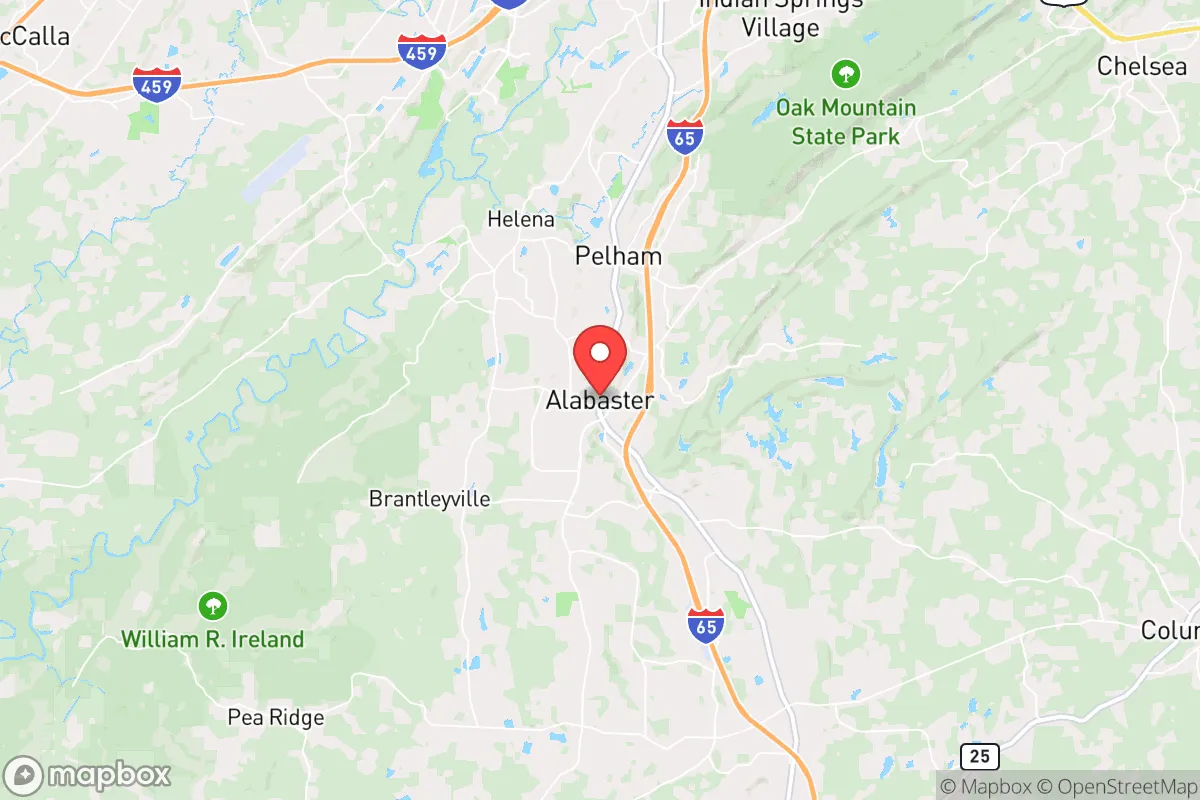
Photo: Wikipedia
Strategic Assessment of Alabaster, AL
Workable tactical position. Some exposure to population density or targets, but generally defensible in a crisis.
What does the Strategic Assessment tell us?
Our Strategic Assessment grades tactical survivability of an area. Major population centers, military targets, fallout zones, natural disasters, and border exposure all drive risk — lower exposure means a more defensible position in a crisis.
This is heavily inspired by Joel Skousen's Strategic Relocation book. Highly recommended you checkout the book ($)What does this tell us?
Our Strategic Assessment grades tactical survivability of an area. Major population centers, military targets, fallout zones, natural disasters, and border exposure all drive risk — lower exposure means a more defensible position in a crisis.
This is heavily inspired by Joel Skousen's Strategic Relocation book. Highly recommended you checkout the book ($)Strategic Pillars

Key Distances
Regional Safe Places
Below is our recommended "safe zones" in Alabama and the surrounding area based on our strategic heuristics. For most people, it's unrealistic to live in a “safe zone” full-time due to work, family or other personal reasons. They tend to be more rural. However, many of these areas are perfect for second homes and retreat properties that double as a vacation home or even a short-term rental.
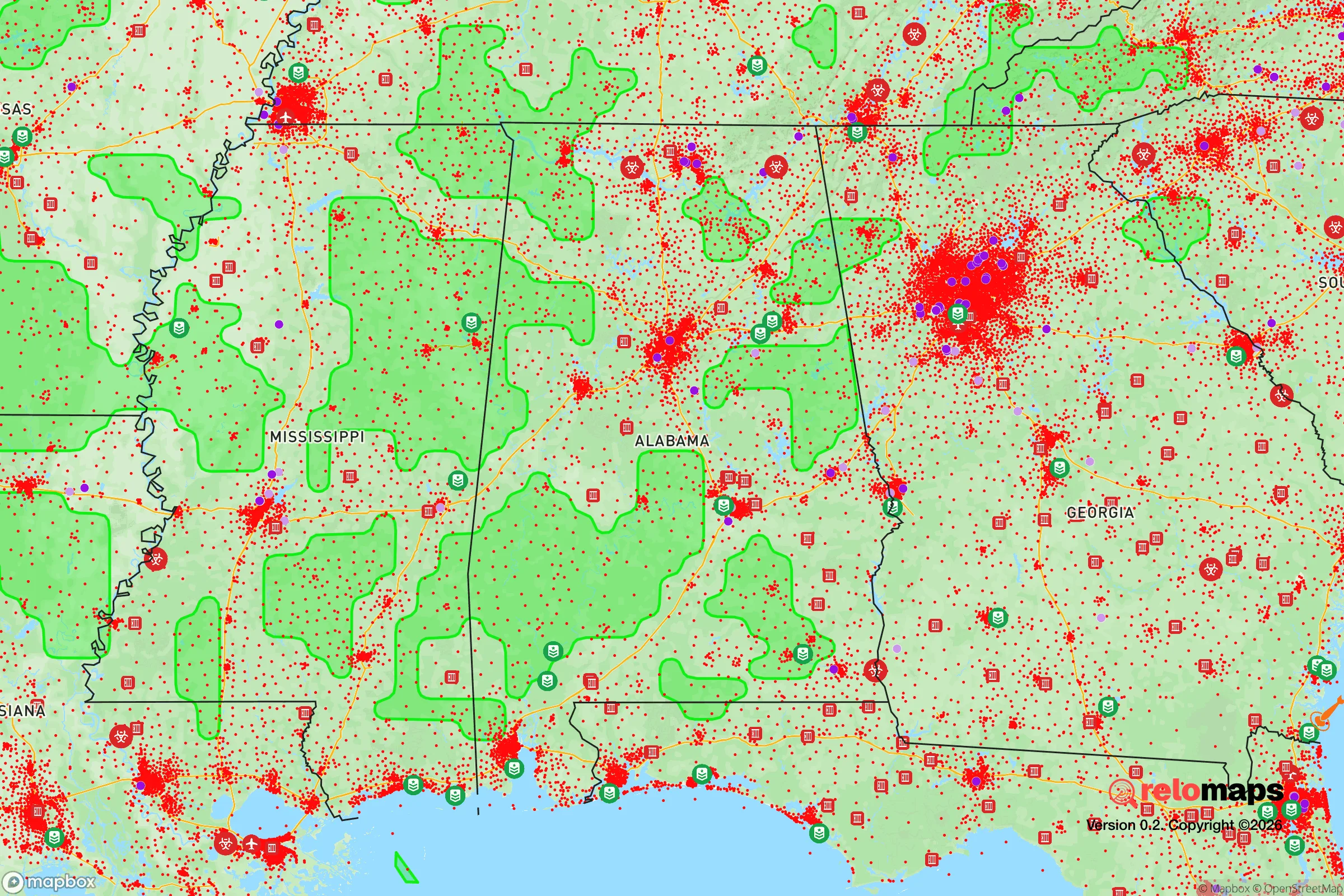
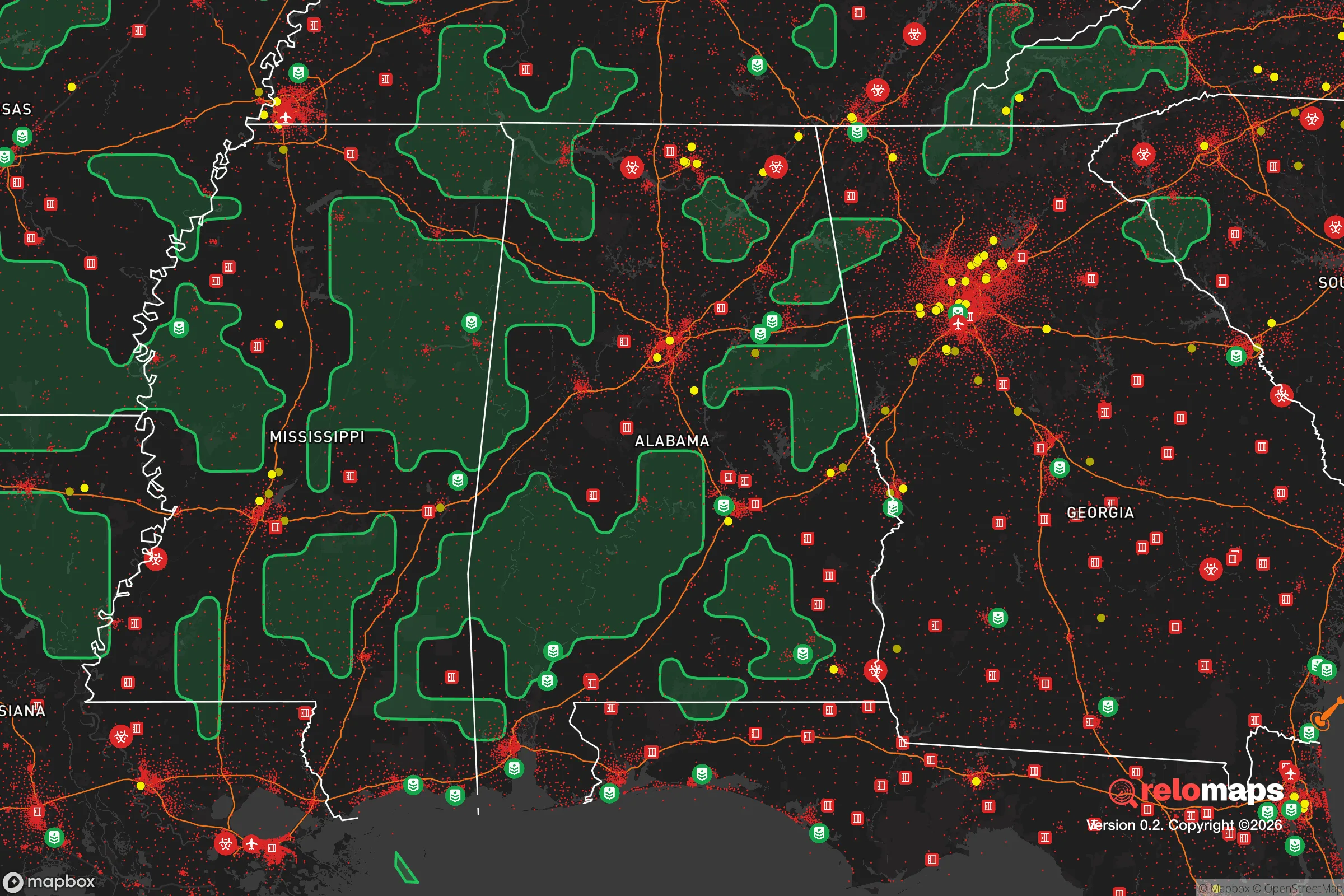


Important Note: For informational purposes only. This does not mean nothing bad ever happens in the green zones. Please use common sense. This is based on public data and modeled with AI. We tried to take a conservative approach but mistakes happen. We update this regularly as new information becomes available.
Solar Generator Recommendations
Backup power matters more here than in safer locations. We've picked three solar generators across budgets and capacity tiers — start with the budget unit if you only need a few essentials, or step up if you want to run a fridge and HVAC for days at a time.

Jackery Portable Power Station Explorer 300
Budget OptionPower on the Go: Weighing only 11 lbs, it's convenient to set up and store with book-sized foldable solar panels

BLUETTI Portable Power Station AC180
Designed for both indoor and outdoor scenarios, AC180 is highly capable as it has a robost capacity and continuous output power.

EF ECOFLOW DELTA Pro Ultra Power Station
Upgraded PickEcoFlow DELTA Pro Ultra is a whole-home energy system designed to grow with your family. Integrated with the Smart Home Panel 2, it scales to meet your evolving energy needs — keeping your home powered, intelligent, and secure through every stage of life.
We earn a commission, at no additional cost to you.
Strategic Assessment Analysis
Alabaster, Alabama, sits in a strategic sweet spot that few relocators fully appreciate: close enough to Birmingham’s economic engine to sustain a career, yet far enough south to dodge the worst of urban collapse scenarios. Its position along the I-65 corridor gives it rapid access to the Gulf Coast for evacuation or supply runs, while the surrounding Shelby County offers a mix of suburban density and rural buffer that most preppers find workable. For a conservative-leaning individual or family weighing long-term stability against national volatility, Alabaster presents a credible base of operations—provided you understand both its strengths and its soft underbelly.
Geographic position and natural advantages for long-term stability
Alabaster’s geography is its first and most durable asset. The city sits on the Fall Line Hills, a transition zone between the Appalachian foothills and the Gulf Coastal Plain, which means elevation is moderate but sufficient to avoid the catastrophic flooding that plagues lower-lying parts of the state. The Cahaba River runs just east of town, providing a natural water source that, with proper filtration, could sustain a household indefinitely. The surrounding terrain is a mix of hardwood forest and cleared farmland—ideal for small-scale food production, timber for fuel, and natural cover that makes the area harder to surveil than open plains. Shelby County’s soils are generally well-drained and support a long growing season (roughly 220 frost-free days), so a family with gardening skills can produce a meaningful portion of their own calories. The local climate is humid subtropical, which means hot summers and mild winters—no deep freezes to kill off infrastructure, but also no mountain redoubt to hide in. For a prepper, the trade-off is acceptable: the area’s agricultural potential and water availability outweigh the lack of dramatic terrain.
Risks, exposures, and proximity to fallout-relevant landmarks
No honest assessment can ignore the liabilities. Alabaster is roughly 20 miles south of Birmingham, a major metropolitan area with a population over 200,000. In a scenario involving civil unrest, mass casualty events, or a breakdown of supply chains, that proximity cuts both ways. Birmingham’s hospitals, warehouses, and fuel depots are useful in normal times, but in a crisis, the city becomes a source of refugees, looters, and resource competition. The I-65 corridor, which runs straight through Alabaster, is a double-edged sword: it’s your lifeline for evacuation or resupply, but it’s also the most likely route for displaced populations moving south from Birmingham or north from Mobile. The city itself has a population of about 34,000, dense enough that a complete grid-down scenario would strain local food and water supplies within days. There are no major military bases or nuclear facilities within immediate striking distance—the closest significant target is the Birmingham-Shuttlesworth International Airport, which in a war scenario could be a secondary target but is unlikely to draw a direct hit on Alabaster. More concerning is the chemical manufacturing and storage along the Black Warrior River northwest of Birmingham; a catastrophic release there could contaminate water tables or create a toxic plume that drifts south. For the strategic relocator, the takeaway is that Alabaster is not a remote bunker—it’s a suburban buffer zone that requires active preparation to remain viable under pressure.
Practical resilience for a relocator: food, water, energy, and defensibility
For a family or individual serious about self-sufficiency, Alabaster offers a workable but not effortless foundation. Municipal water comes from the Cahaba River and groundwater wells, treated by the Shelby County Water Services. In a prolonged power outage, those pumps stop—so a well on your own property, or at least a rainwater catchment system, is non-negotiable. The local water table is high enough that shallow wells (50–100 feet) are common, and hand pumps or solar-powered submersibles can keep you operational when the grid goes dark. Food production is feasible: the growing season supports tomatoes, peppers, squash, beans, and leafy greens from April through October, and the county has active farmers’ markets and a strong 4-H network for those learning from scratch. Hunting is legal in much of Shelby County, with white-tailed deer and wild turkey abundant, but you’ll need private land or permission—public hunting land is limited. For energy, solar is the most practical bet: Alabaster averages 215 sunny days per year, slightly above the national average, and there are no restrictive HOA covenants that outright ban panels in most subdivisions (though you should verify your specific lot). Propane backup for cooking and heating is widely available, and wood-burning stoves are a smart addition given the forest cover. Defensibility is the weak point: most homes in Alabaster sit on quarter-acre to half-acre lots in suburban subdivisions with multiple entry points. A rural property on the outskirts—say, near the unincorporated areas of Shelby County south of town—offers better standoff distance, natural chokepoints, and the ability to layer fencing, cameras, and early-warning systems without drawing neighborly suspicion. If you’re buying, prioritize a lot with a creek or pond, southern exposure for solar, and at least one access road that isn’t I-65.
The overall strategic picture for Alabaster is one of conditional viability. It is not a survivalist’s paradise—you won’t find the isolation of Montana or the defensible terrain of the Appalachians. What you will find is a community that still values self-reliance, a county government that hasn’t gone full progressive on land use or taxation, and a location that balances access to urban resources with enough rural buffer to ride out a moderate crisis. The key is to treat Alabaster as a base, not a fortress: build your food and water stores, establish relationships with neighbors who share your mindset, and have a plan for bugging out south toward the Gulf if Birmingham collapses. For a conservative relocator who wants to stay in the South, keep a job, and still sleep reasonably well at night, Alabaster is a solid B-plus. It won’t save you from a direct hit, but it will give you a fighting chance in the kind of slow-motion unraveling that most of the country is not prepared for.

* Values derived from national, state, county, city and local statistics and may differ in a specific area. Last updated: 2026-04-19T18:40:45.000Z
Narrative content on this page is AI-generated and may contain mistakes. Verify any details that matter before acting on them.
ReloMaps may earn a commission from affiliate links at no extra cost to you.

