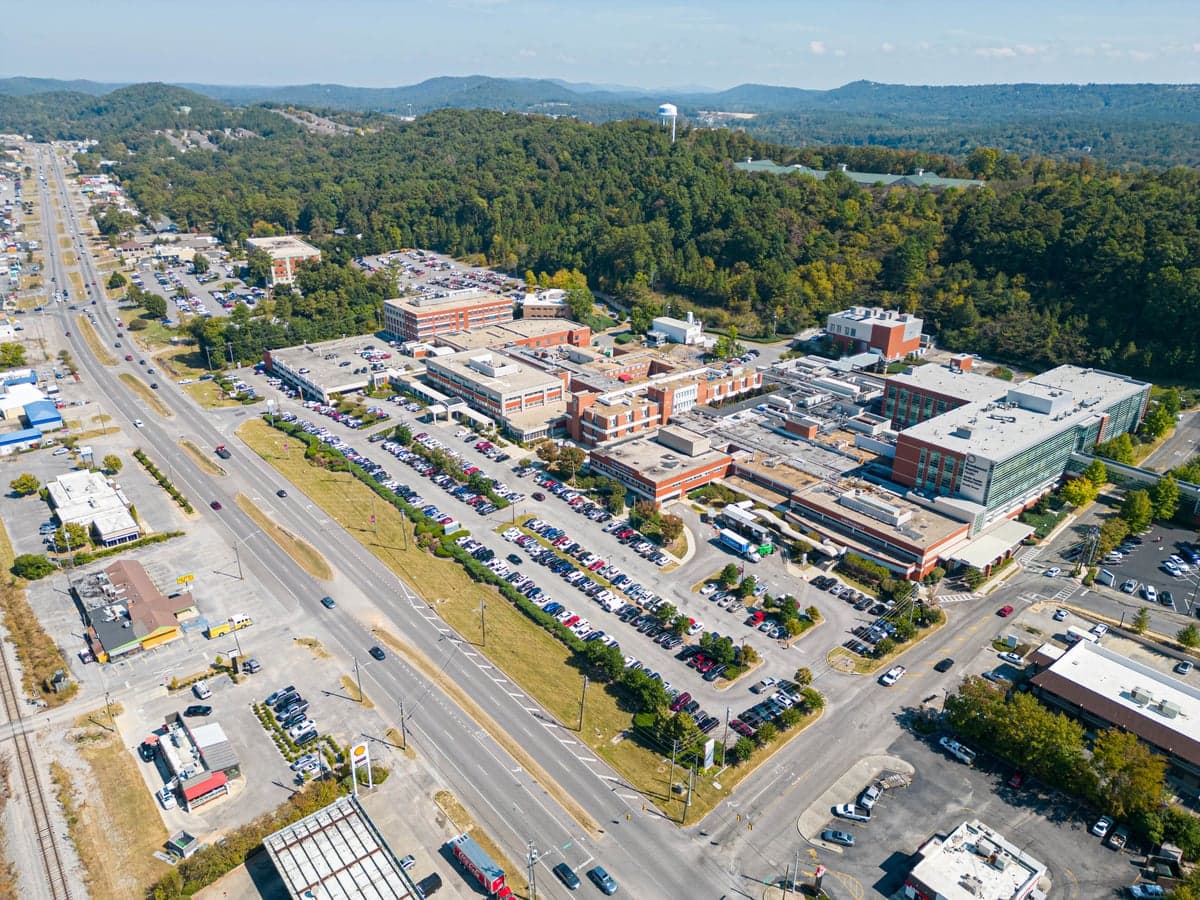
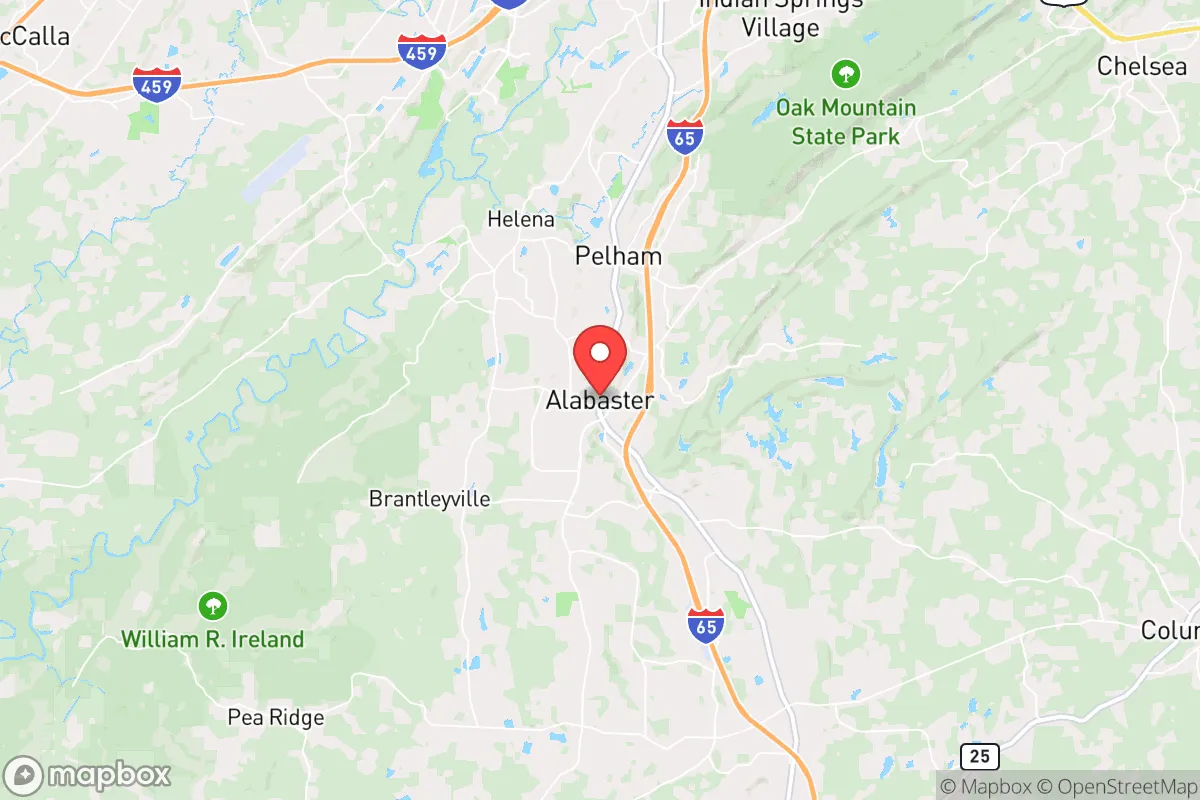
Photo: Wikipedia
Demographics of Alabaster, AL
Affluence Level in Alabaster, AL
A middle-class area roughly in line with national averages across income, home values, education, and employment.
People of Alabaster, AL
Alabaster, Alabama, is a fast-growing suburban city of 33,633 residents that is predominantly White (70.0%) with a significant Black minority (14.7%) and a rising Hispanic population (10.7%). The city is characterized by its family-oriented, middle-to-upper-middle-class character, with 40.8% of adults holding a college degree and a foreign-born share of just 3.6%. Alabaster’s identity is rooted in its role as a bedroom community for Birmingham, yet it has developed its own distinct commercial and civic core along the U.S. 31 corridor. The population is notably younger and more diverse than the surrounding Shelby County average, driven by new-home construction and in-migration from both within Alabama and other states.
How the city was settled and grew
Alabaster’s human history begins not with colonial settlement but with the post-Civil War railroad economy. The area was originally part of the agricultural hinterland of Shelby County, with scattered farms and small crossroads communities. The city’s founding is tied directly to the discovery of limestone and dolomite deposits in the late 19th century, which led to the establishment of the Alabama Portland Cement Company in 1907. This industrial anchor drew a workforce of primarily White laborers from rural Alabama and a smaller number of Black workers from surrounding plantations and farms. The original settlement clustered around what is now the Old Town Alabaster district, where modest worker cottages and company-built houses lined unpaved streets. By the 1920s, a small but stable community of about 500 people had formed, with a distinct Black neighborhood emerging along Valley Street and adjacent blocks, where African American families who worked in the cement plant and as domestic laborers lived. The Great Depression and World War II slowed growth, but the cement plant remained the economic anchor through the mid-20th century, drawing a second wave of White workers from the Tennessee Valley and the Appalachian foothills during the 1940s and 1950s. These families settled in the expanding Thompson Road area, building modest ranch homes on larger lots.
Modern era (post-1965)
The post-1965 era transformed Alabaster from a company town into a sprawling suburb. The Immigration and Nationality Act of 1965 had a negligible direct effect on Alabaster’s population; the city remained overwhelmingly native-born and White through the 1970s. The real driver was domestic in-migration: the construction of Interstate 65 in the 1960s and the completion of the U.S. 31 bypass in the 1970s made Alabaster a commuter destination for Birmingham professionals. The Buck Creek subdivision, developed in the early 1970s, attracted the first wave of White-collar families from Jefferson County, seeking larger homes and better schools. The 1980s and 1990s saw explosive growth, with the Kent Dairy Road corridor filling with subdivisions like Savannah Place and Huntley Farms, which drew a mix of White and Black middle-class families from Birmingham and Montgomery. The Hispanic population began to grow noticeably in the 2000s, driven by construction and service-sector jobs in the expanding retail corridor along U.S. 31. These families concentrated in the South Alabaster area, particularly in apartment complexes and older single-family homes near the intersection of U.S. 31 and Thompson Road. The East/Southeast Asian population (1.3%) is small but visible, with families settling in newer subdivisions like Riverchase (which straddles the Alabaster-Hoover line) and working in professional and medical fields. The Indian-subcontinent population is effectively zero, consistent with the city’s lack of a tech or academic anchor that typically draws that group.
The future
Alabaster’s population is heading toward greater diversity, but the pace is moderate. The Hispanic share (10.7%) is the fastest-growing segment, driven by both births and continued in-migration from other parts of Alabama and from Latin America. This group is likely to concentrate further in the South Alabaster and Thompson Road corridors, where older, more affordable housing stock exists. The Black population (14.7%) is stable and well-established, with families spread across the city but with a notable concentration in the Valley Street historic area and newer subdivisions near Buck Creek. The White population, while still the majority, is aging slightly and seeing slower growth as younger White families often choose newer exurban developments in unincorporated Shelby County. The city is not tribalizing into stark enclaves; rather, it is experiencing a gradual, income-driven sorting where newer, pricier subdivisions (like those off Kent Dairy Road) remain predominantly White, while older, more affordable areas diversify. Over the next 10-20 years, Alabaster will likely become a majority-minority city in the sense that the White share will drop below 50%, driven by Hispanic growth and an aging White cohort. The foreign-born share will rise from 3.6% to perhaps 8-10%, but the city will remain a predominantly native-born, English-dominant suburb.
For someone moving in now, Alabaster is becoming a more diverse, younger, and economically stable suburb that still retains a distinctly Southern, family-oriented character. The schools are strong, the commute to Birmingham is manageable, and the housing stock ranges from historic cottages in Old Town to new construction in master-planned subdivisions. The city is not a melting pot in the classic sense, but a place where distinct racial and ethnic groups live in overlapping but somewhat separate residential and social spheres, connected by shared civic institutions and a common commitment to the city’s growth.

* Values derived from national, state, county, city and local statistics and may differ in a specific area. Last updated: 2026-04-19T18:40:45.000Z
Narrative content on this page is AI-generated and may contain mistakes. Verify any details that matter before acting on them.
ReloMaps may earn a commission from affiliate links at no extra cost to you.

