
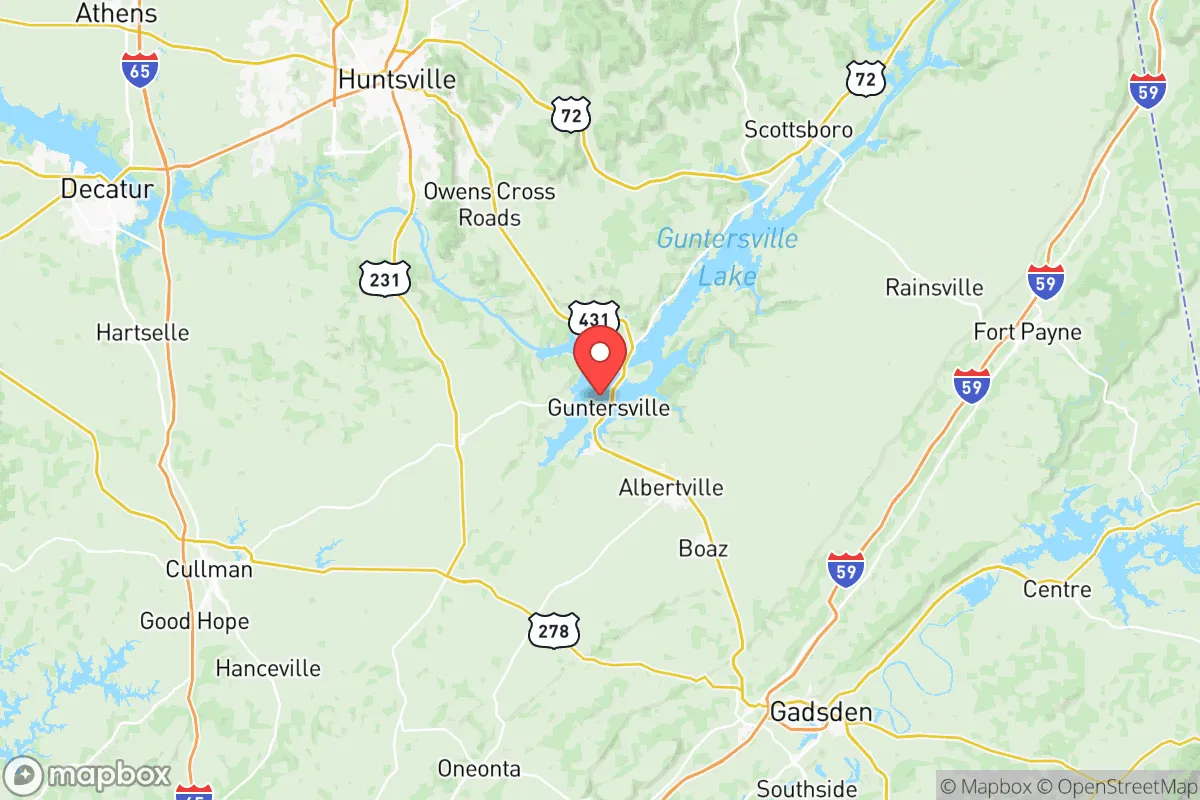
Photo: Wikipedia
Personal Sovereignty in Marshall County
Viable for self-reliance. Generally workable, though some barriers may limit total independence.
What does Personal Sovereignty tell us?
Personal Sovereignty measures your capacity for self-reliance and independence with minimal government friction. Higher scores mean fewer barriers between you and the way you want to live... but it assumes you have the space you need and good neighbors.
What does this tell us?
Personal Sovereignty measures your capacity for self-reliance and independence with minimal government friction. Higher scores mean fewer barriers between you and the way you want to live... but it assumes you have the space you need and good neighbors.
State Policy
Energy independence: Importer (45% of energy produced in-state)
Personal Liberty
Homesteading

Personal Liberty Analysis
For the individual or family prioritizing personal sovereignty above all else, Marshall County, Alabama, offers a notably permissive environment compared to the tightening regulatory grip found in much of the Southeast. While no location is a complete escape from state and federal authority, this corner of North Alabama maintains a strong culture of self-reliance, with local governance that tends to defer to individual choice rather than impose top-down mandates. The county’s blend of low taxes, robust gun rights, and practical homesteading potential creates a foundation where a prepper or liberty-minded parent can operate with far fewer constraints than in urban centers like Birmingham or Huntsville, though the specific flavor of that freedom varies across towns like Guntersville, Albertville, and Boaz.
Tax burden and regulatory posture: How Marshall County compares to state and regional norms
Marshall County’s tax structure is a clear win for those seeking to keep more of their own resources. Alabama already boasts one of the lowest combined state and local tax burdens in the nation, and Marshall County leans into that advantage. Property taxes are exceptionally low, typically hovering around 0.4% of assessed home value—a fraction of what you’d pay in neighboring Tennessee or Georgia. There is no county-level income tax, and the state’s flat 5% income tax rate is among the lowest in the country. Sales tax is a mixed bag: the county rate is 4%, but municipalities add their own. Albertville and Guntersville both tack on an additional 4%, bringing the total to 8%, while Boaz and Arab sit at 9% and 8.5% respectively. For daily purchases, this stings a bit, but the overall annual tax burden remains far below the national average. On the regulatory front, Marshall County is decidedly hands-off. There is no county-wide zoning ordinance outside of incorporated city limits, meaning unincorporated areas—especially around Grant, Horton, and the rural stretches near Lake Guntersville—allow for a wide range of land uses without bureaucratic interference. Building permits are required for new construction, but the process is straightforward and inexpensive compared to states like California or Colorado. Business licensing is minimal, and there are no county-level health department overrides on private well or septic systems beyond basic safety codes. For someone looking to operate a small workshop, keep livestock, or run a home-based business, the regulatory friction is low.
Self-defense and gun law specifics: What the Second Sanctuary status means for daily carry and storage
Marshall County is a Second Amendment Sanctuary, a formal resolution passed by the county commission affirming that local resources will not be used to enforce federal gun laws deemed unconstitutional. This is not just symbolic—it signals a deep cultural commitment to firearm rights that permeates daily life. Alabama is a constitutional carry state, meaning no permit is required to carry a concealed handgun for anyone legally allowed to possess a firearm. Open carry is also fully legal without a permit, and the state’s Stand Your Ground law provides broad latitude for using deadly force in self-defense, with no duty to retreat in any place you have a legal right to be. For the prepper, this means you can keep a rifle in your truck, a pistol on your hip, and a safe full of long guns at home without worrying about magazine capacity bans, assault weapon registries, or waiting periods. The local sheriff’s office in Guntersville is known for issuing permits quickly for those who still want one for reciprocity when traveling, but the reality is that most residents simply carry without one. Gun stores and ranges are plentiful—Albertville has several, including the well-stocked Marshall County Gun & Pawn, and the rural areas around Boaz and Crossville host private shooting clubs. There is no county-level restriction on where you can shoot on your own property, provided you’re outside city limits and follow basic noise and safety common sense. For the family, this means teaching kids firearm safety is a normal part of life, not a politically charged topic.
Self-reliance and homesteading viability: Lot sizes, zoning, and off-grid feasibility across the county
Marshall County is a legitimate homesteading destination, but the feasibility varies sharply depending on where you land. In unincorporated areas, minimum lot sizes are not strictly enforced, and you can find parcels as small as one acre that are perfectly suitable for a garden, a few chickens, and a goat. Rural areas near Grant and Horton offer the most freedom, with large tracts of land available for under $5,000 per acre, no HOA restrictions, and county officials who rarely inspect beyond basic septic requirements. Off-grid living is entirely feasible here. There are no county laws prohibiting solar panels, rainwater collection, or composting toilets, though you will need a permitted septic system for wastewater. The Tennessee Valley Authority (TVA) provides grid power, but disconnecting is your choice. Wells are common and affordable to drill, typically running $5,000 to $10,000 depending on depth. In contrast, Guntersville and Albertville have stricter city codes that can complicate off-grid ambitions—Guntersville requires a minimum lot size of 10,000 square feet in most residential zones, and both cities enforce building codes that mandate grid-tied electrical connections for new homes. Boaz is more lenient, with less aggressive code enforcement, but still requires permits for major structures. For the serious prepper, the sweet spot is the unincorporated land between Crossville and the DeKalb County line, where you can buy 20 acres, drill a well, set up solar, and live with minimal oversight. The county’s agricultural extension office in Guntersville is helpful for soil testing and livestock advice, but they do not impose land-use restrictions beyond basic animal cruelty laws.
Personal liberties: Parental rights, medical autonomy, speech, and property in practice
Marshall County’s culture strongly supports parental rights and medical freedom, though state-level laws provide the framework. Alabama has some of the strongest parental rights laws in the country, including the Parental Rights Protection Act, which affirms that parents have the fundamental right to direct their children’s education, healthcare, and upbringing. In practice, this means local school boards in Albertville, Boaz, and Guntersville are responsive to parental concerns, and there is no county-level mandate for vaccine requirements beyond state exemptions—which include religious and philosophical grounds. Medical autonomy is similarly respected. There are no county health orders that override individual choice, and the state has banned vaccine passports and mask mandates in public schools. For the prepper, this means stocking prescription medications or pursuing alternative treatments is not subject to local interference, though you must still comply with federal pharmacy laws. Free speech is robustly protected; Marshall County has no local ordinances restricting political speech, and public meetings in Guntersville and Albertville are known for open, sometimes heated, citizen commentary. Property rights are the bedrock of the county’s identity. Eminent domain is rarely used, and the county commission has a reputation for siding with landowners against state or federal encroachment. No county-wide noise ordinances exist outside city limits, so running a generator, chainsaw, or target practice at 2 AM on your own land is legally your business. For the parent, this means your children can play, explore, and learn practical skills without the hovering oversight common in more regulated areas.
Overall, Marshall County ranks among the top-tier locations in Alabama for personal sovereignty, especially when compared to the increasingly restrictive environments of Huntsville or Birmingham. The combination of constitutional carry, low taxes, minimal zoning, and a culture that prizes self-reliance creates a buffer against government overreach that is increasingly rare in 2026. For the single individual or family operating from a prepper or survivalist mindset, the county offers a practical, livable balance—you can own your land, keep your guns, raise your food, and raise your kids without constant bureaucratic friction. The trade-offs are real: lower-tier public services in rural areas, higher sales tax in towns, and the occasional need to drive 30 minutes to Guntersville for supplies. But for those who value freedom over convenience, Marshall County delivers where it counts.

* Values derived from national, state, county, city and local statistics and may differ in a specific area. Last updated: 2026-06-06T08:30:42.000Z
Narrative content on this page is AI-generated and may contain mistakes. Verify any details that matter before acting on them.
ReloMaps may earn a commission from affiliate links at no extra cost to you.

