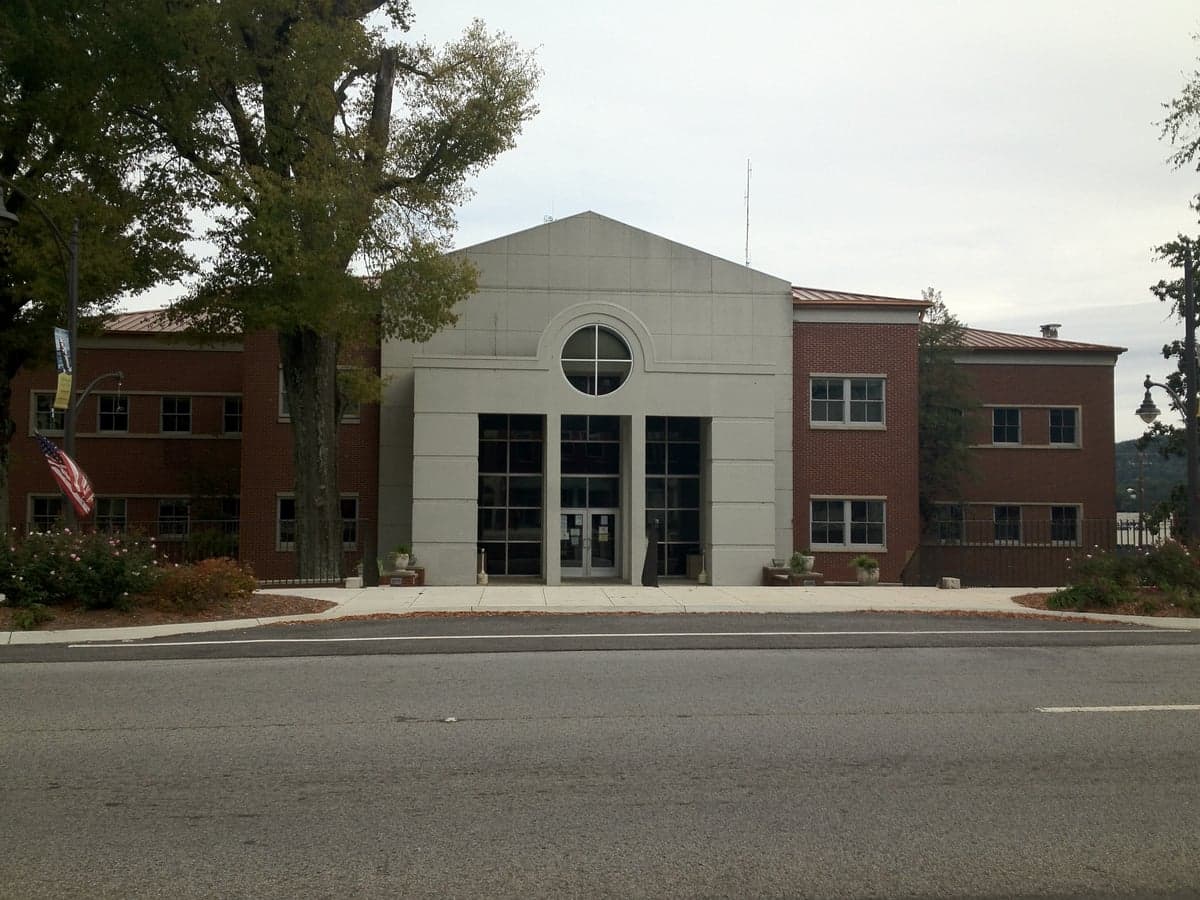
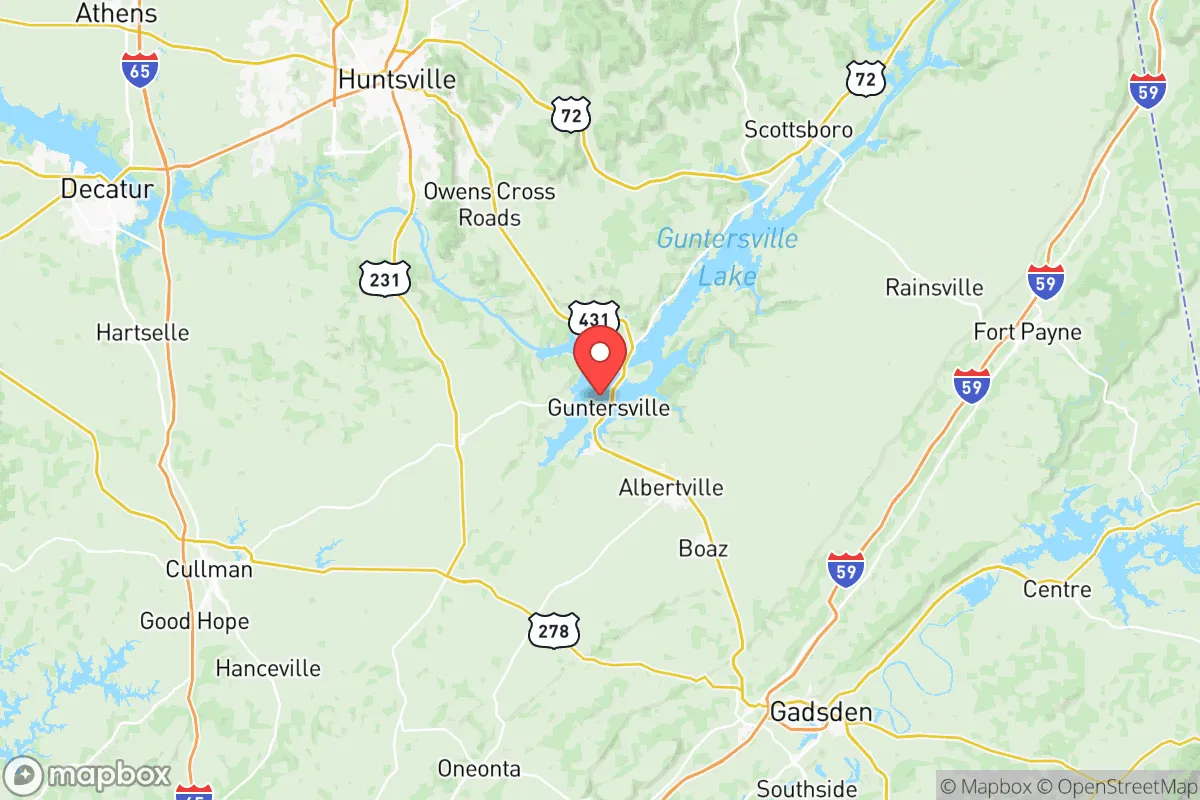
Photo: Wikipedia
Demographics of Marshall County
Affluence Level in Marshall County
A middle-class area roughly in line with national averages across income, home values, education, and employment.
People of Marshall County
Marshall County, Alabama, is home to 98,712 residents who form a predominantly white, native-born population with a growing Hispanic minority, concentrated in the county’s primary cities of Guntersville, Albertville, and Arab. The county’s character is defined by its deep-rooted Southern identity, a strong manufacturing and agricultural economy, and a notably lower college attainment rate of 21.3% compared to national averages. Distinctive markers include a significant Hispanic community—now 16.6% of the population—that has reshaped the cultural and economic landscape, particularly in Albertville and Boaz, while the overall population remains overwhelmingly native-born with only 5.0% foreign-born. This is a place where traditional Southern values intersect with a modern, diversifying workforce, creating a community that is both stable and evolving.
Settlement & growth (pre-1960)
Before American settlement, the area now known as Marshall County was part of the ancestral homeland of the Cherokee Nation, who established towns and farmlands along the Tennessee River and its tributaries. The Cherokee were forcibly removed in the 1830s via the Trail of Tears, opening the region to white settlers. The first major wave of American settlers arrived in the 1830s and 1840s, primarily Scots-Irish and English yeoman farmers from Tennessee, Georgia, and the Carolinas. They were drawn by the fertile river valleys and the promise of cheap land following the Cherokee removal. These early settlers founded the county’s oldest towns, including Guntersville (established 1846) and Claysville, which became the county seat before Guntersville took that role in 1870.
The arrival of the Nashville, Chattanooga and St. Louis Railway in the 1850s spurred a second wave of growth, connecting Marshall County to regional markets and attracting small-scale merchants and craftsmen. The post-Civil War period saw a modest influx of freedmen, who established rural communities and worked as sharecroppers and laborers; however, the Black population never grew large, and today it stands at just 2.5%. The early 20th century brought a third wave: the construction of Guntersville Dam (completed 1939) by the Tennessee Valley Authority transformed the local economy. The dam created Guntersville Lake, a major recreational asset, and brought construction workers and engineers to the area. This period also saw the rise of the poultry industry, which would become a cornerstone of the local economy, particularly in Albertville and Boaz. By 1960, Marshall County’s population was overwhelmingly white, native-born, and rural, with a strong agricultural base and a growing manufacturing sector centered on textiles and poultry processing.
Modern era (post-1965)
The 1965 Hart-Cellar Act had a delayed but profound effect on Marshall County. Unlike coastal cities that saw immediate waves of Asian and Latin American immigration, Marshall County’s demographic shift began in the 1980s and accelerated in the 1990s, driven by labor demand in the poultry processing plants of Albertville, Boaz, and Guntersville. The primary immigrant group has been Hispanic, overwhelmingly from Mexico and Central America, who arrived to fill low-skill, physically demanding jobs in the poultry industry. This wave transformed Albertville and Boaz into the county’s Hispanic hubs, where Spanish-language businesses, churches, and community organizations are now prominent. The Hispanic share of the population grew from negligible in 1980 to 16.6% today, making it the largest minority group by far.
Domestic migration has also reshaped the county, though more subtly. Since the 1990s, Marshall County has attracted retirees and second-home buyers drawn to Guntersville Lake’s recreational opportunities, as well as some Rust Belt migrants seeking lower costs and a slower pace of life. This in-migration has been predominantly white and has reinforced the county’s conservative political character. Suburbanization has been limited; the county’s towns remain distinct, with no major suburban sprawl from a nearby metropolis. The East/Southeast Asian population remains tiny at 0.5%, and the Indian subcontinent population is negligible at 0.1%, reflecting the county’s lack of high-tech or professional-service industries that attract such groups. The Black population has remained stable at 2.5%, concentrated in Guntersville and rural areas.
The future
Marshall County’s population is likely to continue its gradual diversification, driven primarily by Hispanic growth through both immigration and higher birth rates. The Hispanic community is not tribalizing into isolated enclaves but is increasingly integrating into the broader economy and school system, though cultural and linguistic distinctiveness remains strong in Albertville and Boaz. The white population is aging and growing slowly, while the Hispanic cohort is younger, which will gradually shift the county’s age structure and cultural identity. The foreign-born share, currently 5.0%, may rise modestly but is unlikely to approach national averages, as the county lacks the professional job base to attract high-skilled immigrants. The low college attainment rate (21.3%) suggests that the economy will continue to rely on manufacturing, agriculture, and tourism, limiting the draw for highly educated domestic migrants.
In the next 10-20 years, Marshall County will likely become more Hispanic, but the overall character will remain conservative and rooted in Southern traditions. The Hispanic community is being absorbed into the local culture to a degree, with many second-generation residents becoming bilingual and adopting local customs, while also maintaining their heritage. The county is not homogenizing into a bland suburbia; instead, it is developing a bicultural identity in its industrial towns, while Guntersville and Arab remain more traditionally white and Southern. For someone moving in now, Marshall County offers a stable, family-oriented environment with a strong sense of place, but one that is quietly becoming more diverse in its working-class core.
This is a place where the past—Cherokee removal, Scots-Irish settlement, TVA development—still shapes the landscape, but the future is being written by the Hispanic families who now call Albertville and Boaz home. For a conservative-leaning individual or parent, Marshall County represents a community where traditional values persist, but where the workforce and schools are adapting to a new demographic reality. The county is not becoming a melting pot, but rather a layered society where old and new coexist, offering both stability and the opportunity to witness a quiet demographic transformation.

* Values derived from national, state, county, city and local statistics and may differ in a specific area. Last updated: 2026-06-06T08:30:42.000Z
Narrative content on this page is AI-generated and may contain mistakes. Verify any details that matter before acting on them.
ReloMaps may earn a commission from affiliate links at no extra cost to you.

