Photo: Wikipedia
Demographics of Washakie County
Affluence Level in Washakie County
A middle-class area roughly in line with national averages across income, home values, education, and employment.
People of Washakie County
Washakie County's 7,708 residents form one of Wyoming's most demographically stable rural populations: overwhelmingly white (81.2%), with a significant Hispanic minority (14.1%) that has been present for generations rather than a recent arrival. The county's identity is deeply tied to agriculture—sugar beets, dryland wheat, and cattle—and to the outdoor recreation corridor of the Big Horn Basin. With only 1.4% foreign-born and a college attainment rate of 22%, this is a place where settlement patterns set before 1960 still define who lives here and why.
Settlement & growth (pre-1960)
The human history of Washakie County begins with the Shoshone people, whose territory included the Big Horn Basin. The county's name honors Chief Washakie, a Shoshone leader who negotiated with the U.S. government and whose band used the area for seasonal hunting. No permanent American settlement existed until the late 19th century, when the federal government opened the Shoshone Reservation to homesteading after the Fort Bridger Treaty of 1868. The first wave of non-Native settlers—mostly Anglo-American cattle ranchers—arrived in the 1880s and 1890s, drawn by open range and the promise of free land under the Homestead Act.
The critical growth period came after 1900 with the expansion of the Chicago, Burlington & Quincy Railroad, which reached the basin in 1906. The railroad established Worland as a division point, and the town quickly became the county's commercial hub. New rail service also attracted the next major wave: sugar beet farmers. The Holly Sugar Corporation built a processing plant in Worland in 1910, recruiting German-Russian immigrants—descendants of Volga Germans who had already settled in the Great Plains—to work the beet fields. These German-Russian families concentrated in Worland and the smaller railroad stop of Manderson, where they built St. Mary's Catholic Church and maintained their language and traditions well into the 20th century.
A smaller but distinct group arrived during the Dust Bowl years of the 1930s: "Okies" from Oklahoma, Texas, and Kansas fleeing drought and bank foreclosures. They settled primarily on dryland farms around Ten Sleep and the southeastern part of the county, where they raised wheat and livestock. Their descendants still form a conservative, deeply rural thread in the county's population. By 1950, the county's population had peaked at roughly 7,000, and the agricultural economy—sugar beets, dryland grains, and fattening cattle in the Worland feedlots—was fully established. No further major ethnic or cultural in-migration occurred before 1960.
Modern era (post-1965)
The 1965 Hart-Cellar Act had almost no direct impact on Washakie County. The foreign-born population today is just 1.4%, and the racial composition has remained overwhelmingly non-Hispanic white. The most significant demographic shift since 1965 has been the slow expansion of the Hispanic population, which rose from a negligible share in 1970 to 14.1% by the 2020s. This is not driven by immigration but by natural increase among the descendants of the German-Russian sugar beet workers, who began intermarrying with Mexican-origin laborers brought into the industry in the 1980s and 1990s. These Hispanic families are concentrated in Worland, where they make up about one-fifth of the school-age population, and in the farm-worker housing along the Big Horn River valley. No distinct ethnic enclaves exist outside Worland.
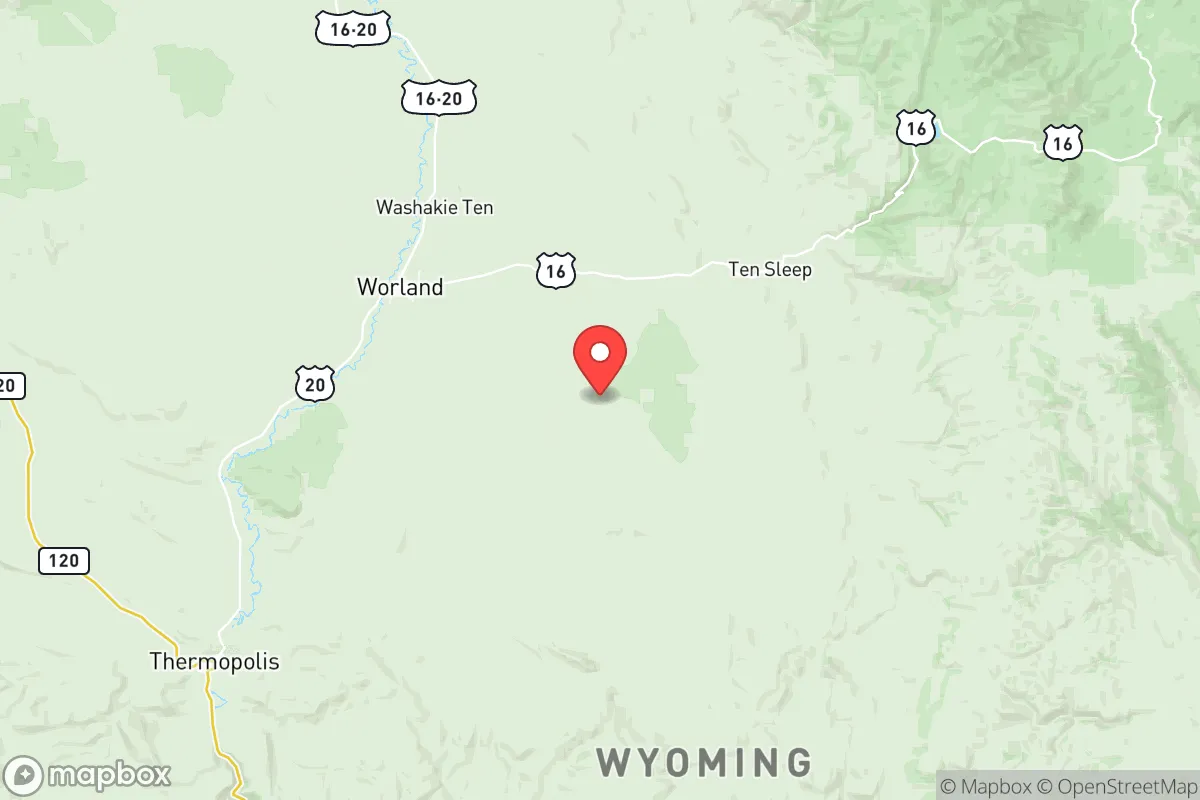
Domestic migration patterns have been minimal. The county has not experienced the coastal flight or Sun Belt influx seen in larger Wyoming counties. Instead, the population has slowly declined from a 1980 peak of 9,000 to the current 7,708, as younger residents leave for college and do not return. Those who stay are disproportionately middle-aged and older, with a median age of about 42. Suburbanization has been absent; the only incorporated municipality is Worland (pop. 5,200), and the rest of the population lives in tiny towns like Ten Sleep (pop. 250) and Manderson (pop. 110), or on rural ranchsteads. The county's housing stock remains dominated by single-family homes on large lots, and the cost of living is low by national standards.
The future
Washakie County's population is projected to continue a slow decline over the next 10–20 years, barring an unanticipated economic shock. The Hispanic share will likely rise to 18–20% as the white population ages out and younger Hispanic families have higher birth rates, but this group shows signs of cultural assimilation: English is dominant among children, and intermarriage with non-Hispanic whites is common. No new immigrant groups are expected because the county offers few jobs outside agriculture and energy services (oil and gas, mining) and lacks the urban amenities that attract foreign-born populations to larger Wyoming towns like Gillette or Rock Springs.
The cultural identity of the county is likely to remain stable: conservative, self-reliant, and tied to the land. There is no trend toward ethnic tribalization because the Hispanic minority is itself heavily integrated and the population is too small to sustain distinct enclaves. The main long-term challenge is not cultural change but simple depopulation, especially in the outlying communities of Ten Sleep and Manderson, which may lose their remaining services—schools, gas stations, grocery stores—if current trends continue. Worland, as the county seat and hub for health care and retail, is likely to hold its own, but the county as a whole will become older, whiter, and smaller.
For a relocation-seeking individual or family, Washakie County offers a genuinely rural, conservative community where the population is known and civic participation matters. The trade-off is limited economic opportunity and a gradually shrinking base of services. The kind of person who thrives here is one who values quiet, space, and tradition over diversity, density, and rapid change. It is not a place for those seeking rapid growth or a cosmopolitan environment, but it remains one of the most authentically "Wyoming" counties in the state.

* Values derived from national, state, county, city and local statistics and may differ in a specific area. Last updated: 2026-05-21T00:56:08.000Z
Narrative content on this page is AI-generated and may contain mistakes. Verify any details that matter before acting on them.
ReloMaps may earn a commission from affiliate links at no extra cost to you.

