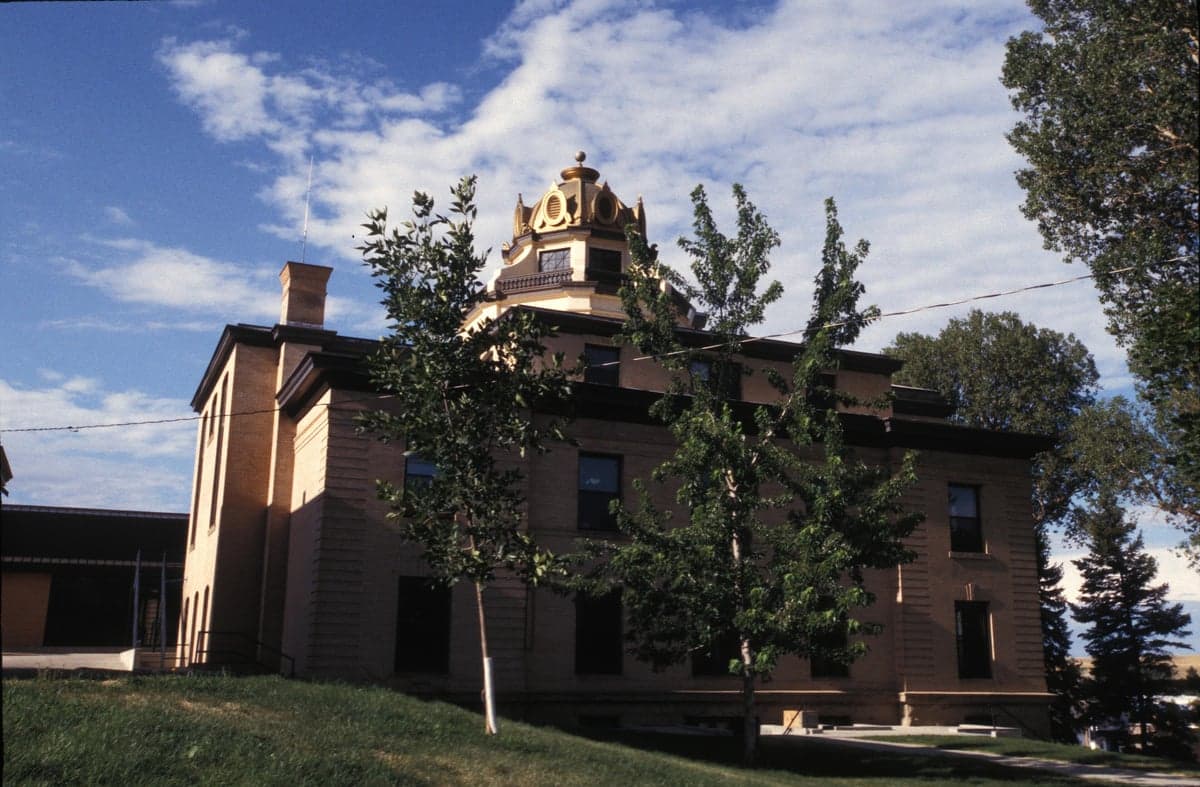
Photo: Wikipedia
Political ClimatePolitical Climate in Sheridan County
Showing state-level results — no local-only data available.
Local Political AnalysisPolitical Analysis of Sheridan County
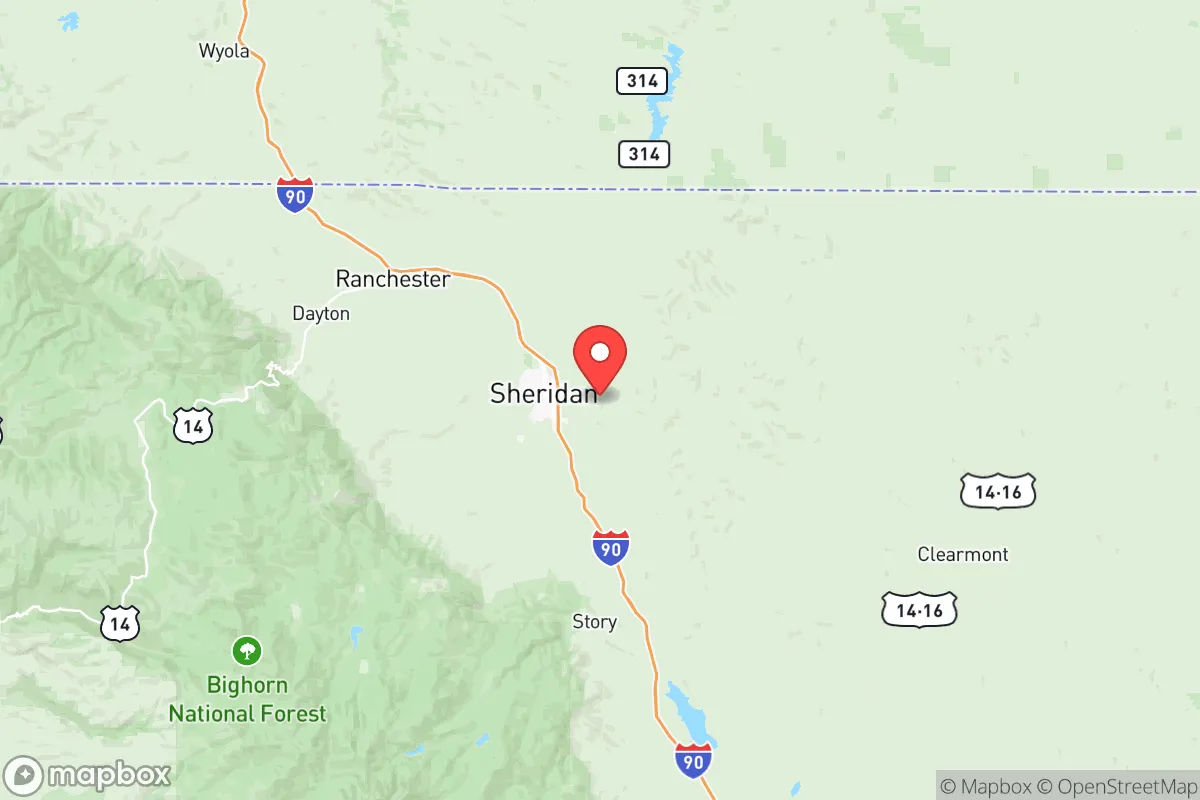
Sheridan County, Wyoming, is a reliably Republican stronghold with a Cook Partisan Voting Index (PVI) of R+23, making it one of the most conservative counties in the state. The county has voted for the GOP presidential candidate by margins of 30 to 40 points in recent elections, with Donald Trump carrying it by 38 points in 2020. While the county as a whole leans heavily red, there are notable pockets of political diversity, particularly in the city of Sheridan itself, where a small but visible Democratic presence exists, and in the town of Story, which has a more moderate, independent streak. The surrounding rural areas, including the towns of Ranchester and Dayton, are overwhelmingly conservative, with precincts often voting Republican by 50 points or more.
How it compares
Comparing Sheridan County to the state of Wyoming as a whole is a bit like comparing apples to oranges, since Wyoming doesn't have a single dominant city or county that defines its politics. The state as a whole is also deeply red, with a Cook PVI of R+25, but Sheridan County's R+23 is slightly less conservative than the state average. This is largely due to the influence of Sheridan city, which has a more diverse economy and a growing population of retirees and remote workers who bring a mix of political views. In contrast, the rest of the county—especially the rural areas and smaller towns like Big Horn and Banner—is as conservative as any place in the state. The key difference is that Sheridan County has a more visible and organized Democratic Party presence than many other parts of Wyoming, though it remains a minority voice.
What this means for residents
For conservative residents, Sheridan County is a comfortable place where their values are reflected in local policy and community norms. The county commission is solidly Republican, and issues like gun rights, limited government, and energy development are widely supported. For liberal residents, the political climate can feel isolating, but there are active groups like the Sheridan County Democrats and the League of Women Voters that provide community and advocacy. The city of Sheridan itself is more tolerant of diverse viewpoints, with a few local businesses and organizations that are openly progressive. In practice, the political lean means that local elections are often decided in the Republican primary, and general elections are rarely competitive. However, the county's growing population—driven by an influx of out-of-state residents—is slowly shifting the political dynamics, with some precincts in Sheridan city becoming more competitive in recent years.
Culturally, Sheridan County stands out for its strong sense of community and its blend of Western heritage and new-economy influences. The county is home to the Sheridan WYO Rodeo, a major annual event that celebrates ranching and cowboy culture, but it also has a thriving arts scene and a growing number of breweries and coffee shops that cater to a more urban crowd. Policy-wise, the county has been a leader in local land-use planning and conservation, with initiatives like the Sheridan County Land Use Plan that balance development with preservation. This pragmatic approach to governance is a hallmark of the area, reflecting a willingness to find common ground on issues like water rights and public lands, even as the broader political climate remains deeply conservative. For residents, this means a place where political differences are often set aside in favor of practical solutions, though the underlying partisan divide is as real as anywhere in Wyoming.

State Political ClimatePolitical Climate in Wyoming
State Political AnalysisPolitical Environment in the State
Wyoming is one of the most reliably Republican states in the nation, with a partisan lean that has only deepened over the past two decades. In the 2024 presidential election, Donald Trump carried the state by roughly 46 points, a margin that has held steady or grown since 2016. The dominant coalition is a mix of ranchers, energy workers, and conservative transplants from states like California and Colorado, all united by a fierce commitment to limited government and individual liberty. Over the last 10-20 years, the state has shifted further right as its small Democratic presence in places like Teton County has been overwhelmed by the broader rural conservative vote.
Urban vs. rural divide
The political map of Wyoming is starkly divided between a handful of small urban centers and the vast rural expanse. Cheyenne, the state capital and largest city, leans Republican but is more moderate than the rest of the state, often electing pragmatic conservatives who focus on infrastructure and education. Casper, the second-largest city, is a conservative stronghold driven by the energy industry, while Laramie, home to the University of Wyoming, is the state's most liberal enclave, with a noticeable progressive student and faculty presence. Jackson in Teton County is a unique outlier: a wealthy, tourist-driven town that votes Democratic in presidential elections, but its influence is dwarfed by the surrounding rural counties. The rest of the state—places like Rock Springs, Gillette, and Rawlins—votes overwhelmingly Republican, with margins often exceeding 70%.
Policy environment
Wyoming's policy environment is defined by its absence of a state income tax, a low property tax burden, and a regulatory posture that favors extractive industries like coal, oil, and natural gas. The state has a flat 4% corporate income tax and no personal income tax, making it attractive for high-earners and business owners. Education policy is locally controlled, with school choice options limited but growing; the state has a small but active charter school sector. Healthcare is a mixed bag: Wyoming did not expand Medicaid under the Affordable Care Act, leaving a coverage gap for low-income adults, but the state has a robust network of rural health clinics. Election laws are straightforward—voter ID is required, and same-day registration is not available, but absentee voting is widely accessible. The state's libertarian streak is evident in its alcohol laws, which allow for the sale of liquor in grocery stores, and its permissive stance on firearms.
Recent policy direction
In the last few years, Wyoming has moved decisively to expand individual liberties across several fronts. Gun and self-defense law is among the most permissive in the nation: the state passed constitutional carry in 2021, allowing concealed carry without a permit, and has no red flag law. Parental and education rights have been a major focus, with the 2023 "Parents' Bill of Rights" requiring schools to notify parents of any curriculum involving sexual orientation or gender identity. Speech is broadly protected, with no state-level hate speech laws and a strong tradition of free expression. Privacy and surveillance are areas of concern: the state has limited data privacy laws, but a 2024 law restricts the use of facial recognition technology by law enforcement. Medical and bodily autonomy is sharply divided: Wyoming has a near-total abortion ban, with exceptions only for rape, incest, and the life of the mother, but it also has a strong medical freedom movement that has pushed back against vaccine mandates. Property rights are fiercely protected, with a 2022 law limiting the use of eminent domain for carbon capture pipelines. Taxation remains low, but a 2023 bill to phase out the corporate income tax failed. Voting and ballot access have been tightened: a 2021 law requires a valid excuse for absentee voting, though mail-in voting is still available for those who qualify.
Civil unrest & political movements
Wyoming is not known for large-scale civil unrest, but it has a history of organized political movements on both sides. The Yellowstone Club and other wealthy enclaves in Teton County have seen occasional protests over housing affordability and environmental issues, but these are small and localized. On the right, the Wyoming Freedom Caucus has become a powerful force in the state legislature, pushing for further tax cuts and restrictions on federal land management. Immigration politics are relatively quiet, as the state has a small foreign-born population, but a 2024 law requires local law enforcement to cooperate with federal immigration authorities. Sanctuary policies are nonexistent; the state has actively banned them. Secession and nullification rhetoric is common but mostly symbolic: a 2023 resolution calling for a "convention of states" to amend the U.S. Constitution passed easily. Election integrity controversies have been minimal, though the 2020 election saw a brief push for an audit in a few counties. The most visible flashpoint for new residents is likely the tension between the state's libertarian ethos and the growing influence of federal land management, which controls nearly half of Wyoming's territory.
Projection
Over the next 5-10 years, Wyoming's political trajectory is likely to remain deeply conservative, but with increasing internal friction. In-migration from blue states is accelerating, particularly to Teton County and the I-25 corridor near Cheyenne, bringing a small but growing number of moderate and liberal voters. However, these newcomers are often wealthier and more focused on property rights and low taxes than on social issues, so they may not shift the state's overall lean significantly. The energy transition is the wild card: as coal declines, the state's economy will need to diversify, which could weaken the political power of the extractive industries and open space for new coalitions. The Wyoming Freedom Caucus is likely to continue pushing for more aggressive tax cuts and deregulation, but may face resistance from more pragmatic Republicans in Cheyenne and Casper who worry about funding schools and roads. A new resident moving in now should expect to find a state that is politically stable but not static, with a growing divide between the libertarian-leaning rural areas and the more moderate urban centers.
For a new resident, the bottom line is that Wyoming offers a political environment that is overwhelmingly conservative and libertarian, with low taxes, strong gun rights, and a hands-off approach to personal behavior. Liberal residents will find themselves in a clear minority, especially outside of Laramie and Jackson, but the state's culture of live-and-let-live means they are unlikely to face active hostility. Conservative residents will feel at home, but should be aware that the state's small population and limited resources mean that political battles are often personal and local. The key takeaway is that Wyoming is a place where your vote matters more than in almost any other state, but where the political conversation is dominated by a few key issues: land use, energy, and the balance between individual freedom and community responsibility.
* Values derived from national, state, county, city and local statistics and may differ in a specific area. Last updated: 2026-08-08T16:39:13.000Z
Narrative content on this page is AI-generated and may contain mistakes. Verify any details that matter before acting on them.
ReloMaps may earn a commission from affiliate links at no extra cost to you.

