Photo: Wikipedia
Demographics of Winnemucca, NV
Affluence Level in Winnemucca, NV
A middle-class area roughly in line with national averages across income, home values, education, and employment.
People of Winnemucca, NV
The people of Winnemucca, Nevada, today number roughly 8,400, forming a community that is predominantly White (63.0%) with a substantial Hispanic minority (27.9%) and a small but notable East/Southeast Asian presence (2.2%). The city’s identity is rooted in its role as a railroad and mining hub, giving it a working-class, Western character that is more conservative and self-reliant than Nevada’s urban centers like Reno or Las Vegas. With a foreign-born population of just 5.3% and a college attainment rate of 30.5%, Winnemucca is a place where longtime ranching and railroad families live alongside newer Hispanic and Asian arrivals, creating a demographic blend that is slowly diversifying but remains anchored in its pioneer-era foundations.
How the city was settled and grew
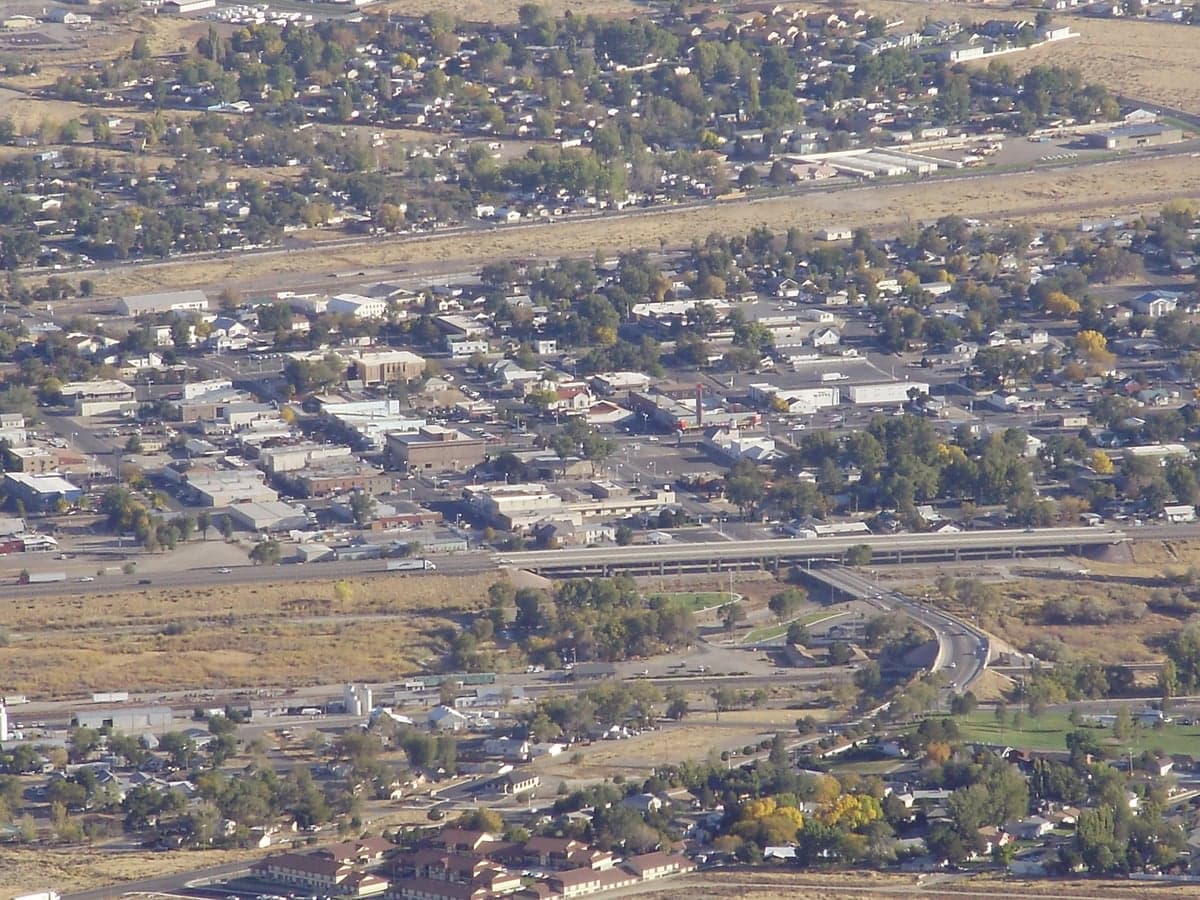
Winnemucca’s human history begins with the Northern Paiute people, who inhabited the Humboldt River basin for centuries before European contact. The city itself was founded in 1868 as a station on the Central Pacific Railroad, drawing its first permanent settlers—mostly Irish, Italian, and Chinese laborers—who built the rail line and serviced the trains. The original Downtown Winnemucca district, centered on Bridge Street and Winnemucca Boulevard, became the commercial and residential hub for these railroad workers, with boarding houses and saloons catering to a transient male workforce. By the 1880s, the discovery of silver and gold in the nearby Humboldt Range spurred a second wave of miners, many of them Cornish and German, who settled in the Grass Valley area just south of town, establishing small homesteads and ranches. The early 20th century saw the rise of the livestock industry, with Basque sheepherders arriving from the Pyrenees to work the open ranges; their descendants remain a distinctive cultural group, concentrated in the Basque District around Melarkey Street, where traditional boarding houses and restaurants still operate. Through the mid-20th century, Winnemucca’s population remained small and overwhelmingly White, with a stable economy based on rail, mining, and ranching.
Modern era (post-1965)
The 1965 Hart-Cellar Act had a limited immediate impact on Winnemucca, but the city began to see significant demographic change after the 1970s, driven by the expansion of the mining industry—particularly gold mining at the nearby Carlin Trend and Cortez mines. This boom attracted a new wave of Hispanic workers, primarily from Mexico and Central America, who took jobs in mining, construction, and service industries. Many settled in the East Winnemucca neighborhood, east of the Humboldt River, where affordable housing and proximity to industrial areas made it a natural landing point. By the 1990s, the Hispanic share of the population had risen to roughly 15%, and by 2026 it stands at 27.9%. A smaller but distinct East/Southeast Asian community (2.2%) also emerged during this period, largely Filipino and Vietnamese workers recruited for mining and healthcare roles; they are concentrated in the West Winnemucca area near the hospital and the Winnemucca Regional Medical Center. The White population, while still the majority at 63.0%, has seen a gradual decline in relative share as the city’s overall growth has been driven by minority in-migration. The Black population remains negligible at 0.7%, and the Indian subcontinent population is effectively zero, reflecting the city’s limited appeal to professional-class immigrants who typically gravitate toward larger metropolitan areas.
The future
Winnemucca’s population is heading toward continued slow diversification, but the pace is moderate compared to Nevada’s faster-growing regions. The Hispanic community is the primary driver of growth, with younger families and higher birth rates ensuring that the share will likely rise to 30-35% within the next decade. However, the city shows signs of tribalization into distinct enclaves rather than full assimilation: East Winnemucca is increasingly Hispanic, while West Winnemucca and the older Basque District remain predominantly White. The East/Southeast Asian community is small and appears to be plateauing, as mining automation reduces demand for low-skill labor and the area lacks the ethnic infrastructure—temples, grocery stores, language schools—that would attract sustained Asian immigration. The White population is aging, with many younger White residents leaving for college or jobs in Reno or Salt Lake City, a trend that will accelerate the Hispanic share increase. The city’s overall population is projected to grow slowly, perhaps reaching 9,500 by 2035, driven by mining cycles and the expansion of the nearby Thacker Pass lithium project, which could attract a new wave of workers—potentially including more Hispanic and Native American laborers from the Fort McDermitt Paiute-Shoshone Reservation to the north.
For someone moving to Winnemucca now, the city is becoming a more Hispanic-influenced Western town, where the old Basque and railroad heritage still dominates public life but the future is increasingly shaped by Latino families and mining-industry newcomers. The community remains politically conservative, with a strong sense of local identity and a resistance to the rapid change seen in Nevada’s urban centers. New residents should expect a place where neighborly ties are strong, the economy is tied to resource extraction, and the demographic shift is gradual enough that longtime residents and newcomers can find common ground in the city’s enduring ranching and railroad culture.

* Values derived from national, state, county, city and local statistics and may differ in a specific area. Last updated: 2026-04-30T06:40:27.000Z
Narrative content on this page is AI-generated and may contain mistakes. Verify any details that matter before acting on them.
ReloMaps may earn a commission from affiliate links at no extra cost to you.

