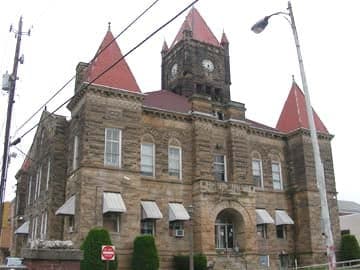
Photo: Wikipedia
Demographics of Wetzel County
Affluence Level in Wetzel County
A below-average socioeconomic profile. Incomes, home values, and educational attainment trail the U.S., with higher poverty and unemployment.
People of Wetzel County
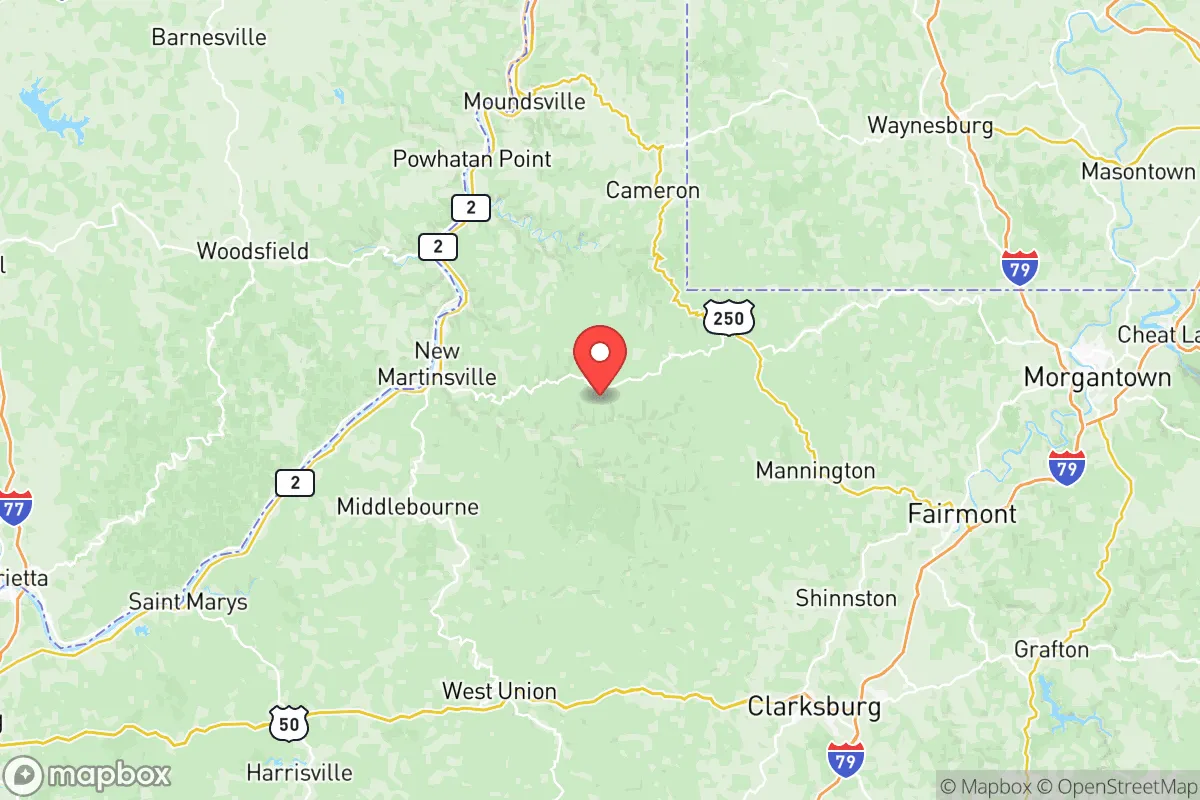
Today, the people of Wetzel County, West Virginia number roughly 14,233, making it one of the state’s least densely populated counties at about 39 people per square mile. The population is overwhelmingly white (94.1%) and native-born (99.7% U.S.-born), with a foreign-born share of just 0.3% — among the lowest in the nation. The county’s identity is rooted in Appalachian independence, a legacy of Scots-Irish and German settlement, and an economy historically tied to oil, natural gas, and coal. With only 13.5% of adults holding a college degree, Wetzel County remains a working-class, rural stronghold where family ties and local institutions — churches, volunteer fire departments, and high school sports — define community life.
Settlement & growth (pre-1960)
Long before European settlers arrived, the area now known as Wetzel County was part of the hunting and trading grounds of the Shawnee and Mingo peoples, who used the Ohio River and its tributaries — including Fishing Creek and the Little Kanawha River — for travel and seasonal camps. The region saw no permanent European settlement until after the French and Indian War (1754–1763), when the British Crown began granting land to veterans. The first wave of settlers were Scots-Irish from Pennsylvania and Virginia, who pushed into the Ohio Valley in the 1770s and 1780s, drawn by cheap land and the promise of independence from tidewater elites. They established small farms along the Ohio River and its creeks, founding communities like New Martinsville (the county seat, platted in 1790), Paden City, and Hundred. These early settlers were largely Presbyterian and fiercely self-reliant, traits that still echo in the county’s political and social conservatism.
A second wave arrived in the mid-19th century, this time German immigrants fleeing political unrest and economic hardship in the German states. They settled primarily in the northern and central parts of the county, establishing farming hamlets like Littleton and Burton. German Lutherans and Catholics built churches that remain community anchors today. Unlike the Scots-Irish, who favored dispersed homesteads, Germans often clustered in small villages, creating a denser social fabric around church and school.
The late 19th and early 20th centuries brought the county’s defining economic boom: oil and natural gas. The discovery of the Burning Springs oil field in the 1860s — one of the earliest commercial oil fields in the world — triggered a rush of speculators, drillers, and laborers. Towns like Hundred and New Martinsville swelled with workers, many of them native-born Appalachians from neighboring counties, but also a small number of Italian and Polish immigrants who came to work the oil rigs and pipelines. By 1900, Wetzel County’s population peaked at over 22,000, driven by oil and later by coal mining in the county’s eastern hills. The Great Depression hit hard, but the county’s resource economy — oil, gas, coal, and timber — kept it from collapsing entirely. The post-World War II era saw a gradual decline as oil fields matured and younger generations began leaving for industrial jobs in Ohio, Pennsylvania, and the Midwest.
Modern era (post-1965)
The 1965 Hart-Cellar Act, which reshaped U.S. immigration by prioritizing family reunification and skilled labor, had almost no impact on Wetzel County. The county’s foreign-born population has remained below 1% for decades, and as of the latest data, it stands at just 0.3%. Unlike much of the nation, Wetzel County did not experience significant immigration from Latin America, Asia, or the Indian subcontinent. The small Hispanic population (1.8%) and even smaller Black (0.5%) and East/Southeast Asian (0.1%) communities are concentrated almost entirely in New Martinsville, the county’s largest town and commercial hub, often tied to the local hospital, schools, or the Mountaineer Casino, Racetrack & Resort just across the Ohio River in Hancock County.
Domestic migration has been the dominant demographic force since 1965 — and it has been a story of out-migration, not in-migration. The county’s population has fallen steadily from its 1950 peak of 22,000 to the current 14,233, a decline of roughly 35%. Young adults leave for college or jobs in larger cities like Pittsburgh, Columbus, or Morgantown, and many do not return. The population that remains is older — the median age is 45.7, well above the national average — and increasingly reliant on healthcare, social services, and the energy sector. The Marcellus Shale natural gas boom of the 2010s brought a temporary influx of out-of-state workers, mostly from Texas, Oklahoma, and Pennsylvania, but few settled permanently. These workers were predominantly white, native-born, and transient, living in man camps or renting in New Martinsville and Paden City before moving on to the next drilling site.
Suburbanization has been minimal. Wetzel County has no suburbs in the traditional sense; its towns are small, and most residents live in unincorporated rural areas. The county’s few subdivisions, such as those around New Martinsville and Hundred, were built in the 1970s and 1980s for local oil and gas workers and have seen little new construction since. The county’s housing stock is aging, and property values remain low — a barrier to attracting new residents but a draw for those seeking affordable rural living.
The future
Wetzel County’s population is projected to continue declining slowly, likely falling below 13,000 by 2040. The county is homogenizing rather than diversifying: the already tiny non-white populations are not growing, and the foreign-born share is essentially static. The Hispanic population, while slightly larger than other minority groups, remains small and concentrated in New Martinsville, with little evidence of a growing enclave or cultural shift. The county’s cultural identity — white, Appalachian, Christian, and politically conservative — is being reinforced by out-migration of younger, more liberal-leaning residents and the absence of significant in-migration from other regions or countries.
The Marcellus Shale industry remains the wild card. A sustained natural gas boom could bring temporary population bumps, but the industry’s boom-bust cycle and increasing automation mean that long-term population growth is unlikely. The county’s aging demographic profile — with a median age approaching 50 — suggests that natural decrease (more deaths than births) will accelerate. Schools in Paden City and Hundred have already consolidated due to declining enrollment, a trend that will continue.
For someone moving in now, Wetzel County offers a stable, culturally homogeneous community where neighbors know each other, crime is low, and the pace of life is slow. The trade-off is limited economic opportunity, a shrinking tax base, and a social environment that may feel insular to outsiders. The county is not becoming more diverse or cosmopolitan; it is becoming more of what it already is — a quiet, rural, white Appalachian stronghold with deep roots and a cautious outlook on change.

* Values derived from national, state, county, city and local statistics and may differ in a specific area. Last updated: 2026-05-19T17:34:38.000Z
Narrative content on this page is AI-generated and may contain mistakes. Verify any details that matter before acting on them.
ReloMaps may earn a commission from affiliate links at no extra cost to you.

