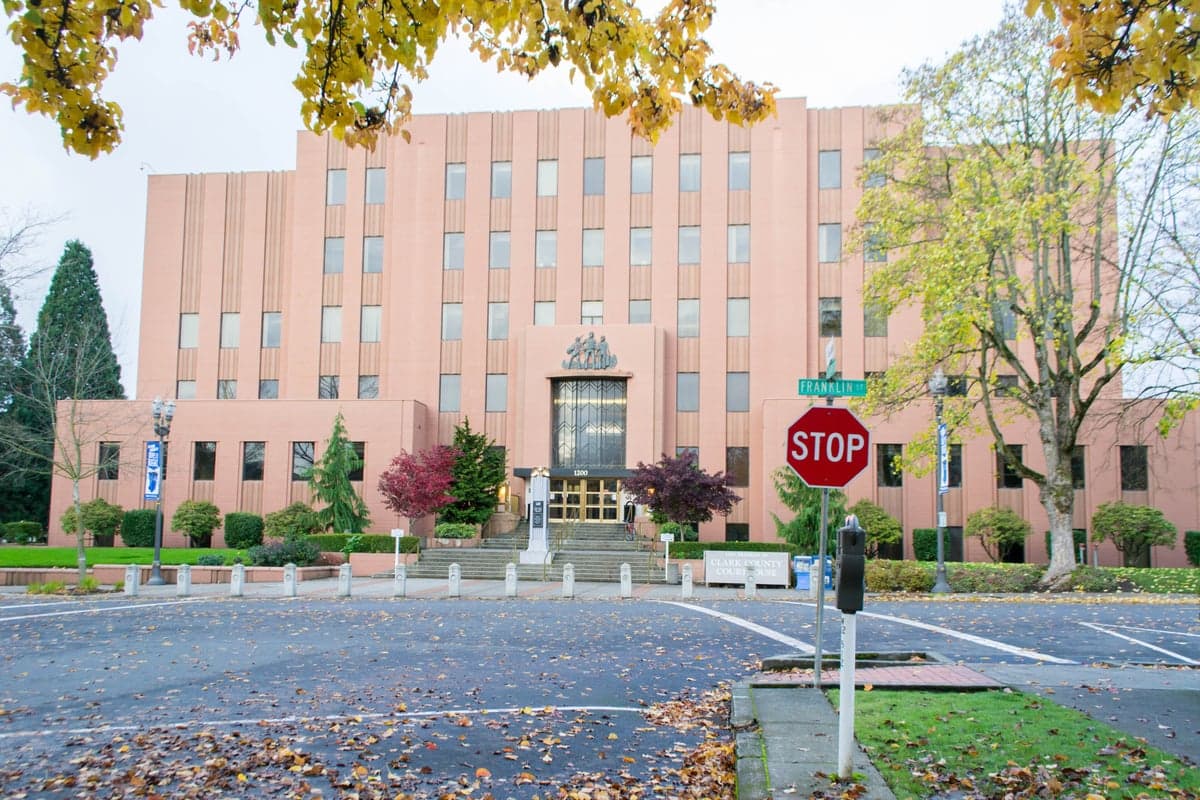
Photo: Wikipedia
Personal Sovereignty in Clark County
Viable for self-reliance. Generally workable, though some barriers may limit total independence.
What does Personal Sovereignty tell us?
Personal Sovereignty measures your capacity for self-reliance and independence with minimal government friction. Higher scores mean fewer barriers between you and the way you want to live... but it assumes you have the space you need and good neighbors.
What does this tell us?
Personal Sovereignty measures your capacity for self-reliance and independence with minimal government friction. Higher scores mean fewer barriers between you and the way you want to live... but it assumes you have the space you need and good neighbors.
State Policy
Energy independence: Importer (55% of energy produced in-state)
Personal Liberty
Homesteading

Personal Liberty Analysis
Clark County, Washington offers a nuanced personal sovereignty environment that balances the relative freedom of a less densely populated region with the regulatory realities of a state governed by a Democratic supermajority in Olympia. While Washington State imposes a progressive income tax on capital gains and maintains strict environmental regulations, Clark County’s proximity to the Oregon border and its mix of rural, suburban, and urban zones create distinct pockets where autonomy—from tax burden to self-defense rights—varies significantly. For individuals and families prioritizing personal freedom, the county presents a strategic trade-off: lower property taxes than neighboring Oregon and a strong gun culture in rural areas, but with state-level constraints on self-defense, medical autonomy, and property use that require careful navigation.
Tax burden and regulatory posture in Clark County vs. Washington State
Clark County’s tax environment is shaped by Washington State’s lack of a personal income tax on wages, which is a major draw for conservative-leaning residents. However, the state does impose a 7% capital gains tax on profits exceeding $250,000 (indexed for inflation), enacted in 2021 and upheld by the state Supreme Court in 2023. Property taxes in Clark County average around 0.93% of assessed value, slightly below the state median, with rates varying by city: Vancouver levies a combined rate of roughly $11.50 per $1,000 of assessed value, while unincorporated areas like Brush Prairie and Hockinson see rates closer to $10.50 due to fewer municipal services. Sales tax in Clark County is 8.4%, composed of the state’s 6.5% rate plus local options for transit and public safety—higher than Oregon’s 0% but offset by no income tax. Regulatory posture is mixed: the county’s Department of Community Development enforces the state’s Growth Management Act, which restricts rural development through urban growth boundaries (UGBs). In practice, this means Ridgefield and La Center have tighter zoning for new subdivisions, while areas east of Battle Ground allow larger lot sizes with fewer permitting hurdles. The state’s environmental regulations, including the Shoreline Management Act and the State Environmental Policy Act (SEPA), add layers of review for any construction near waterways or wetlands, which can delay homesteading projects by months.
Self-defense and gun law specifics in Clark County’s rural and urban zones
Washington State’s gun laws have tightened significantly since 2023, with the passage of a ban on certain semi-automatic firearms (often called “assault weapons”) and a requirement for a 10-day waiting period on all firearm purchases. Magazine capacity is limited to 10 rounds for rifles and 15 for handguns. These laws apply uniformly across Clark County, but enforcement and cultural acceptance vary by location. In Yacolt and Amboy, rural communities in the county’s northern and eastern reaches, gun ownership is near-universal, and private firearm sales (still legal without a background check for long guns, though state law requires a background check for handguns) are common. The county’s sheriff, John Horch, has publicly stated that his office will not proactively enforce the state’s magazine ban, reflecting a local posture of resistance. In contrast, Vancouver city limits, particularly in the downtown and westside neighborhoods, see higher compliance with state laws, and open carry is less common. Concealed carry permits are issued by the county sheriff’s office on a shall-issue basis, with a processing time of 30-60 days. Stand-your-ground laws do not exist in Washington; the state uses a “duty to retreat” standard in public spaces, though the castle doctrine applies within one’s home. For self-defense-oriented residents, rural Clark County offers a de facto higher level of autonomy than the state’s legal framework suggests, but the legal risk of using force in a defensive situation is real and should be weighed carefully.
Self-reliance and homesteading viability: lot sizes, zoning, and off-grid feasibility
Homesteading in Clark County is feasible but constrained by state and local regulations. Minimum lot sizes in unincorporated areas are typically 5 acres for rural residential zoning, though some areas like Heisson and Venersborg have parcels as small as 1 acre with septic approvals. The county’s zoning code allows for accessory dwelling units (ADUs) on properties over 1 acre, and keeping chickens, goats, and up to two cows is permitted on lots of 1 acre or more without a conditional use permit. Off-grid living faces significant hurdles: Washington State requires all new dwellings to connect to the electrical grid unless a renewable energy system is approved through a lengthy permitting process. Rainwater collection is legal for outdoor use but requires a permit for potable indoor use, and composting toilets are allowed only with a state-approved design. Solar panel installation is straightforward in unincorporated areas, but net metering is capped at 100% of a home’s annual consumption. Battle Ground and Ridgefield have more restrictive ordinances on livestock and noise, while rural Washougal (east of the city) offers greater flexibility for small-scale farming. The county’s agricultural zoning (AG-20) requires 20-acre minimums for commercial farming, but hobby farms on 5-10 acres are common in the La Center area. Water rights are a critical issue: new wells in the county’s eastern basalt aquifers require a permit from the Department of Ecology, and approval can take 6-12 months. Overall, homesteading is viable for those willing to navigate the permitting process, but it is not a “free-for-all” environment.
Personal liberties: parental rights, medical autonomy, speech, and property
Washington State has some of the strongest parental rights laws in the Pacific Northwest, including a 2024 law requiring school districts to notify parents of any changes to a student’s mental, physical, or emotional health—though this has been challenged in court by LGBTQ+ advocacy groups. In Clark County, school boards in Battle Ground and Hockinson have been battlegrounds for parental rights, with conservative majorities pushing for curriculum transparency and opt-out options for sex education. Medical autonomy is more restricted: the state mandates COVID-19 and MMR vaccinations for school attendance, and a 2023 law prohibits the sale of raw milk for human consumption without a herd-share agreement. Telehealth for out-of-state doctors is legal, but prescribing controlled substances via telehealth requires an in-person visit. Speech protections are robust under the Washington State Constitution, which has a stronger free-speech clause than the U.S. Constitution, and Clark County has seen no local ordinances restricting political signage or public assembly. Property rights are limited by the Growth Management Act, which restricts subdivision of rural land and requires counties to designate “critical areas” (wetlands, steep slopes, fish habitats) that can reduce buildable area by 30-50% on a given parcel. In Yacolt, property owners have successfully challenged critical area designations through the county’s hearing examiner process, but legal costs can run $5,000-$15,000. For those who value property rights above all, the county’s regulatory framework is a significant constraint compared to states like Idaho or Texas.
Compared to other areas in the Pacific Northwest, Clark County offers a middle ground on personal sovereignty. It is far less restrictive than King County (Seattle) on gun rights and property use, but more regulated than rural counties in eastern Washington or Oregon’s Klamath County. For a conservative-leaning individual or family, the county’s best autonomy is found in its rural northern and eastern towns—Yacolt, Amboy, and Heisson—where local culture and lax enforcement of state mandates create a de facto higher level of freedom. The trade-off is proximity to Vancouver’s job market and amenities, which come with higher taxes and tighter zoning. For those willing to navigate state-level constraints, Clark County provides a viable, if imperfect, environment for self-reliance and personal liberty.

* Values derived from national, state, county, city and local statistics and may differ in a specific area. Last updated: 2026-08-14T10:35:09.000Z
Narrative content on this page is AI-generated and may contain mistakes. Verify any details that matter before acting on them.
ReloMaps may earn a commission from affiliate links at no extra cost to you.

