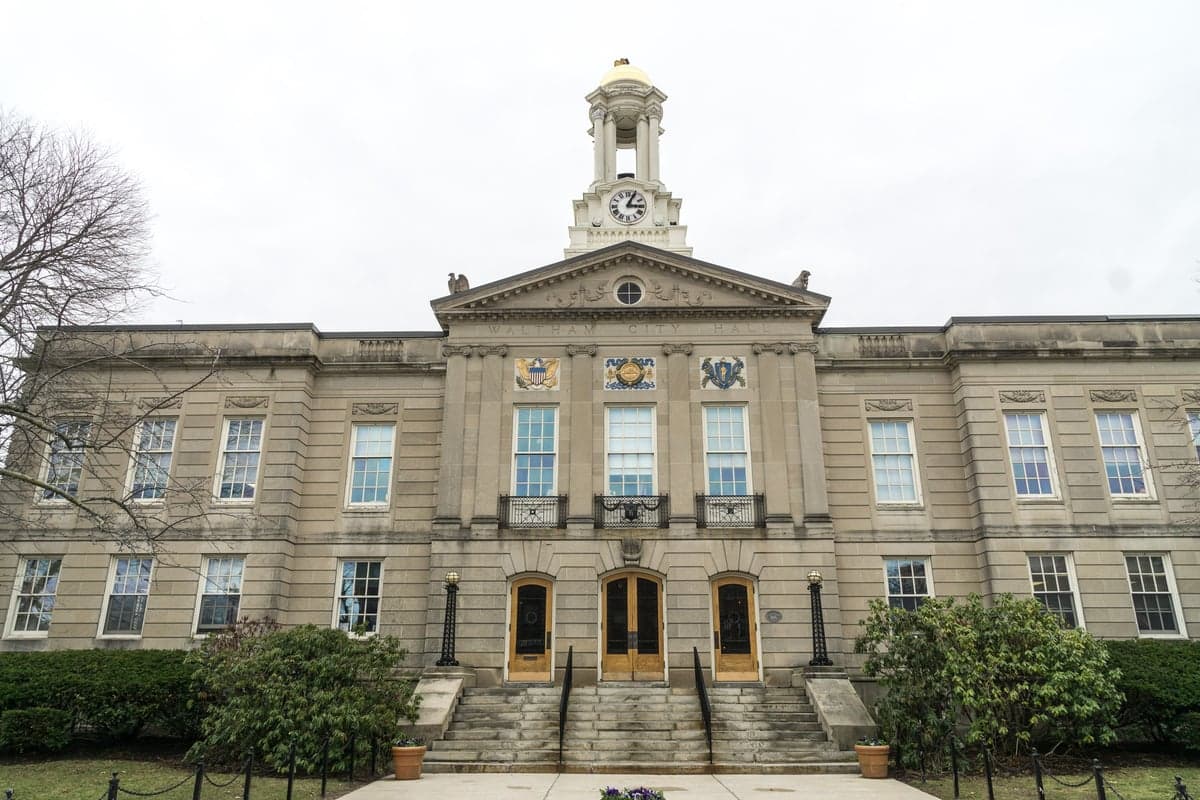
Photo: Wikipedia
Demographics of Waltham, MA
Affluence Level in Waltham, MA
An upper-middle-class area. Household wealth, education levels, and homeownership run ahead of national benchmarks.
People of Waltham, MA
The people of Waltham, Massachusetts today form a dense, diverse, and highly educated population of 64,723. The city is a distinct blend of historic Yankee and Irish-Catholic roots, a long-standing Italian and Armenian presence, and a rapidly growing mix of Hispanic, East/Southeast Asian, and Indian-subcontinent communities. With 56.4% of adults holding a college degree and a foreign-born population of 14.5%, Waltham is neither a homogeneous suburb nor a gritty post-industrial city—it is a dynamic, mid-sized urban center where old ethnic neighborhoods coexist with new immigrant enclaves and a swelling professional class drawn by biotech and academia.
How the city was settled and grew
Waltham was settled in 1634 as part of the Massachusetts Bay Colony, but its population story truly begins with the Industrial Revolution. The city was incorporated in 1738 and remained a small farming village until the Boston Manufacturing Company built the first integrated textile mill on the Charles River in 1814, birthing the "Waltham System" of mass production. This drew a first wave of Yankee farm girls from rural New England, followed by Irish immigrants fleeing the Great Famine in the 1840s and 1850s. The Irish settled in the South Side neighborhoods near the mills, particularly along Moody and Main Streets, building St. Mary’s Church and establishing a political and labor presence that would dominate the city for a century. By the late 1800s, the Watch City (named for its watch factory, the Waltham Watch Company) attracted French-Canadians and Italian immigrants, who clustered in The Highlands around Lexington Street and in North Waltham near the watch factory. A smaller but significant wave of Armenian refugees arrived after the Armenian genocide (1915–1923), settling in the Lakeview and Warrendale sections, where St. Stephen’s Armenian Apostolic Church remains a cultural anchor. By 1950, Waltham was a classic industrial satellite of Boston—overwhelmingly white, working-class, and Catholic, with a dense, walkable street grid and strong neighborhood identities.
Modern era (post-1965)
The 1965 Hart-Cellar Immigration Act and the collapse of Waltham’s manufacturing base after the 1950s reshaped the city’s population. The Waltham Watch Company closed in 1957, and textile mills shuttered through the 1960s and 1970s, but the city reinvented itself as a hub for research and higher education—anchored by Brandeis University (founded 1948) and Bentley University (relocated to Waltham in 1968). This drew a new domestic wave of college-educated professionals into Banks Square and the South Side near Brandeis, replacing some of the departing working-class families. Simultaneously, post-1965 immigration brought East/Southeast Asian communities—primarily Chinese and Vietnamese—who settled in the North Side and Warrendale areas, opening restaurants and small businesses along Main Street. A smaller but growing Indian-subcontinent population (4.5% of the city) arrived from the 1990s onward, drawn by tech and biotech jobs at companies like Raytheon (now part of RTX) and Novartis, and concentrated in the Highlands and near Bentley. The Hispanic population (18.2%)—overwhelmingly Salvadoran, Guatemalan, and Puerto Rican—grew rapidly after 2000, settling in the South Side and Lakeview neighborhoods, where they now form a visible presence in local Catholic parishes and along Moody Street’s restaurant corridor. The Black population (7.1%) is a mix of African American families who arrived during the Great Migration and more recent Afro-Caribbean immigrants, living primarily in the South Side and North Waltham public housing developments. Today, Waltham is 58.1% white, but that white population is aging and shrinking, while the Hispanic and Asian shares are rising steadily.
The future
Waltham’s population is heading toward greater diversity and higher density, but not toward a single melting pot. The city is tribalizing into distinct enclaves rather than homogenizing: the South Side remains heavily Hispanic and working-class; the Highlands and Banks Square are increasingly professional and white/Asian; Warrendale and Lakeview retain their Armenian and Italian cores while absorbing new Hispanic and East Asian arrivals. The Indian-subcontinent community is small but growing, likely to expand as biotech firms along the Route 128 corridor continue hiring. The East/Southeast Asian population (8.3%) is plateauing as second-generation families move to suburbs like Lexington and Newton. The Hispanic population is the fastest-growing segment, projected to approach 25% by 2035, driven by both immigration and higher birth rates. The white population will continue to shrink as older residents age out and are not replaced by younger white families, who often choose nearby suburbs for schools. The next 10–20 years will see Waltham become a majority-minority city (likely by the early 2040s), with a bifurcated class structure: a highly educated, affluent professional class in the Highlands and Banks Square, and a working-class, immigrant-heavy population in the South Side and Lakeview.
For someone moving in now, Waltham offers a rare combination: walkable urban neighborhoods, strong transit access to Boston and Cambridge, and a genuinely multiethnic population that is still in flux. It is not a placid suburb—it is a city where old ethnic loyalties persist alongside new arrivals, and where the schools and housing market reflect the tensions of rapid demographic change. The bottom line: Waltham is becoming a denser, more diverse, and more stratified city, ideal for those who value urban energy and diversity over homogeneity, but challenging for those seeking stable, uniform neighborhoods.

* Values derived from national, state, county, city and local statistics and may differ in a specific area. Last updated: 2026-04-19T08:50:44.000Z
Narrative content on this page is AI-generated and may contain mistakes. Verify any details that matter before acting on them.
ReloMaps may earn a commission from affiliate links at no extra cost to you.

