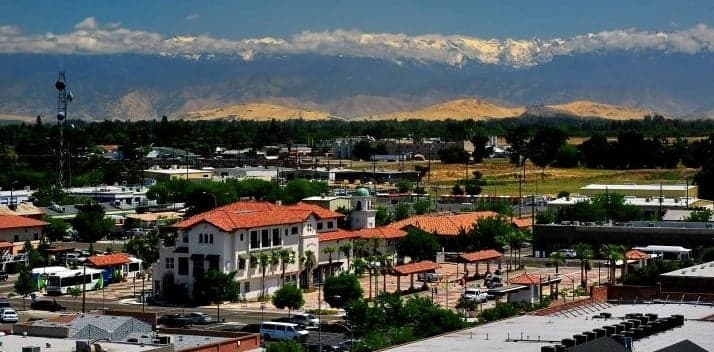
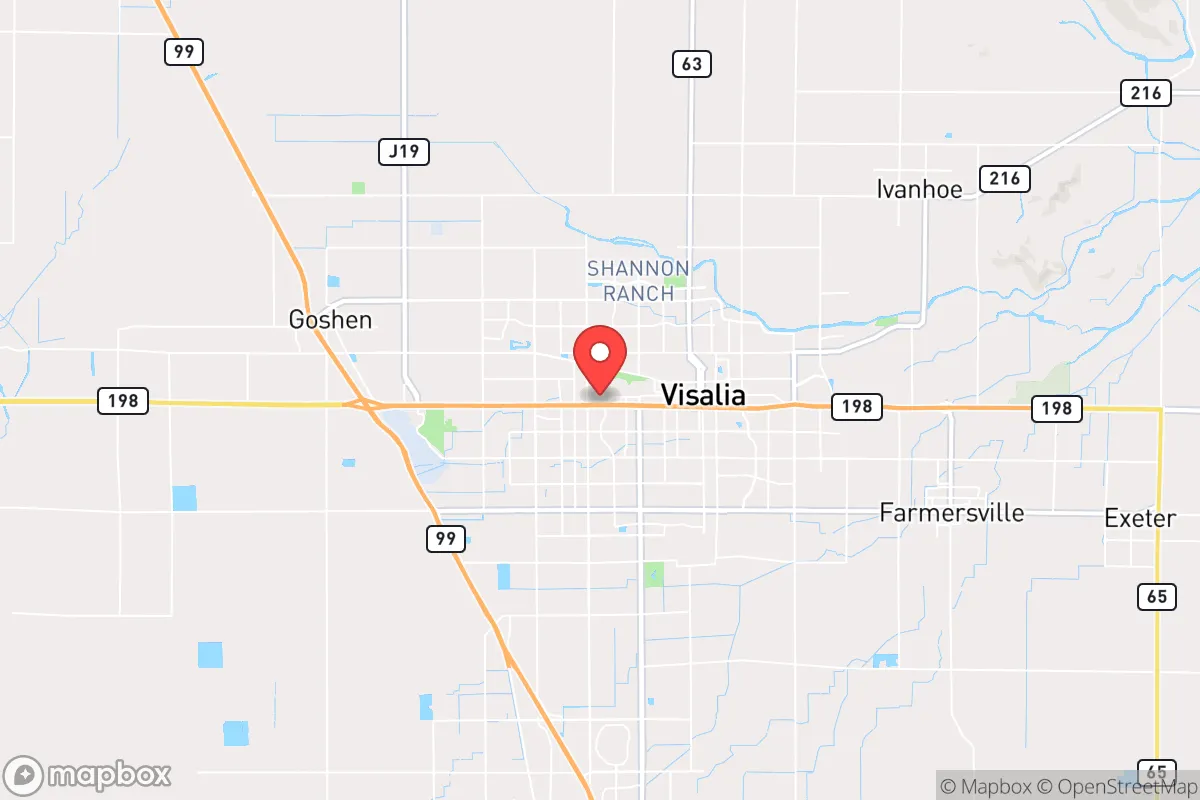
Photo: Wikipedia
Demographics of Visalia, CA
Affluence Level in Visalia, CA
A middle-class area roughly in line with national averages across income, home values, education, and employment.
People of Visalia, CA
The people of Visalia, California today form a predominantly Hispanic (51.7%) and White (36.3%) community of 142,649 residents, creating a bicultural identity that blends Central Valley agricultural roots with suburban growth. The city is notably less diverse in its Asian and Black populations than California as a whole, with East and Southeast Asian residents making up 5.8% and Black residents 2.3%, while the foreign-born share sits at a modest 7.8%. Visalia’s character remains grounded in family-oriented, church-going values, with a lower college attainment rate (22.9%) than the state average, reflecting its working-class heritage and agricultural economy. For those considering a move, Visalia offers a slower-paced, conservative-leaning environment where community ties run deep and newcomers are often drawn by affordable housing and proximity to Sequoia National Park.
How the city was settled and grew
Visalia was founded in 1852 as a trading post for miners heading to the Sierra Nevada goldfields, making it one of the oldest inland settlements in California. The original population was overwhelmingly Anglo-American, drawn by the promise of land under the 1851 Land Act and later by the expansion of irrigated agriculture. By the 1870s, the arrival of the Southern Pacific Railroad solidified Visalia as a regional agricultural hub, attracting a wave of European immigrants—primarily Portuguese, Italian, and Basque families—who settled in what is now the Historic Downtown district and the surrounding West Visalia neighborhoods. These groups built the city’s early packing houses, churches, and commercial blocks, many of which still stand along Main Street. A smaller but notable Chinese community formed during this period, concentrated along the railroad corridor near Goshen Avenue, though discriminatory laws and economic pressures later dispersed it.
The early 20th century brought a second wave: Dust Bowl migrants from Oklahoma, Arkansas, and Texas, who arrived during the 1930s and 1940s seeking farm work. These families, often called “Okies,” settled in the North Visalia area and along Mooney Boulevard, establishing a distinctly Southern-influenced culture that persists in local speech patterns and food traditions. By 1950, Visalia’s population had reached roughly 11,000, remaining overwhelmingly White and native-born.
Modern era (post-1965)
The post-1965 era transformed Visalia’s demographic makeup dramatically. The 1965 Immigration and Nationality Act opened the door for large-scale immigration from Latin America, and by the 1970s, Mexican and Central American families began arriving in force to work in the region’s citrus, grape, and dairy operations. These newcomers concentrated in South Visalia and the Plaza Park neighborhood, areas that today have the highest Hispanic density in the city. The Hispanic share of Visalia’s population rose from under 15% in 1970 to over 50% by 2020, driven by both immigration and higher birth rates.
Domestic in-migration also shifted. From the 1980s onward, White families from coastal California—particularly Los Angeles and the Bay Area—began moving to Visalia for lower housing costs and a more conservative lifestyle. They settled primarily in newer subdivisions in Northwest Visalia (near the Visalia Municipal Airport) and the Green Acres area, creating a socio-economic divide: the northwest is newer, more affluent, and Whiter, while the south and east remain older, more Hispanic, and working-class. The East and Southeast Asian population (5.8%) is small but visible, with Filipino and Vietnamese families concentrated near Demaree Street and the College of the Sequoias campus. The Indian-subcontinent population (0.5%) remains negligible, mostly professionals in healthcare and tech.
The future
Visalia’s population is projected to continue growing, reaching roughly 170,000 by 2040, driven by natural increase among Hispanic families and continued domestic in-migration from expensive coastal metros. The city is becoming more Hispanic over time, not less: the White share has declined from 45% in 2010 to 36.3% in 2024, while the Hispanic share has risen from 48% to 51.7%. The Asian and Black shares are expected to remain small, as Visalia lacks the high-skilled job base that attracts those groups to larger California cities. New housing developments are pushing outward into the northeast and southeast fringe areas, where master-planned communities are attracting a mix of young families and retirees, but these remain predominantly White and Hispanic.
Culturally, Visalia is evolving from a quiet farm town into a regional retail and medical hub, but its identity remains rooted in agriculture and conservative values. The city’s political leanings—Tulare County voted +16 Republican in 2024—are unlikely to shift dramatically, as the growing Hispanic population here tends to vote more conservatively than Hispanic voters in coastal California.
For someone moving in now, Visalia offers a stable, family-oriented community where the cost of living is roughly 30% below the California average, but where cultural diversity is limited primarily to the White-Hispanic dynamic. Newcomers will find a city that is growing but not gentrifying rapidly, where the old agricultural rhythms still set the pace, and where the biggest change ahead is the gradual deepening of its Hispanic character—a shift that is reshaping neighborhoods, schools, and local politics in real time.

* Values derived from national, state, county, city and local statistics and may differ in a specific area. Last updated: 2026-09-28T16:15:20.000Z
Narrative content on this page is AI-generated and may contain mistakes. Verify any details that matter before acting on them.
ReloMaps may earn a commission from affiliate links at no extra cost to you.

