Strategic Assessment of Galax City County
Workable tactical position. Some exposure to population density or targets, but generally defensible in a crisis.
What does the Strategic Assessment tell us?
Our Strategic Assessment grades tactical survivability of an area. Major population centers, military targets, fallout zones, natural disasters, and border exposure all drive risk — lower exposure means a more defensible position in a crisis.
This is heavily inspired by Joel Skousen's Strategic Relocation book. Highly recommended you checkout the book ($)What does this tell us?
Our Strategic Assessment grades tactical survivability of an area. Major population centers, military targets, fallout zones, natural disasters, and border exposure all drive risk — lower exposure means a more defensible position in a crisis.
This is heavily inspired by Joel Skousen's Strategic Relocation book. Highly recommended you checkout the book ($)Strategic Pillars
Key Distances
Strategic Assessment Analysis
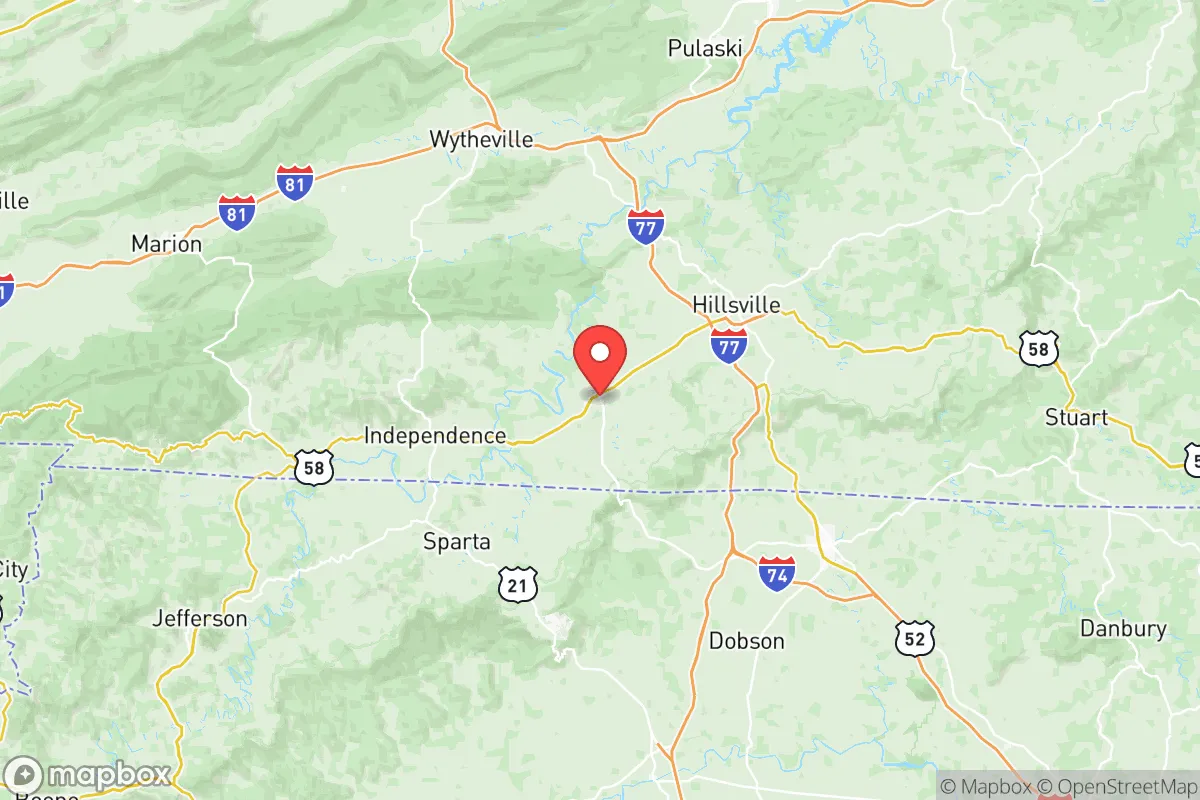
Galax City County, Virginia, presents a compelling case for relocation-minded individuals and families who prioritize resilience and self-sufficiency, though its strategic value is nuanced. As an independent city carved out of Carroll and Grayson counties in the Blue Ridge Highlands, Galax offers a blend of geographic isolation and practical defensibility that is rare east of the Mississippi. Its location along the New River Valley and near the Blue Ridge Parkway provides natural barriers and resource access, but its proximity to critical infrastructure and population corridors demands a clear-eyed assessment of both advantages and exposures.
Geographic position and natural advantages for long-term security
Galax sits at roughly 2,500 feet elevation in the Blue Ridge Mountains, a position that confers several strategic benefits. The surrounding terrain—steep ridges, dense hardwood forests, and the New River watershed—creates natural chokepoints and limits approach vectors, making the area inherently more defensible than flatter, more accessible regions. The city is roughly 90 miles southwest of Roanoke and 120 miles north of Charlotte, North Carolina, placing it outside the immediate blast or fallout zones of those metropolitan areas while still within a day's drive of supply routes. The New River, one of the oldest rivers in the world, flows through the county and provides a reliable freshwater source, supplemented by numerous smaller creeks and springs in the surrounding national forest lands. The Jefferson National Forest borders the area to the north and west, offering a vast buffer of undeveloped land that reduces the risk of suburban sprawl and provides potential foraging, timber, and game resources. For a relocator, the key advantage is distance from major population centers—Galax is not a suburb of anything, which means it avoids the cascading failure risks of a dense urban grid.
Risks, exposures, and proximity to fallout-relevant landmarks
While Galax’s isolation is a strength, it is not immune to man-made and natural risks. The area lies within the New River Valley, which has a history of seismic activity, though major earthquakes are rare. More immediate are the risks tied to regional infrastructure. The Surry Nuclear Power Plant is roughly 200 miles east, placing Galax outside the 50-mile emergency planning zone for that facility, but prevailing winds from the west mean any major release from a western facility—such as the Watts Bar Nuclear Plant in Tennessee, about 180 miles southwest—could theoretically carry fallout into the region. More concerning is the Blue Ridge Parkway and Interstate 77, which run near the city; these are evacuation and supply corridors that could become chokepoints or targets during a crisis. The Mountain Valley Pipeline, which transports natural gas through the region, presents a localized explosion and contamination risk, though its impact radius is limited. For a relocator, the most significant exposure is proximity to the I-81 corridor, a major trucking and logistics artery that runs about 30 miles east. A disruption there—whether from natural disaster, cyberattack, or civil unrest—could strain local supply chains. However, Galax’s position in a mountain valley means it is less likely to be a primary target for any strategic strike, and its low population density (roughly 6,800 residents) reduces the likelihood of being a secondary fallout zone.
Practical resilience for a relocator: food, water, energy, and defensibility
For a family or individual serious about self-sufficiency, Galax offers a strong baseline. Water is abundant: the New River and its tributaries provide year-round flow, and the area’s average annual rainfall of 45 inches supports rain catchment systems. The local water table is high enough that shallow wells are viable in many parts of the county. Food production is feasible, with a growing season of roughly 150 days and fertile valley soils suitable for gardens, orchards, and small livestock. The surrounding national forest offers hunting for deer, turkey, and small game, though competition from other preppers and locals could increase in a crisis. Energy resilience is mixed: the grid is served by Appalachian Power, which has a history of outages during winter storms, but the mountainous terrain makes solar microgrids viable, and wood heating is common. The city’s small size means defensibility is practical—a single-family home on a ridge with a long driveway and clear sightlines is achievable for under $250,000, and the local sheriff’s office is responsive but not overstretched. The biggest practical challenge is medical access: the nearest hospital with a trauma center is in Wytheville, about 25 miles north, and specialized care requires a 90-minute drive to Roanoke. For a relocator, stockpiling medications and basic medical supplies is non-negotiable. The local economy is anchored by furniture manufacturing and retail, meaning that in a prolonged crisis, barter networks could form around tools, lumber, and food rather than cash.
The overall strategic picture for Galax City County is one of moderate resilience with clear trade-offs. It offers genuine geographic advantages—elevation, water access, forest buffer, and distance from major targets—that make it a viable option for those prioritizing long-term security over convenience. The risks are real but manageable: pipeline infrastructure, a nearby interstate corridor, and limited medical access require planning, but they do not negate the area’s fundamental defensibility. For a conservative-leaning relocator who values self-reliance and community cohesion, Galax represents a solid B+ option—not a fortress, but a place where a prepared family can thrive without the constant pressure of urban collapse. The key is to arrive with skills, supplies, and a willingness to integrate into a community that already values independence. If you are looking for a location that balances isolation with access to the broader Appalachian region, Galax deserves a serious look.

* Values derived from national, state, county, city and local statistics and may differ in a specific area. Last updated: 2026-11-09T02:34:06.000Z
Narrative content on this page is AI-generated and may contain mistakes. Verify any details that matter before acting on them.
ReloMaps may earn a commission from affiliate links at no extra cost to you.

