Political ClimatePolitical Climate in Danville City County
Showing district-level results — no local-only data available.
Local Political AnalysisPolitical Analysis of Danville City County
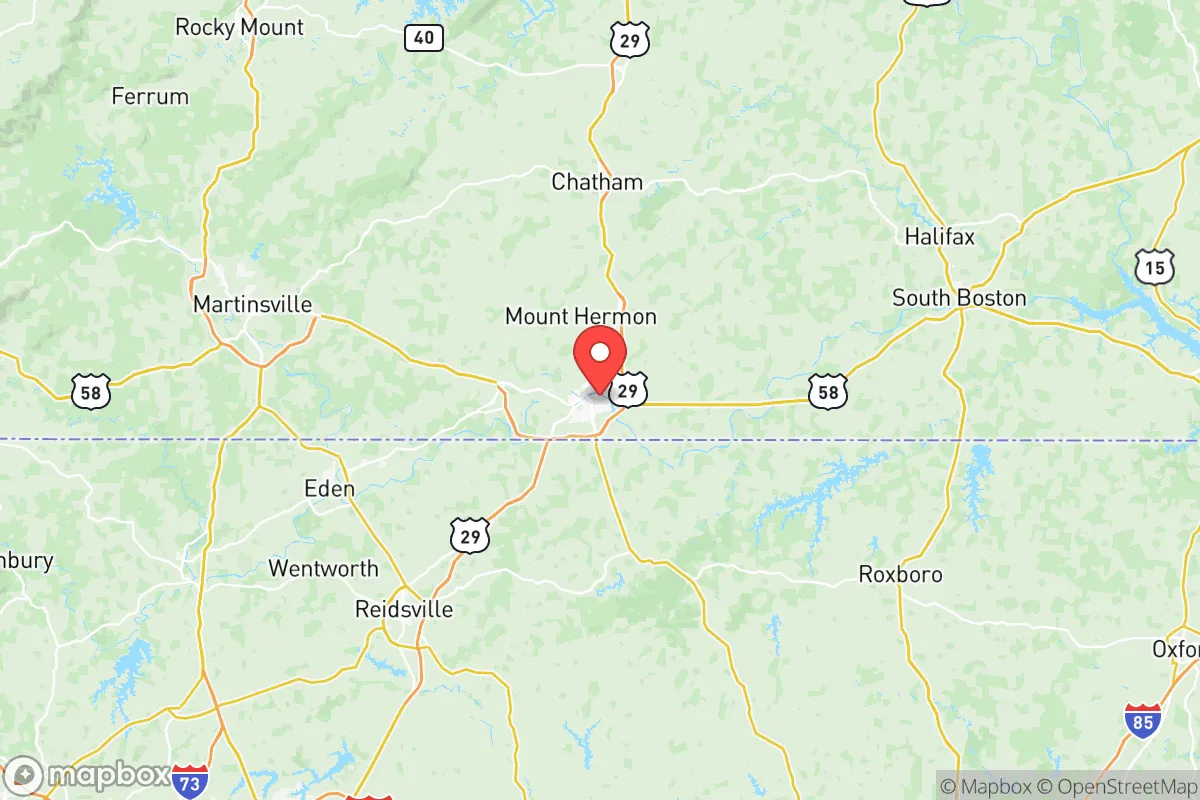
Danville City County leans solidly Republican, with a Cook PVI of R+6, meaning it votes about six points more conservative than the national average. This stands in stark contrast to the state of Virginia as a whole, which has a Cook PVI of D+4, reflecting a Democratic lean. The city itself has been trending more competitive in recent cycles, though, with the rural outskirts and southern precincts near the North Carolina border remaining deeply red, while the downtown core and areas around Averett University show more blue influence. The 2024 presidential race saw Danville vote for Trump by a margin of roughly 12 points, a narrower gap than in 2020, signaling a slow but real shift.
How it compares
Danville’s R+6 rating places it far to the right of Virginia’s D+4 statewide average, a gap of 10 points. This is typical of many small industrial cities in the South that have lost manufacturing jobs and feel culturally distant from the booming, diverse suburbs of Northern Virginia. Within Danville City County, the political geography is clear: precincts in the western neighborhoods like Westover and Forest Hills lean heavily Republican, often delivering 65% or more of the vote for GOP candidates. Meanwhile, the Downtown and North Danville precincts, particularly around the River District and the Danville Community College area, are more competitive, sometimes splitting 50-50 or even tipping slightly Democratic in local races. The swing precincts are in the central part of the city, like Piney Forest and Mount Hermon, where suburban growth and new residents from outside the region are slowly diluting the old conservative base. Compared to the state, Danville is a Republican stronghold in a purple-to-blue state, but it’s not as deep red as neighboring Pittsylvania County (R+18) or as blue as Charlottesville (D+15).
What this means for residents
For conservative residents, Danville’s lean means local government—city council and school board—tends to be center-right, with a focus on fiscal conservatism, limited regulation, and support for traditional values. You’ll find strong representation in the state legislature from Republicans, and the city’s congressional district (VA-05) is reliably red. For liberal residents, it means being in the minority, but not an isolated one—there’s an active Democratic committee, and the city’s growing arts scene and revitalized River District attract younger, more progressive folks. The practical reality is that political debates here are less about national culture wars and more about local issues: economic development (attracting new employers to replace lost tobacco and textile jobs), school funding, and infrastructure like the widening of Route 58. Both sides generally agree on wanting to improve the city’s tax base and quality of life, but they differ on how fast to change zoning laws or how much to spend on public services.
Culturally, Danville feels more like a Southern small town than a Virginia suburb. The city has a strong sense of history—both the Civil War and the Civil Rights Movement left deep marks—and there’s a palpable pride in the recent downtown revival. Policy-wise, Danville is more permissive on gun rights and more cautious on social spending than the state average, but it’s not a hotbed of partisan conflict. The real distinction is economic: Danville’s poverty rate (around 20%) and median household income ($38,000) are far lower than Virginia’s averages, so political conversations here are grounded in survival and opportunity, not ideology. If you’re moving here, expect a place where your vote matters locally but where the national political noise is often secondary to the daily grind of making a living.

State Political ClimatePolitical Climate in Virginia
State Political AnalysisPolitical Environment in the State
Virginia has shifted from a reliably red state to a solidly blue one over the past two decades, with a Cook PVI of D+4 that reflects a Democratic lean in statewide elections, though the state remains deeply divided between a rapidly growing, diverse urban crescent and a conservative rural expanse. The transformation is dramatic: as recently as 2008, Virginia voted for Barack Obama after a 44-year Republican streak in presidential elections, and it has not looked back since, with Democrats now controlling the governorship, both U.S. Senate seats, and both chambers of the General Assembly for the first time in a generation. For a conservative-leaning relocator, this means you’ll find a state where your vote carries weight in local races but where statewide policy increasingly reflects a progressive agenda, especially in the populous northern and eastern regions.
Urban vs. rural divide
The political map of Virginia is essentially a tale of two commonwealths. The urban crescent—anchored by Northern Virginia (Arlington, Alexandria, Fairfax County), Richmond, and the Hampton Roads area (Norfolk, Virginia Beach)—drives the Democratic majority. Northern Virginia alone accounts for over a third of the state’s population, and its voters are heavily influenced by federal government employment, tech industries, and a highly educated, diverse populace. In 2024, Fairfax County gave Kamala Harris a 35-point margin, while rural counties like Lee County in the far southwest and Patrick County on the North Carolina border delivered 70-80% for Donald Trump. The divide is stark: Loudoun County, once a Republican stronghold, flipped blue in the 2010s and now votes D+20, while Montgomery County (rural southwest) remains deeply red. The Richmond metro area is a microcosm—the city itself is heavily Democratic, but surrounding suburbs like Chesterfield County have trended purple, with some precincts still reliably Republican. For a conservative, living in Virginia Beach or Chesapeake offers a more balanced political environment than Northern Virginia, while the Shenandoah Valley (e.g., Harrisonburg) and Southside (e.g., Danville) remain conservative strongholds.
Policy environment
Virginia’s policy landscape is a patchwork that reflects its divided nature. The state has a flat income tax rate of 5.75% and a sales tax of 5.3% (higher in Northern Virginia and Hampton Roads for transportation), which is moderate by national standards. Property taxes are set locally and vary widely—Loudoun County has rates around $1.20 per $100 of assessed value, while rural Grayson County is under $0.50. The state’s regulatory posture leans progressive: it has adopted California-style vehicle emissions standards, and in 2020, Democrats passed the Virginia Clean Economy Act, mandating a carbon-free grid by 2050. Education policy is a flashpoint: the state has seen a push for LGBTQ-inclusive curricula and critical race theory in schools, which has galvanized conservative parents, particularly in Loudoun County and Spotsylvania County. Healthcare is mixed—Virginia expanded Medicaid under the Affordable Care Act in 2018, but the state also has a strong right-to-work law and is a “shall-issue” state for concealed carry (no permit required since 2021 for open carry, but a permit is still needed for concealed). Election laws have tightened: Virginia now requires photo ID to vote (though a signed statement can substitute), and early voting is available 45 days before elections.
Recent policy direction
Over the past five years, Virginia has moved decisively left on several fronts, but with notable exceptions that matter to conservatives. In 2020, Democrats passed a sweeping gun control package that included universal background checks, a “red flag” law (extreme risk protective orders), and a one-handgun-per-month limit. This was a direct response to the 2019 Virginia Beach mass shooting and sparked massive backlash, with over 100 counties declaring themselves “Second Amendment sanctuaries.” On education, the 2020 Virginia Literacy Act and the 2021 LGBTQ Student Rights law (requiring schools to adopt policies supporting transgender students) have been deeply controversial. In 2023, Governor Glenn Youngkin, a Republican, signed a parental rights bill requiring schools to notify parents of any changes to a student’s health or well-being, including gender identity. On abortion, Virginia remains a relative outlier in the South: abortion is legal up to 26 weeks (the second trimester), with no waiting period, though a 2024 bill to enshrine it in the state constitution failed. Property rights are strong—Virginia is a “Dillon Rule” state, meaning local governments have only powers explicitly granted by the state, which limits local zoning experiments. On voting, the state has no-excuse absentee voting and same-day voter registration (during early voting), but also maintains a voter ID law that conservatives generally support. The net effect: a relocator will find a state that has moved left on guns and social issues but remains moderate on taxes and property rights.
Civil unrest & political movements
Virginia has been a national flashpoint for political movements. The 2017 Unite the Right rally in Charlottesville remains a defining moment, leading to a statewide ban on firearms at public demonstrations and a push to remove Confederate monuments. In 2020, the Black Lives Matter protests in Richmond were among the largest in the country, with the Robert E. Lee statue becoming a focal point until its removal in 2021. On the right, the Second Amendment sanctuary movement in 2019-2020 saw over 100 counties pass resolutions vowing not to enforce new gun laws, and the Loudoun County school board meetings in 2021 became a national symbol of parental rights activism. Immigration politics are relatively quiet compared to border states—Virginia has no sanctuary city laws, but Fairfax County and Arlington have policies limiting cooperation with ICE. Election integrity controversies have been muted, though the 2020 election saw Trump’s campaign challenge Virginia’s results (he lost by 10 points). A new resident will notice the Confederate monument debates still simmering in smaller towns like Danville and Fredericksburg, and the occasional protest at the state capitol in Richmond.
Projection
Over the next 5-10 years, Virginia’s political trajectory points toward continued Democratic dominance at the statewide level, driven by population growth in Northern Virginia and the Richmond suburbs. The 2020 census gave Virginia an additional congressional seat, and the state’s population is projected to grow by another 5-7% by 2030, almost entirely in the urban crescent. This means the rural conservative vote will continue to be diluted, though the state’s gerrymandering ban (passed in 2020 via a constitutional amendment) has created more competitive districts—witness the 2022 midterms, where Republicans flipped three U.S. House seats. The wildcard is the 2025 gubernatorial election: if a Republican wins, it could slow the leftward trend, but the underlying demographics favor Democrats. For a conservative moving in, expect to see more gun control (magazine capacity limits are likely), continued expansion of LGBTQ rights in schools, and higher taxes for transportation and education in Northern Virginia. The rural-urban divide will likely widen, with Southwest Virginia and the Eastern Shore becoming more politically isolated.
For a new resident, the bottom line is that Virginia offers a high quality of life with moderate taxes and strong property rights, but the political climate is increasingly progressive on social issues and gun rights. If you’re a conservative, you’ll find your values reflected in the rural and exurban counties, but you’ll need to engage locally—school board and county supervisor races are where the real battles are fought. If you’re a liberal, you’ll feel at home in the cities and inner suburbs, but be prepared for a state that still has a strong conservative rural base. Either way, Virginia is a state where your vote matters, and where the political landscape is shifting under your feet.
* Values derived from national, state, county, city and local statistics and may differ in a specific area. Last updated: 2026-08-14T04:05:07.000Z
Narrative content on this page is AI-generated and may contain mistakes. Verify any details that matter before acting on them.
ReloMaps may earn a commission from affiliate links at no extra cost to you.

