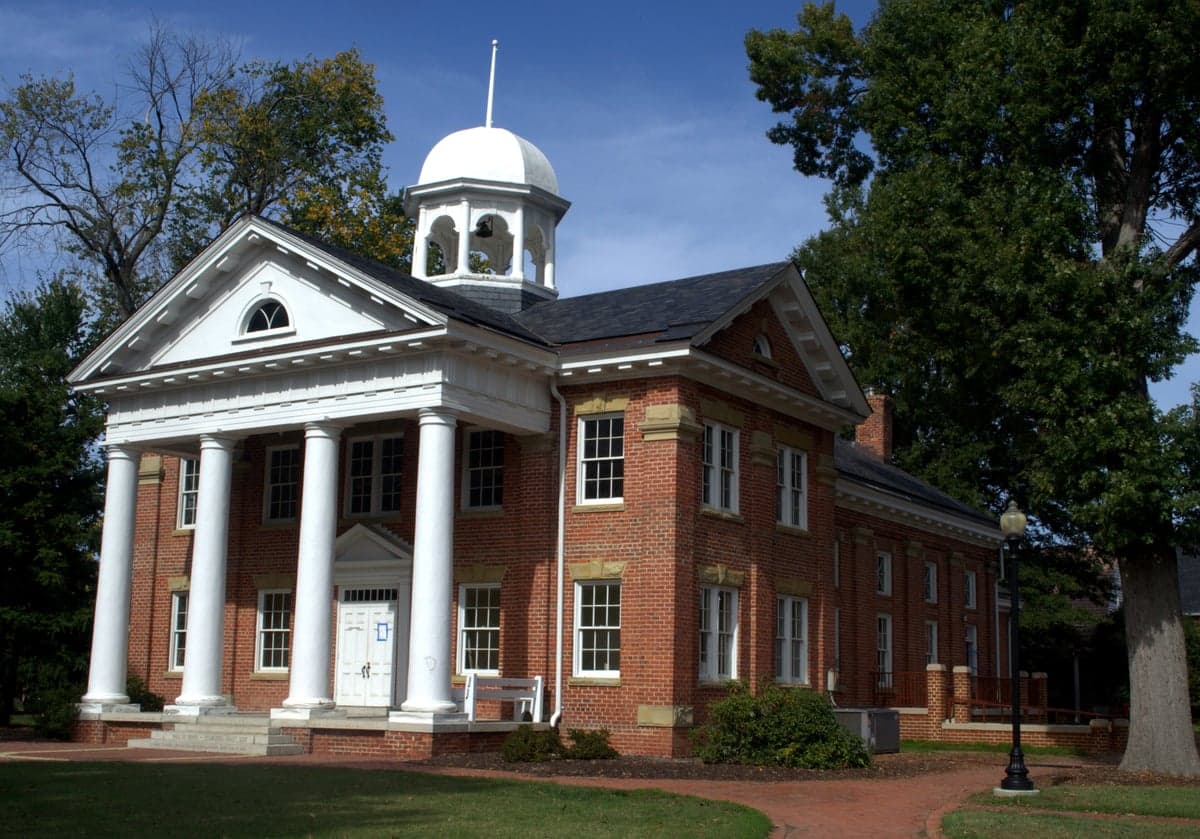
Photo: Wikipedia
Political ClimatePolitical Climate in Chesterfield County
Showing state-level results — no local-only data available.
Local Political AnalysisPolitical Analysis of Chesterfield County
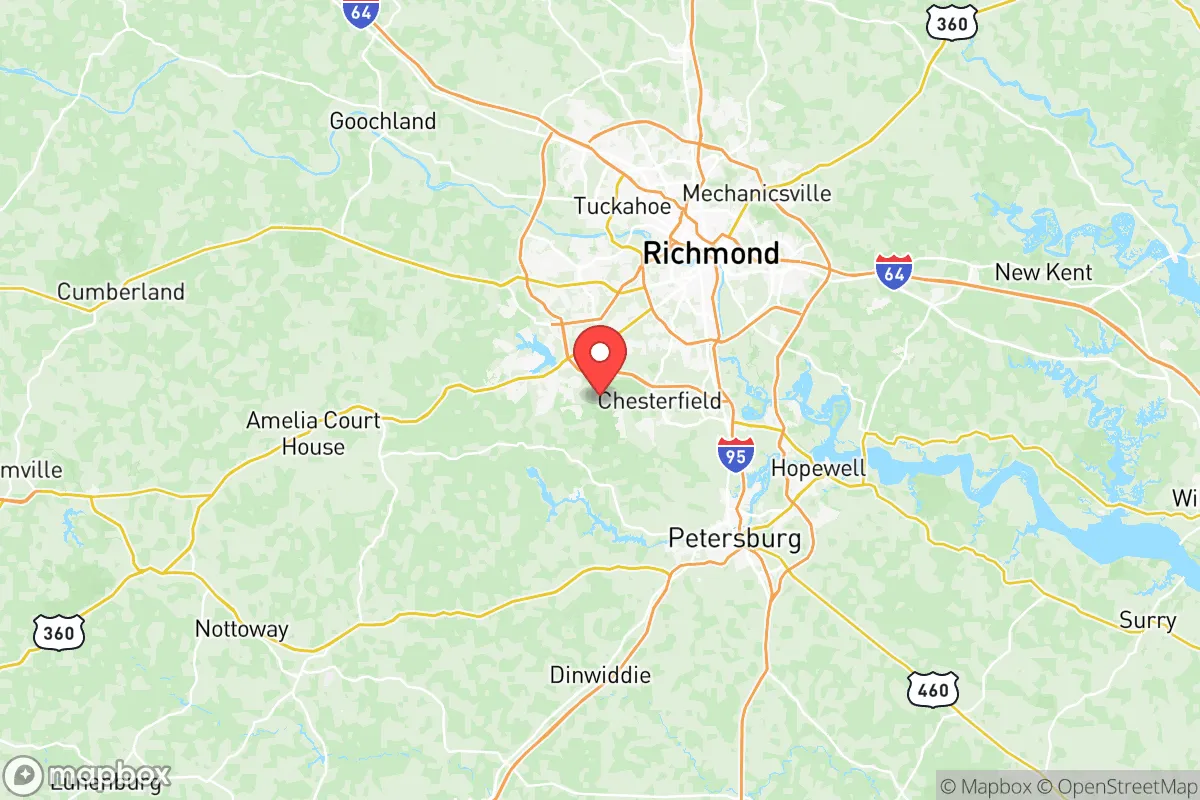
Chesterfield County has shifted dramatically over the past decade, moving from a reliably red suburban stronghold to a solidly Democratic-leaning county with a Cook PVI of D+17. That’s a far cry from where it was even ten years ago, when the county was reliably Republican in statewide races. The shift mirrors the broader transformation of Virginia’s suburbs, but Chesterfield’s move is more pronounced than the state’s overall D+4 PVI, making it one of the most Democratic-leaning counties in Central Virginia outside of Richmond city proper.
How it compares
Chesterfield County’s D+17 PVI is a full 13 points more Democratic than Virginia’s statewide D+4 PVI. That’s a massive gap for a suburban county that was once a GOP stronghold. The change is driven almost entirely by the explosive growth of the county’s western and central sections, particularly around Midlothian and Huguenot. These areas, filled with new subdivisions and young families, now vote heavily Democratic. Meanwhile, the more rural southern and eastern parts of the county—places like Matoaca, Ettrick, and Chester—still lean red, but their populations are smaller and growing slower. The swing precincts are in the Brandermill and Woodlake communities, where educated professionals and transplants from Northern Virginia have tipped the balance. In 2024, Chesterfield voted for the Democratic presidential candidate by about 12 points, while Virginia overall was decided by roughly 5 points.
What this means for residents
For conservative residents, the political shift means their influence in local elections has waned significantly. School board and county supervisor races that were once safely Republican are now competitive or Democratic-held. The county’s board of supervisors, which was all-Republican as recently as 2019, now has a Democratic majority. For liberal residents, the change means their votes actually matter—Chesterfield is no longer a place where Democrats feel like they’re shouting into the wind. But the county isn’t a monolith: the southern end, around Matoaca and Ettrick, still sends conservative representatives to the state legislature, and local debates over land use, schools, and taxes still split along geographic lines. The practical effect is that both sides have to work harder to build coalitions, especially on nonpartisan issues like school funding and transportation.
Culturally, Chesterfield remains more moderate than Richmond city or Henrico County. You still see more pickup trucks with American flags than with political bumper stickers, and the county’s large evangelical Christian population keeps social conservatism alive in local churches and civic groups. But the county’s rapid growth—population topped 380,000 in 2025—has brought a wave of newcomers who are less tied to traditional Virginia politics. The result is a place where a Republican can still win a countywide race if they run as a moderate, but where a hardline conservative platform is a nonstarter. For anyone moving here, the key takeaway is that Chesterfield is no longer the reliably red suburb it was in the 2000s—it’s a purple county trending blue, with all the political friction and opportunity that entails.

State Political ClimatePolitical Climate in Virginia
State Political AnalysisPolitical Environment in the State
Virginia has shifted from a reliably purple swing state to a solidly Democratic-leaning one, carrying a Cook PVI of D+4. The state hasn't voted for a Republican presidential candidate since 2004, and Democrats now control the governorship, the state Senate, and the House of Delegates. That said, this is not a deep-blue monolith — it’s a state where the urban crescent from Northern Virginia down through Richmond to Hampton Roads overwhelms a deeply conservative rural and exurban interior, creating a political landscape that feels like two different states under one capitol dome.
Urban vs. rural divide
The political map of Virginia is a story of two Virginias. The Democratic stronghold is the "urban crescent" — Arlington, Alexandria, and Fairfax County in Northern Virginia, plus Richmond and Norfolk/Virginia Beach. These areas are dense, diverse, and heavily influenced by federal government employment, tech, and defense contracting. They vote 65-75% Democratic and supply the votes that flip the statewide totals. In contrast, rural and exurban Virginia — places like Lynchburg, Roanoke, Harrisonburg, and the Southside counties along the North Carolina border — vote 60-70% Republican. The divide is stark: in 2024, Fairfax County gave Kamala Harris 70% of the vote, while Lee County in the far southwest gave Donald Trump 82%. The suburbs of Richmond (like Chesterfield and Henrico) have been trending blue, while exurbs like Spotsylvania and Stafford remain competitive but lean red. The result is a state where statewide races are decided by the urban crescent, but local governance in most of the landmass remains deeply conservative.
Policy environment
Virginia’s policy environment is a mixed bag that reflects its purple-to-blue trajectory. The state income tax is a flat 5.75%, and sales tax is 5.3% (higher in Northern Virginia and Hampton Roads for local transportation projects). Property taxes are set locally and vary widely — Loudoun County has rates around 1.1%, while Bristol is under 0.7%. Education policy is a flashpoint: the state has moved toward expanding public school funding and early childhood education under Governor Glenn Youngkin (R), but the legislature has blocked his push for a school voucher program. Healthcare is a bright spot for conservatives — Virginia expanded Medicaid under the ACA in 2018, but the state also has some of the strongest certificate-of-need laws in the country, which limit competition in healthcare and keep costs higher. Election laws are moderate: no-excuse absentee voting and early voting are allowed, but voter ID is required. The state has no "stand your ground" law, but it does have a "castle doctrine" and a permitless concealed carry law (passed in 2021, then partially rolled back in 2023).
Recent policy direction
The last few years have seen Virginia swing back and forth on key liberty issues. In 2020, Democrats passed a sweeping gun control package — universal background checks, a "red flag" law, and a one-handgun-per-month limit. In 2023, a Republican-controlled House and Governor Youngkin pushed back, restoring permitless concealed carry and blocking further restrictions. On education, Youngkin’s "Parents Matter" campaign led to new policies on transgender student accommodations and critical race theory bans in schools, though the legislature has blocked his broader agenda. On abortion, Virginia remains a relative outlier in the South — abortion is legal up to 26 weeks, and a 2023 bill to ban it at 15 weeks failed. On voting, the state has moved toward expanded access: automatic voter registration, same-day registration, and no-excuse absentee voting are all in place. On property rights, Virginia has a strong right-to-farm law and limited zoning preemption, but localities in Northern Virginia have aggressively pursued inclusionary zoning and rent control measures. On privacy and surveillance, the state has no comprehensive data privacy law, but it does have a ban on facial recognition in police body cameras. The net effect is a state that is moderately free on most dimensions, but with significant variation depending on which party holds the governor’s mansion and the legislature.
Civil unrest & political movements
Virginia has been a flashpoint for national political movements. The 2017 "Unite the Right" rally in Charlottesville put the state on the map for white nationalist organizing, and the subsequent removal of Confederate statues sparked years of local protests and counter-protests. In 2020, Richmond saw weeks of Black Lives Matter protests, including the toppling of a statue of Jefferson Davis in the capital. On the right, the "Parents Matter" movement has been particularly strong in Loudoun County, where school board meetings became national news over transgender policies and critical race theory. Immigration politics are less heated than in border states, but Fairfax County has a "sanctuary" policy that limits cooperation with ICE, which has drawn criticism from conservatives. Election integrity remains a live issue — the 2020 election in Virginia was widely seen as secure, but Republican activists have pushed for stricter voter roll maintenance and signature verification. The state has also seen a rise in "Second Amendment sanctuary" resolutions in rural counties, with over 100 localities passing symbolic resolutions against state gun laws. A new resident in Richmond or Arlington will see visible political activism on both sides, but in most of the state, daily life is politically quiet.
Projection
Over the next 5-10 years, Virginia’s Democratic lean is likely to solidify, but not without resistance. The key demographic driver is Northern Virginia — it’s growing faster than the rest of the state, and its population is younger, more diverse, and more educated. The 2020 census gave Virginia an additional House seat, and that growth is concentrated in the blue crescent. Rural Virginia is shrinking, and its political influence is waning. However, the state’s political geography means that Republicans can still win statewide if they run a moderate like Youngkin who can peel off suburban voters. The wild card is the 2025 gubernatorial election — if a Democrat wins, expect a push for more gun control, abortion protections, and progressive tax policy. If a Republican wins, expect more school choice, tax cuts, and deregulation. For a relocator, the bottom line is that Virginia will remain a competitive but left-tilting state for the foreseeable future, with the urban crescent driving policy and the rural areas fighting a rearguard action.
For a new resident, the practical takeaway is that Virginia offers a moderate-to-liberal policy environment in the urban areas and a conservative one in the countryside. If you’re a conservative moving to Arlington, you’ll be in a deep-blue bubble with high taxes and progressive local policies. If you’re a liberal moving to Lynchburg, you’ll find a conservative community with lower taxes and a slower pace. The state’s political climate is best understood as a patchwork — your experience will depend more on your specific city or county than on the state as a whole. The good news is that Virginia’s political divisions are real but not violent, and most people get along fine day-to-day regardless of their politics.
* Values derived from national, state, county, city and local statistics and may differ in a specific area. Last updated: 2026-08-24T06:56:48.000Z
Narrative content on this page is AI-generated and may contain mistakes. Verify any details that matter before acting on them.
ReloMaps may earn a commission from affiliate links at no extra cost to you.

