
Photo: Wikipedia
Political ClimatePolitical Climate in Union City, NJ
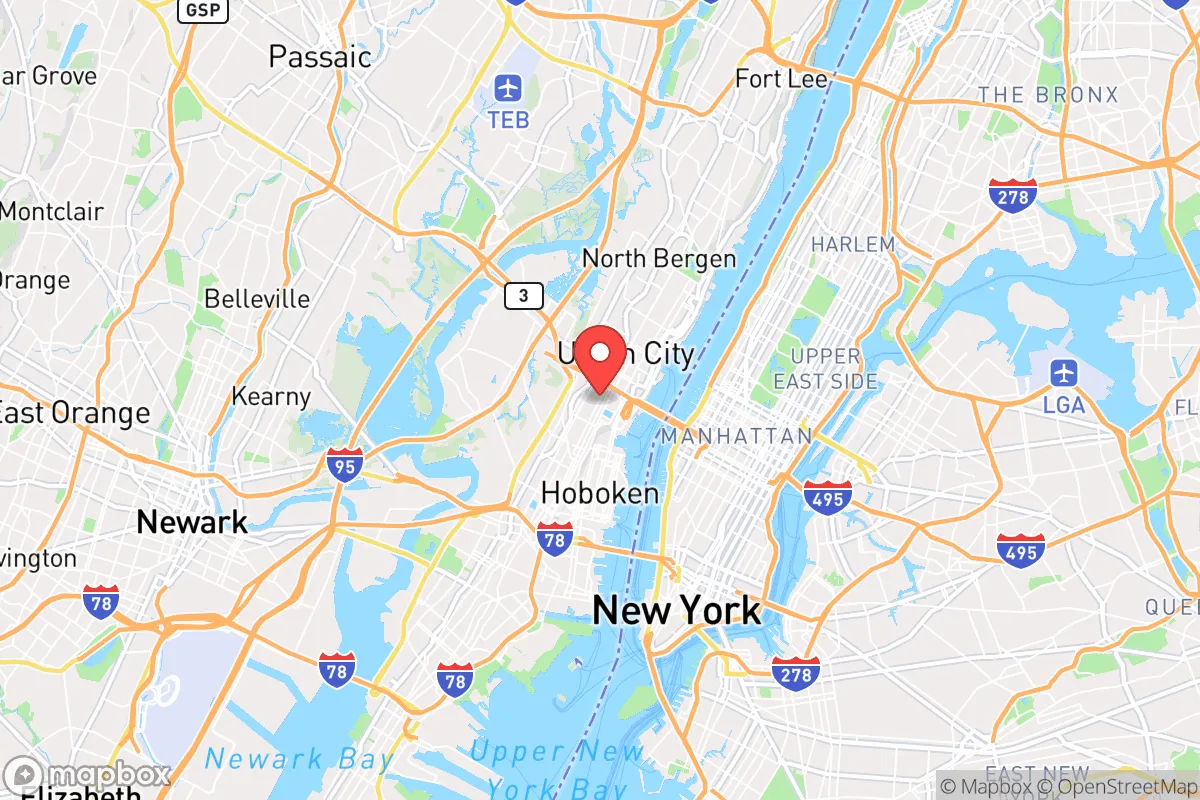
District shown is the primary district for this city’s centroid. Cities may span multiple districts.
Local Political AnalysisPolitical Analysis of Union City, NJ
Union City, New Jersey, has long been a Democratic stronghold, and that’s not changing anytime soon. With a Cook PVI of D+15, it’s one of the most reliably blue areas in the state—far more so than New Jersey as a whole, which sits at D+5. But if you’ve lived here as long as I have, you know that “Democratic” doesn’t always mean what it used to. The old-school, working-class, socially moderate Democrats who ran things for decades are being pushed out by a younger, more progressive crowd that’s less interested in balancing budgets and more interested in social experiments. That shift is something to keep an eye on, especially if you value personal freedoms and local control.
How it compares
Compared to the rest of New Jersey, Union City is a political outlier. The state as a whole leans Democratic, but it’s still a purple-ish place where Republicans can win in places like Morris or Ocean counties. Union City, though? It’s a deep blue island surrounded by similarly blue Hudson County towns like Jersey City and West New York. Drive 20 minutes west to Kearny or Harrison, and you’ll find a slightly more mixed political vibe—still blue, but with more room for dissent. In Union City, that dissent is almost nonexistent. The local machine, long tied to the late Mayor Brian Stack, has kept things tight. But Stack’s brand of politics was more about delivering services and keeping taxes in check than pushing a radical agenda. The worry now is that the next generation of leaders will be more ideological—more focused on things like defunding the police or imposing strict rent control that hurts small landlords. That’s a real concern for anyone who thinks government should stay out of your wallet and your life.
What this means for residents
For residents, the political climate here means you’re living under one-party rule, and that comes with trade-offs. On the plus side, the city is stable and services are decent—trash gets picked up, streets get plowed. But the downside is that there’s little accountability. If you disagree with the direction things are going, good luck finding a candidate who represents you. The local school board, for example, has become a battleground over curriculum and parental rights, and the progressive faction is winning. I’ve seen friends get shouted down at meetings for asking basic questions about what their kids are being taught. That’s not democracy—that’s a rubber stamp. And with the state government in Trenton also solidly blue, there’s no check on things like high property taxes, strict gun laws, or overreaching health mandates. If you value the right to make your own choices—whether it’s about your kids’ education, your business, or your healthcare—Union City’s political climate is something to watch closely.
One thing that sets Union City apart from the rest of New Jersey is its cultural vibe. It’s a dense, walkable, immigrant-heavy city where Spanish is heard as often as English. That’s part of its charm, but it also means the political conversation is heavily shaped by the local Cuban and Dominican communities, who tend to be more socially conservative on issues like family and religion than the national Democratic party. That tension—between old-school values and new-wave progressivism—is playing out in real time. For now, the machine holds, but the cracks are showing. If you’re considering a move here, just know that the political winds are shifting, and not necessarily in a direction that respects your personal freedoms. Keep your eyes on the local elections—that’s where the real fight is.

State Political ClimatePolitical Climate in New Jersey
State Political AnalysisPolitical Environment in the State
New Jersey is a solidly blue state with a Cook PVI of D+5, meaning it leans about five points more Democratic than the national average in presidential elections. The dominant coalition is a mix of urban progressives, suburban moderates, and powerful public-sector unions, with the GOP largely confined to rural and exurban pockets. Over the last 10-20 years, the state has shifted leftward, driven by demographic changes in the suburbs and the growing influence of New York City commuters, though the margin has tightened slightly in recent cycles as some working-class voters have drifted toward the GOP.
Urban vs. rural divide
The political map of New Jersey is a tale of two worlds. The northern and central urban corridor—Newark, Jersey City, Paterson, and Elizabeth—is overwhelmingly Democratic, powered by dense populations, strong union presence, and large minority communities. These cities reliably deliver 70-80% of the vote for Democrats. In contrast, the rural and exurban areas of Sussex County, Hunterdon County, and Ocean County are Republican strongholds, often voting 60-65% for the GOP. The real battleground is the suburbs: Bergen County, Middlesex County, and Monmouth County have trended blue over the past decade as college-educated professionals and commuters from New York City have moved in, flipping once-competitive seats to safe Democratic ones. A notable exception is Morris County, which remains a GOP-leaning suburban holdout, though even there, margins have shrunk.
Policy environment
New Jersey’s policy environment is defined by high taxes, heavy regulation, and a progressive social agenda. The state has the highest property taxes in the nation, averaging over $9,500 annually, and a progressive income tax that tops out at 10.75% for earners over $1 million. The regulatory posture is aggressive, with strict environmental rules, rent control in many municipalities, and a powerful state bureaucracy. Education policy is dominated by the teachers’ union, with per-pupil spending among the highest in the country, yet outcomes are mixed—urban districts like Camden and Newark struggle despite massive funding. Healthcare is heavily regulated, with a state-run insurance exchange and Medicaid expansion. Election laws lean blue: no-excuse mail-in voting, automatic voter registration, and same-day registration are all in place, making it easier to vote but also raising concerns about election integrity among conservatives. The state also has some of the strictest gun laws in the nation, including a carry permit system that was recently tightened further.
Trajectory & freedom
New Jersey is becoming less free by almost any measure, especially for conservatives. Recent legislation has expanded government control over personal choices. In 2022, the state passed a law requiring all public schools to teach "inclusive" sex education, including LGBTQ+ topics, with no opt-out for parents—a direct blow to parental rights. The same year, the governor signed a law banning "conversion therapy" for minors, which conservatives argue restricts religious counseling. On gun rights, the 2024 "Gun Safety Act" further restricted carry permits, requiring applicants to demonstrate "justifiable need" and banning firearms in sensitive places like libraries and parks. Property rights are under pressure from rent control expansions and a "just cause" eviction law that makes it harder for landlords to remove tenants. Medical autonomy took a hit with a 2023 law mandating COVID-19 vaccine reporting for healthcare workers, though the mandate was later softened. The state also passed a law in 2024 requiring all new buildings to be electric-only, effectively banning natural gas hookups—a move that limits consumer choice and raises energy costs. On the positive side for conservatives, the state has not enacted a wealth tax or capital gains surcharge, though such proposals are floated regularly.
Civil unrest & political movements
New Jersey has seen its share of political flashpoints. The Black Lives Matter protests in 2020 were large and sometimes violent in Newark and Trenton, leading to curfews and property damage. More recently, pro-Palestinian protests have erupted on college campuses like Rutgers University in New Brunswick, drawing attention to the state’s progressive activism. On the right, the New Jersey Firearms Coalition and Garden State Gun Rights have organized rallies at the statehouse, but they remain a minority voice. Immigration politics are a hot-button issue: New Jersey is a sanctuary state, with a 2018 executive order limiting cooperation with ICE, and several municipalities, including Newark and Jersey City, have declared themselves sanctuary cities. This has led to tensions with federal immigration enforcement and occasional protests from both sides. Election integrity remains a concern for conservatives, especially after the 2020 election saw widespread use of mail-in ballots without strict signature verification, though no major fraud was proven. The state’s independent redistricting commission has kept congressional maps relatively fair, but the overall tilt remains blue.
Projection
Over the next 5-10 years, New Jersey is likely to become more progressive, not less. Demographic trends favor the Democrats: the state’s population is aging, but younger, more diverse residents are moving into the suburbs, while older, more conservative residents are retiring to Florida or the Carolinas. In-migration from New York City continues to bring left-leaning voters to Hudson County and Bergen County. The GOP’s best hope is in the exurbs and rural areas, but these are shrinking in political influence. Policy-wise, expect more gun control, higher taxes, and further erosion of parental rights. A wealth tax or a millionaire’s surcharge is a real possibility in the next few years, especially if the state faces another budget shortfall. The only wildcard is a potential backlash against high taxes and overregulation, which could fuel a modest GOP resurgence in the suburbs, but that would require a national shift that isn’t currently visible.
For a conservative moving to New Jersey, the bottom line is this: you will be living in a state where your political views are in the minority, and where government policy will often conflict with your values. The high taxes and heavy regulation will hit your wallet, and the progressive social agenda will affect your children’s education and your personal freedoms. If you’re considering a move here, be prepared to fight for your rights at the local level—school board meetings, town council elections, and county GOP committees are where you can make a difference. But if you’re looking for a state that respects individual liberty and fiscal conservatism, New Jersey is not that place, and it’s only getting worse.
* Values derived from national, state, county, city and local statistics and may differ in a specific area. Last updated: 2026-05-28T08:07:56.000Z
Narrative content on this page is AI-generated and may contain mistakes. Verify any details that matter before acting on them.
ReloMaps may earn a commission from affiliate links at no extra cost to you.

