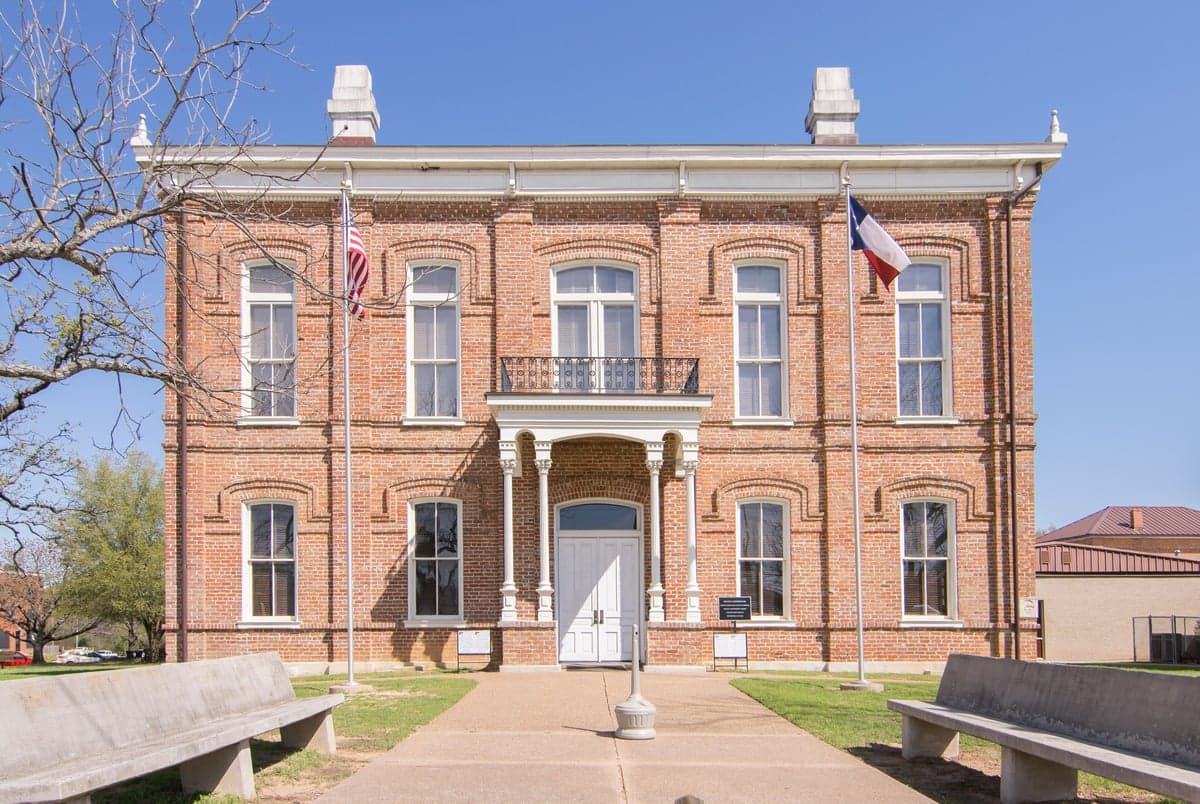
Photo: Wikipedia
Personal Sovereignty in Leon County
Strong independent fundamentals that actively favor personal liberty and low regulation.
What does Personal Sovereignty tell us?
Personal Sovereignty measures your capacity for self-reliance and independence with minimal government friction. Higher scores mean fewer barriers between you and the way you want to live... but it assumes you have the space you need and good neighbors.
What does this tell us?
Personal Sovereignty measures your capacity for self-reliance and independence with minimal government friction. Higher scores mean fewer barriers between you and the way you want to live... but it assumes you have the space you need and good neighbors.
State Policy
Energy independence: Net exporter (220% of energy produced in-state)
Personal Liberty
Homesteading

Personal Liberty Analysis
Leon County, Texas, offers a notably high degree of personal sovereignty, anchored in Texas’s broad preemption laws, low property tax rates relative to the state average, and a deeply ingrained culture of self-reliance. For residents of Centerville, Buffalo, and Jewett, this translates into a regulatory environment where local government interference in daily life is minimal, and individual autonomy—from firearm ownership to land use—is the default. The county’s rural character and conservative political leanings create a setting where personal freedom is not just tolerated but expected, making it a strong contender for relocation-minded individuals and families who prioritize independence over convenience.
Tax burden and regulatory posture: How Leon County compares to Texas norms
Leon County’s tax burden is among the lighter in Texas, a state already known for no personal income tax. The county’s effective property tax rate hovers around 1.2% to 1.4% of assessed value, below the Texas average of roughly 1.6%. This is driven by a combination of a modest county tax rate (around $0.45 per $100 valuation) and relatively low school district rates, particularly in the Centerville and Normangee ISDs. Sales tax is capped at the state’s 6.25% plus local options, totaling 8.25% across most of the county—competitive with rural East Texas. Regulatory posture is light-touch: there is no countywide zoning ordinance, meaning land use in unincorporated areas is governed primarily by state law and subdivision rules. In towns like Buffalo and Oakwood, local ordinances are minimal, focusing on basic health and safety rather than aesthetic or lifestyle controls. This contrasts sharply with the Austin metro area, where development regulations and permitting processes are far more extensive. For a reader seeking to minimize government overhead in daily life, Leon County’s fiscal and regulatory climate is a clear advantage.
Self-defense and gun law specifics: What the Second Amendment looks like in Leon County
Texas is a permitless carry state, and Leon County fully reflects that. As of 2026, any law-abiding adult 21 or older can carry a handgun openly or concealed without a license. The county’s sheriff’s office, led by a conservative incumbent, has publicly stated it will not enforce any federal firearm restrictions it deems unconstitutional, a stance common in rural Texas. Local gun culture is robust: there are multiple gun ranges and firearm retailers in Centerville and Buffalo, and the annual Leon County Gun Show in Jewett draws regional attendance. No local ordinances restrict magazine capacity, firearm types, or storage requirements—state preemption law prohibits cities and counties from enacting their own gun regulations. For self-defense in the home, Texas’s Castle Doctrine and Stand Your Ground laws apply fully, with no duty to retreat in any place where the individual is lawfully present. This legal framework, combined with a community where firearm ownership is the norm rather than the exception, provides a high degree of personal security autonomy. Residents in unincorporated areas near Flynn and Marquez often cite the ability to defend their property without legal ambiguity as a key reason for choosing Leon County over more restrictive jurisdictions.
Self-reliance and homesteading viability: Lot sizes, zoning, and off-grid feasibility
Homesteading and off-grid living are not just possible in Leon County—they are a defining feature of the area. With no countywide zoning, residents in unincorporated areas can build, raise livestock, and manage their land with minimal bureaucratic oversight. Minimum lot sizes for rural subdivisions are typically 1 to 5 acres, but many parcels available for sale are 10, 20, or even 100 acres, particularly around the communities of Concord and Leona. Off-grid feasibility is high: rainwater catchment systems are common, and many homes use septic tanks and private wells. Solar panel installation requires no county permit, and the local electric cooperative (Navasota Valley Electric Cooperative) offers net metering for grid-tied systems. No county-level restrictions exist on composting toilets, alternative energy, or livestock density in unincorporated areas. However, within the city limits of Centerville and Buffalo, some basic building codes apply (e.g., septic system permits from the county health department), but these are far less onerous than in suburban Texas. For a family seeking to raise chickens, keep goats, or operate a small farm, Leon County’s regulatory posture is among the most permissive in the state. The county’s agricultural exemption for property taxes further incentivizes land-based self-reliance, reducing tax burdens for those who use their land for farming or ranching.
Personal liberties: Parental rights, medical autonomy, speech, and property
Leon County’s political culture strongly supports parental rights and medical autonomy. The county is part of Texas’s 3rd Court of Appeals district, which has consistently upheld parental consent requirements for medical procedures and school curriculum transparency. Local school boards in Centerville, Buffalo, and Normangee have adopted policies that require parental notification for any health-related surveys or instruction, and they do not enforce mask or vaccine mandates for students. Medical autonomy is further supported by the absence of any county-level health orders that would restrict private medical decisions; the state’s ban on COVID-19 vaccine mandates applies to all employers and public entities. Free speech is robustly protected, with no local noise or signage ordinances that would limit political expression on private property. Property rights are strong: eminent domain is rarely used, and the county’s appraisal district is known for being responsive to landowner protests. No county-level rental registration or landlord licensing exists, and short-term rental regulations are minimal outside of the few incorporated towns. For a reader who values the ability to make decisions about their children’s education, their own medical care, and their property without government interference, Leon County offers a legal environment that prioritizes individual choice over collective mandates.
Overall, Leon County stands out as a high-sovereignty area within Texas, comparable to other rural counties like Grimes or Houston County but with a slightly lower tax burden and even fewer local ordinances. For a conservative-leaning individual or family, the combination of no income tax, permitless carry, minimal zoning, and strong parental rights creates a living environment where personal autonomy is the baseline. While the county lacks the amenities of urban centers, its regulatory posture is a deliberate trade-off for those who prioritize freedom over convenience. In a state already known for its independent streak, Leon County represents a particularly unencumbered corner of Texas—one where the government’s role is limited, and the individual’s capacity for self-determination is the primary driver of daily life.

* Values derived from national, state, county, city and local statistics and may differ in a specific area. Last updated: 2026-08-02T02:03:32.000Z
Narrative content on this page is AI-generated and may contain mistakes. Verify any details that matter before acting on them.
ReloMaps may earn a commission from affiliate links at no extra cost to you.

