Photo: Wikipedia
Demographics of Leon County
Affluence Level in Leon County
A middle-class area roughly in line with national averages across income, home values, education, and employment.
People of Leon County
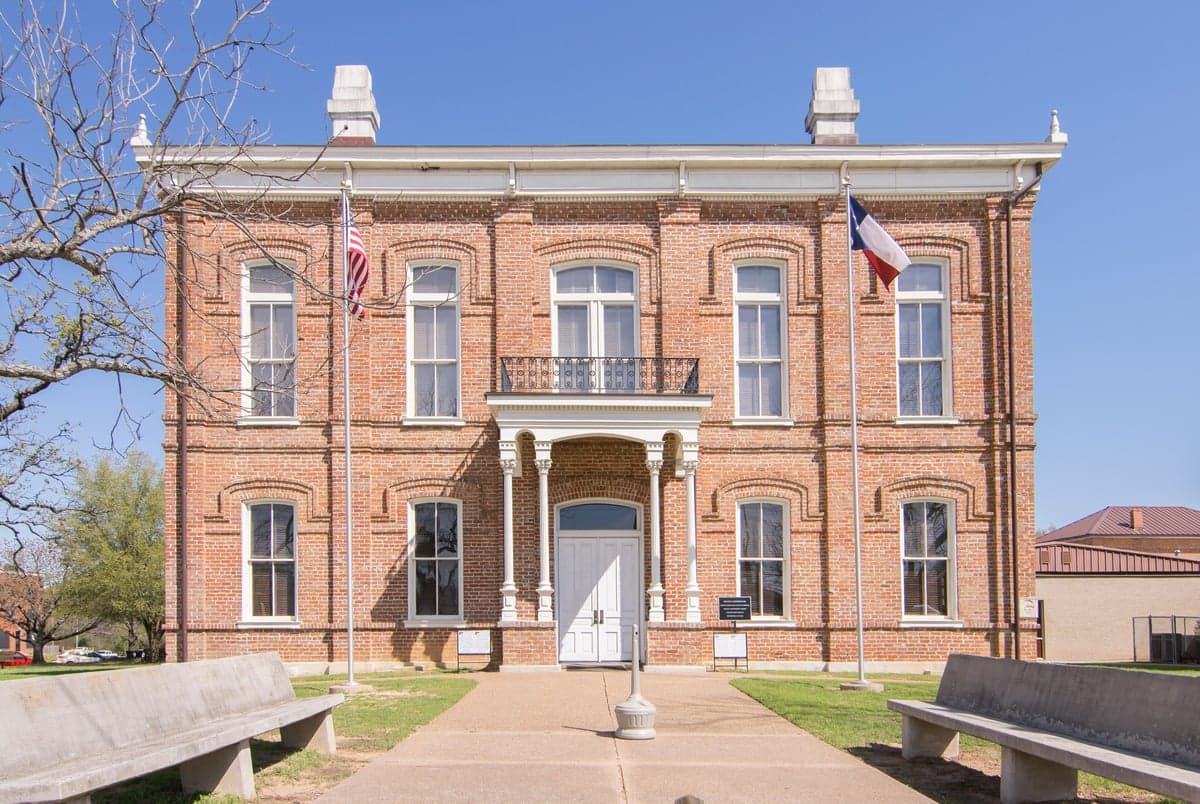
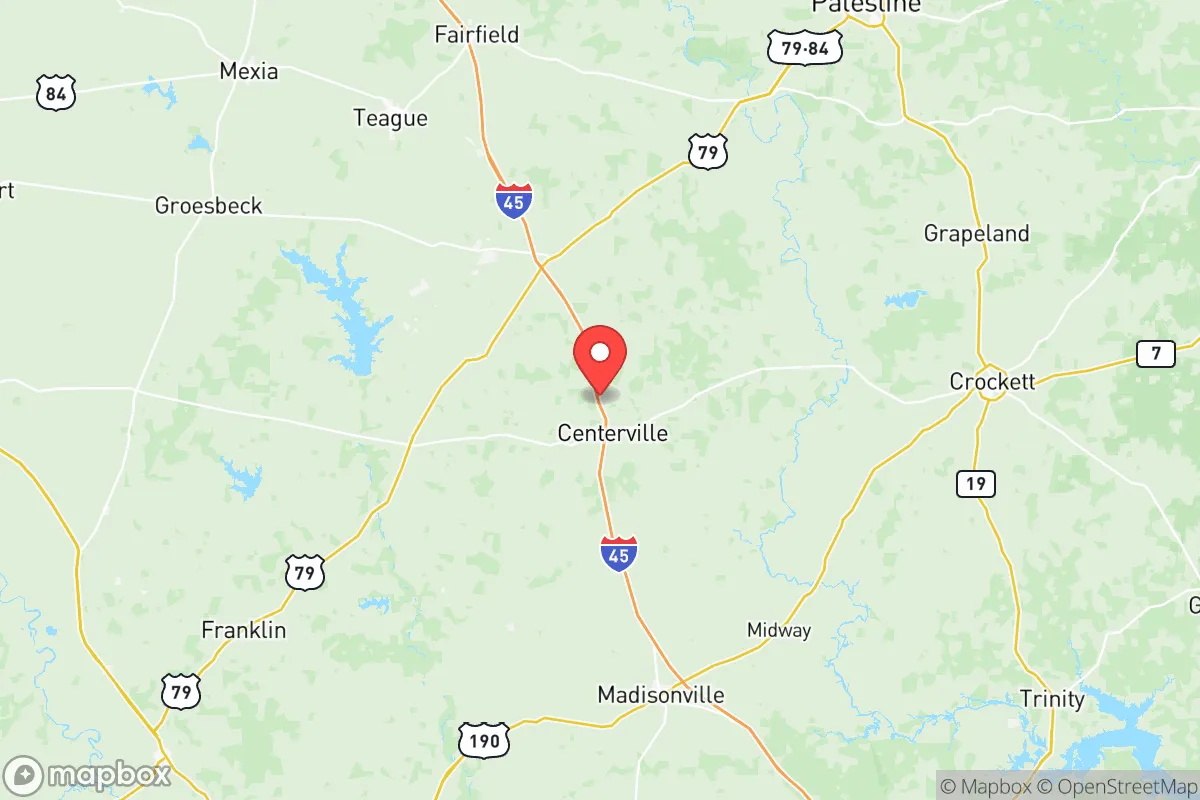
Leon County, Texas, is a rural, predominantly white community of 16,067 residents where a slow, steady demographic shift is underway. The county’s identity is rooted in its agricultural and timber history, with a population that is 73.0% white, 16.1% Hispanic, and 7.3% Black, and a notably low foreign-born share of just 3.5%. With only 17.1% of adults holding a college degree, the county’s character is working-class and traditional, centered on small towns like Centerville (the county seat), Buffalo, Jewett, Normangee, and Oakwood, where family ties to the land run deep.
Settlement & growth (pre-1960)
Long before European settlers arrived, the area now known as Leon County was part of the ancestral homeland of the Caddo and later the Bidai and Tonkawa peoples. These Native groups lived along the Trinity River and its tributaries, relying on hunting, fishing, and some agriculture. Spanish and French explorers passed through in the 17th and 18th centuries, but no permanent European settlements took hold until after Texas independence.
The first major wave of Anglo-American settlers arrived in the 1830s and 1840s, primarily from the U.S. South—Tennessee, Alabama, Mississippi, and Georgia. These were small-scale farmers and cattle ranchers drawn by cheap land grants under the Republic of Texas and later the state. They established the earliest communities: Centerville (founded 1850), Buffalo (1872), and Jewett (1870). The county was officially created in 1846 from Robertson County, and Centerville was named the seat. The economy was built on cotton, corn, and livestock, with enslaved African Americans making up a significant portion of the labor force. By 1860, enslaved people accounted for roughly 30% of the county’s population.
After the Civil War and Emancipation, many freed Black families stayed in the area, working as sharecroppers and tenant farmers. They formed distinct communities, such as the Concord settlement near Oakwood and the Hopewell community south of Centerville. The arrival of the Houston and Texas Central Railway in the 1870s spurred growth in Normangee (originally named Midway) and Oakwood, which became shipping points for cotton and timber. The railroad also brought a small influx of German and Czech immigrants in the 1880s and 1890s, though they never formed the large enclaves seen in Central Texas counties like Lee or Fayette. Instead, they integrated into the existing farming communities.
The early 20th century saw the rise of the timber industry, with vast pine and hardwood forests logged to supply sawmills in Flynn and Leona. This drew a modest number of workers from other parts of the South, including some African Americans from East Texas. The Great Depression hit the county hard, and many families left for cities or the West Coast. The Dust Bowl had little direct effect here, but the mechanization of agriculture after World War II accelerated the decline of small farms. By 1950, the county’s population had peaked at around 12,000, then began a slow decline as younger generations moved to Houston, Dallas, and other urban centers for work.
Modern era (post-1965)
The 1965 Hart-Cellar Act had a minimal direct impact on Leon County. Unlike urban Texas, the county saw virtually no new immigration from Asia, Africa, or Latin America during the late 20th century. The foreign-born population remains at just 3.5%, and the East/Southeast Asian share is 0.1%, with Indian-subcontinent residents also at 0.1%. The county’s modest Hispanic growth—from about 8% in 2000 to 16.1% today—is driven primarily by domestic migration from South Texas and Mexico, not by new international arrivals. These Hispanic families have settled mostly in Buffalo and Jewett, where they work in construction, poultry processing, and the oilfield service industry.
The most significant demographic shift since 1965 has been the return of domestic migrants. Starting in the 1990s, Leon County began attracting retirees and second-home buyers from the Houston and Dallas-Fort Worth metro areas, drawn by cheap land, lake access, and a slower pace of life. The construction of Lake Limestone (completed 1978) and the expansion of State Highway 7 made areas near Jewett and Normangee more accessible. This “amenity migration” has brought a small but noticeable influx of white, middle-class families, many of whom are college-educated and politically conservative. They have not, however, dramatically changed the county’s overall educational attainment, which remains low at 17.1% college graduates.
The Black population has declined from roughly 15% in 1990 to 7.3% today, as younger African Americans have left for better opportunities in Houston and Dallas. The historic Black communities of Concord and Hopewell have shrunk, with many of their churches and schools now closed. Meanwhile, the white population has aged, with a median age of 45.6—significantly higher than the state average of 35.0. This aging trend is most pronounced in Centerville and Oakwood, where the population has been flat or declining for decades.
The future
Leon County’s population is projected to grow slowly, reaching roughly 17,500 by 2040, driven almost entirely by domestic migration from the nearby metro areas. The county will likely become slightly more diverse, with the Hispanic share rising to perhaps 20-22% and the white share declining to around 68-70%. The Black population is expected to continue its slow decline, settling around 6-7%. The East/Southeast Asian and Indian populations will remain negligible, as the county lacks the job base and cultural infrastructure to attract these groups.
The most visible change will be the continued suburbanization of the county’s western edge, particularly around Buffalo and Jewett, which are within commuting distance of College Station and Huntsville. New subdivisions and manufactured-home communities are sprouting on former farmland, attracting young families priced out of the Bryan-College Station market. This will gradually shift the county’s cultural identity from purely rural-agricultural to a more exurban, commuter-oriented character. However, the eastern half of the county—around Centerville, Oakwood, and Normangee—will remain deeply rural, with aging populations and limited economic growth.
For a newcomer, Leon County offers a low-cost, low-crime, and politically conservative environment, but with limited job opportunities, few amenities, and a population that is older and less educated than the state average. The county is becoming a bedroom community for the I-45 corridor, not a destination for immigrants or young professionals. The people who move here are those who value space, quiet, and traditional values over diversity and urban convenience.

* Values derived from national, state, county, city and local statistics and may differ in a specific area. Last updated: 2026-08-02T02:03:32.000Z
Narrative content on this page is AI-generated and may contain mistakes. Verify any details that matter before acting on them.
ReloMaps may earn a commission from affiliate links at no extra cost to you.

