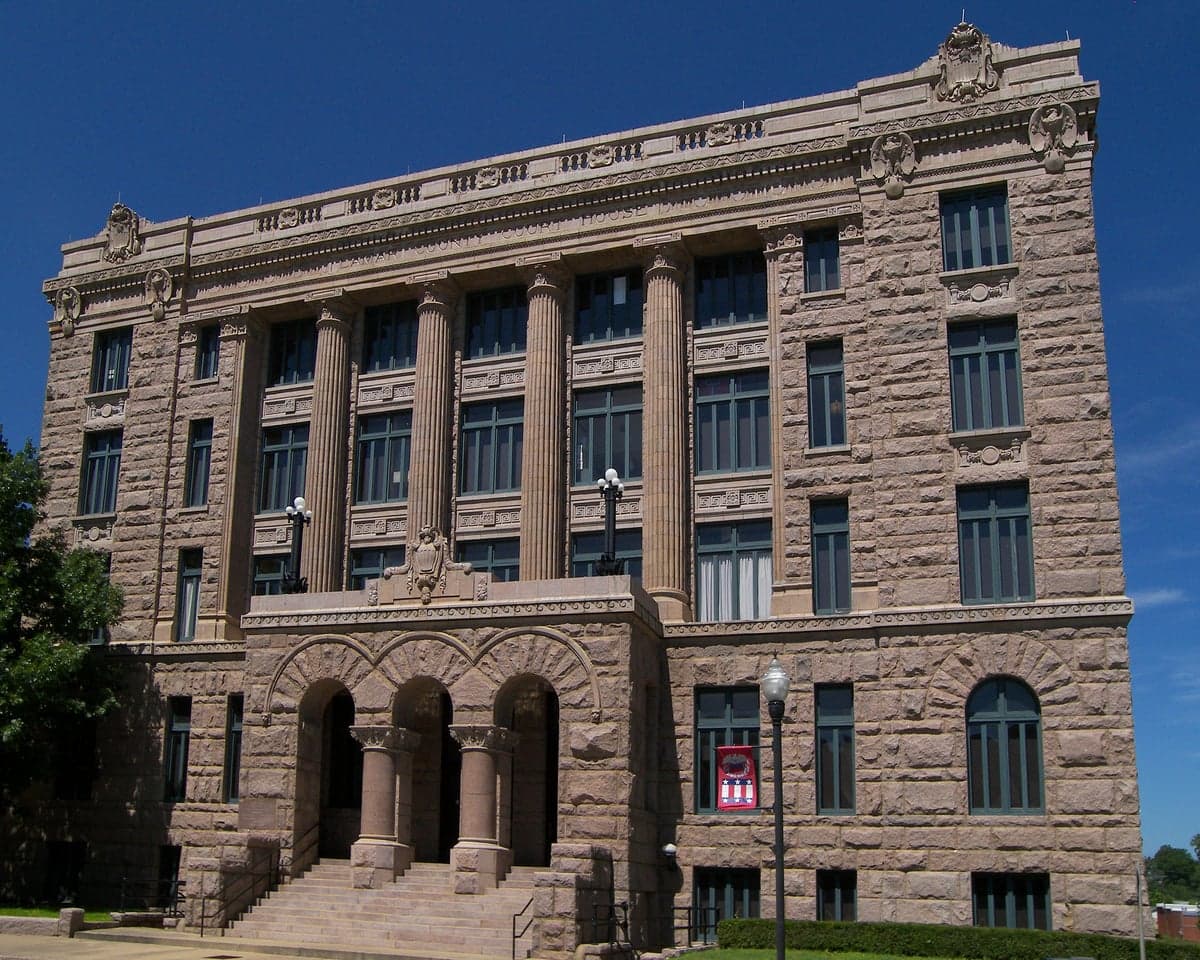

Photo: Wikipedia
Political ClimatePolitical Climate in Lamar County
Showing district-level results — no local-only data available.
Local Political AnalysisPolitical Analysis of Lamar County
Lamar County is a reliably Republican stronghold in Northeast Texas, with a Cook Partisan Voting Index (PVI) of R+16, meaning it votes about 16 percentage points more Republican than the national average. This makes it significantly more conservative than the state of Texas as a whole, which has a PVI of R+4. The county has been trending redder over the past decade, driven by population growth in its more rural areas and a steady shift to the right in its largest city, Paris. While Democrats still hold some local offices, particularly in the county's smaller communities, the overall trajectory is firmly toward the GOP.
How it compares
Lamar County's R+16 PVI places it among the more conservative counties in Texas, but it's not an outlier. For context, the state's overall R+4 rating reflects a mix of deep-red rural counties and increasingly competitive suburban and urban areas. Within Lamar County, the political landscape is not monolithic. The city of Paris, the county seat, is the most politically diverse area, with precincts near the downtown core and the historically Black neighborhoods along the US-82 corridor occasionally voting Democratic. However, these pockets of blue are shrinking. The towns of Blossom, Deport, and Roxton are deeply conservative, often voting Republican by margins of 70% or more. The swing precincts, if they can be called that, are in the unincorporated areas around the county's lakes, where a mix of retirees and new residents from more moderate parts of the state have created a slightly more competitive environment, though still reliably red.
What this means for residents
For conservative residents, Lamar County offers a political environment where their views are the clear majority. Local government, school boards, and county commissions are dominated by Republicans, and policy debates tend to focus on tax rates, property rights, and Second Amendment issues. For liberal residents, the reality is more challenging. While they are not actively suppressed, they often find themselves in a political minority, with limited representation in elected office. Socially, the county is traditional, with a strong emphasis on church and family, and progressive causes like environmental regulation or LGBTQ+ rights rarely gain traction in public discourse. The practical effect is that most residents, regardless of party, engage with local politics through a lens of fiscal conservatism and a preference for limited government intervention.
Cultural and policy distinctions
What sets Lamar County apart from even deeper red parts of Texas is its distinct cultural identity, rooted in its history as a cotton and railroad hub. The county's politics are heavily influenced by the local agricultural economy and the presence of the Paris Junior College, which brings a slightly more moderate influence than the surrounding rural areas. Policy-wise, the county has been a leader in opposing state-level mandates on land use and property taxes, reflecting a strong libertarian streak among its residents. Unlike some parts of Texas where the oil and gas industry drives political debate, Lamar County's politics are more focused on agriculture, small business, and the preservation of its historic downtowns. The near-term future likely holds continued Republican dominance, though the growing number of retirees moving to the area from other states could introduce more moderate voices into local elections, particularly on issues like healthcare and infrastructure.

State Political ClimatePolitical Climate in Texas
State Political AnalysisPolitical Environment in the State
Texas is a solidly Republican state with a Cook Partisan Voting Index of R+4, meaning it leans about four points more Republican than the national average in presidential elections. But that simple number masks a state in the middle of a dramatic political transformation: over the last 20 years, the GOP’s dominance has been slowly eroding as explosive population growth in the urban crescent from Dallas-Fort Worth down through Austin to Houston and San Antonio has shifted the electorate. In 2024, Donald Trump still carried Texas by about 5.5 points, down from his 9-point win in 2020 and well below the 16-point margins George W. Bush enjoyed in 2004. The state is still reliably red at the statewide level, but the trend line is unmistakably toward competitiveness, and the internal political geography is more fractured than ever.
Urban vs. rural divide
The political map of Texas is a story of three distinct worlds. The big metropolitan counties — Harris (Houston), Dallas, Tarrant (Fort Worth), Bexar (San Antonio), Travis (Austin), and El Paso — now cast about 60% of the state’s votes, and most of them are trending blue. Travis County is the bluest of the bunch, giving Democrats 70%+ margins, while Harris and Dallas are reliably Democratic by double digits. The real battleground has been the suburban ring counties: Collin and Denton north of Dallas, Williamson north of Austin, and Fort Bend southwest of Houston. These fast-growing, affluent, and increasingly diverse suburbs have shifted sharply toward Democrats over the past decade. Collin County, once a GOP stronghold, voted for Trump by only 10 points in 2024 after giving Republicans 30-point margins in 2012. Meanwhile, rural and exurban Texas — places like Lubbock, Amarillo, the Permian Basin, and deep East Texas — remains deeply Republican, often voting 70-80% for the GOP. The result is a state where the political center of gravity is slowly moving toward the suburbs and cities, but the rural vote still provides a formidable Republican firewall.
Policy environment
Texas has no state income tax, which is the single biggest policy draw for relocating conservatives and businesses. The trade-off is relatively high property taxes and a reliance on sales tax and business franchise fees. The regulatory posture is famously business-friendly: Texas is a right-to-work state, has minimal zoning in many cities, and has a permitting environment that encourages rapid development. On education, the state funds schools primarily through local property taxes, leading to wide disparities between wealthy and poor districts, and the school choice debate is a perennial legislative battleground — Governor Greg Abbott pushed hard for education savings accounts in 2023 but faced resistance from rural Republicans. Healthcare policy is marked by the state’s refusal to expand Medicaid under the Affordable Care Act, leaving about 18% of Texans uninsured, the highest rate in the nation. Election laws have been tightened in recent cycles: the 2021 Senate Bill 1 restricted mail-in voting, added ID requirements, and expanded poll watcher access. Abortion is effectively banned after about six weeks under the state’s trigger law and the 2021 Heartbeat Act (SB 8), which allows private citizens to sue anyone who aids an abortion. Gun laws are among the most permissive in the country: permitless carry was enacted in 2021, and the state has strong castle doctrine and stand-your-ground statutes.
Recent policy direction
The last few legislative sessions have pushed Texas decisively to the right on a broad front. On gun rights, the 2021 permitless carry law (HB 1927) allows most adults to carry a handgun without a license or training. On parental rights and education, the 2023 law (HB 900) requires age-based content ratings for library books and restricts sexually explicit material in schools, while another measure (SB 14) bans gender-transition care for minors. On speech and privacy, the state passed a law (HB 20) in 2023 that prohibits social media platforms from moderating content based on viewpoint, though it has been blocked in court. On property rights, Texas has strong eminent domain protections and no state-level rent control, but local zoning fights are common in fast-growing cities. On voting, the 2021 election law (SB 1) added new ID requirements for mail ballots and banned drive-through and 24-hour voting options that Harris County had used in 2020. On medical and bodily autonomy, the near-total abortion ban has no exceptions for rape or incest, only for life-threatening medical emergencies. On taxes, the 2023 session delivered a major property tax cut package (SB 2 and SB 3) that increased the homestead exemption and compressed school tax rates, funded by a record budget surplus. The overall direction is clear: Texas is doubling down on conservative governance on social issues and economic freedom, even as the electorate slowly diversifies.
Civil unrest & political movements
Texas has been a flashpoint for several high-profile political movements. The 2020 protests in Austin over George Floyd’s death were among the largest in the country, and the city’s subsequent defunding of its police department by about $150 million became a statewide political issue, leading the legislature to pass a law (HB 1900) in 2021 that punishes cities that cut police budgets. Immigration politics are a constant live wire: the border crisis has driven Governor Abbott’s Operation Lone Star, which deployed state troopers and National Guard to the border, bused migrants to Democratic-led cities, and installed razor wire and buoys in the Rio Grande, leading to ongoing legal battles with the Biden administration. The state has seen a resurgence of secessionist rhetoric from the Texas Nationalist Movement, though it remains a fringe position. Election integrity controversies have been intense: the 2020 and 2022 cycles saw Republican calls for audits in Harris, Dallas, and Tarrant counties, and the 2021 voting law was passed in direct response to Democratic turnout innovations in Harris County. A new resident would notice the political polarization most visibly in yard signs, bumper stickers, and the stark contrast between deep-blue Austin and the deep-red rural areas an hour’s drive away.
Projection
Over the next 5-10 years, Texas is likely to become more competitive at the statewide level, but not necessarily Democratic. The in-migration from California and other blue states has been heavily suburban and often moderate or conservative-leaning — many newcomers are fleeing high taxes and regulation, not seeking progressive politics. The Hispanic electorate, which is growing as a share of voters, has not moved uniformly Democratic; the 2024 election showed significant shifts toward Trump in heavily Hispanic border counties like Starr and Zapata. The urban cores will continue to get bluer, the rural areas will stay deep red, and the suburbs will be the decisive battleground. The Republican Party will face internal tension between its business-friendly, low-tax wing and its culturally conservative, populist wing, especially on issues like school choice and abortion exceptions. A new resident moving in now should expect the state to remain Republican-controlled for at least the next decade, but with narrower margins, more competitive statewide races, and a political environment that will feel increasingly like a purple state in the suburbs even as the rural areas hold the line.
For someone relocating to Texas, the practical takeaway is that your day-to-day experience will vary enormously depending on where you land. If you’re a conservative, you’ll find a state government that broadly shares your values on taxes, guns, education, and regulation, and you’ll feel at home in most suburbs and all rural areas. If you’re a liberal, you’ll find strong communities in the urban cores — Austin, Houston, Dallas, San Antonio, El Paso — where local governments are often progressive, but you’ll be living under a state government that is actively hostile to many of your policy preferences. The political climate is not monolithic, and the state’s size means you can largely choose your own political reality by picking your city or suburb. The trend lines suggest that choice will only become more important as the state’s internal divisions deepen over the next decade.
* Values derived from national, state, county, city and local statistics and may differ in a specific area. Last updated: 2026-08-08T11:15:43.000Z
Narrative content on this page is AI-generated and may contain mistakes. Verify any details that matter before acting on them.
ReloMaps may earn a commission from affiliate links at no extra cost to you.

