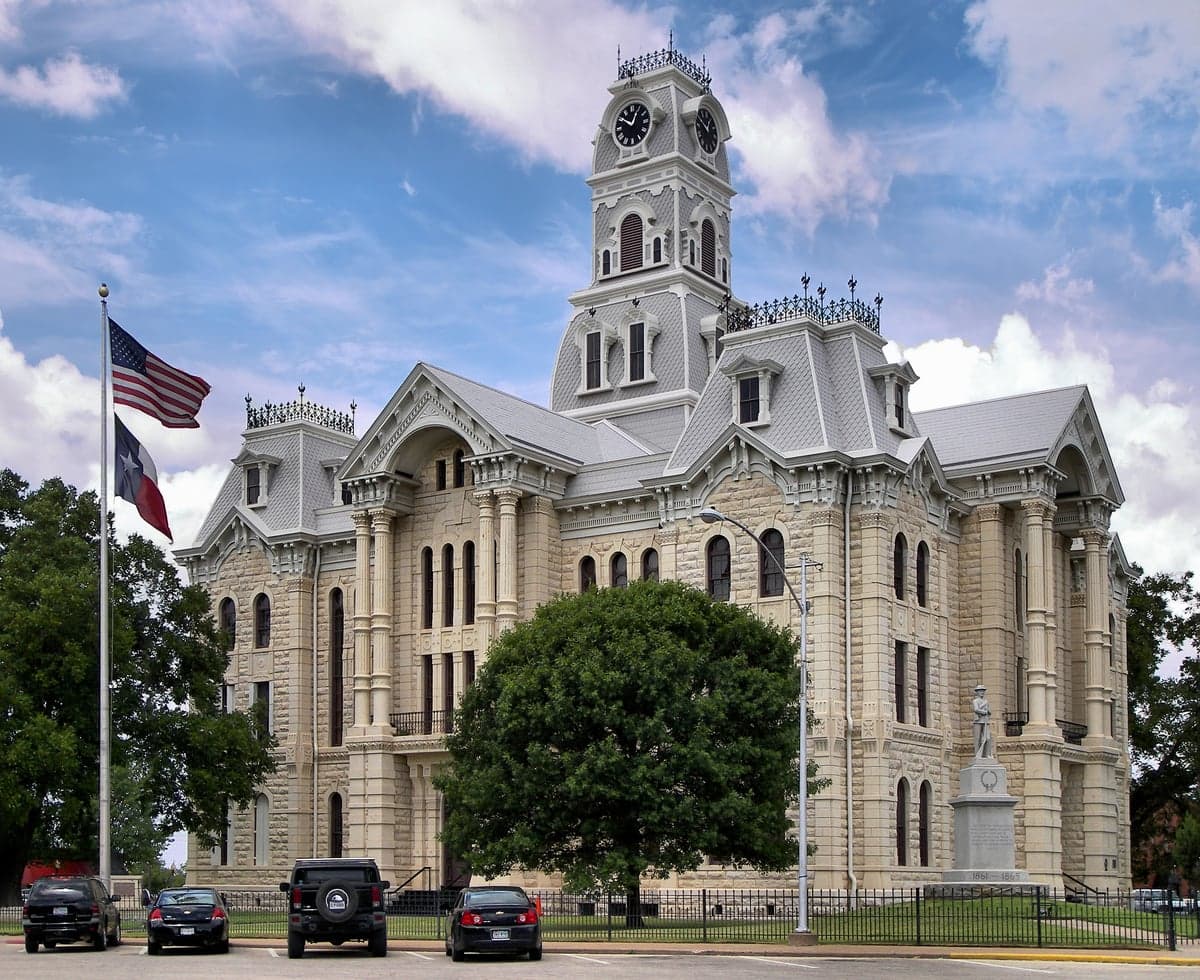
Photo: Wikipedia
Political ClimatePolitical Climate in Hill County
Showing district-level results — no local-only data available.
Local Political AnalysisPolitical Analysis of Hill County
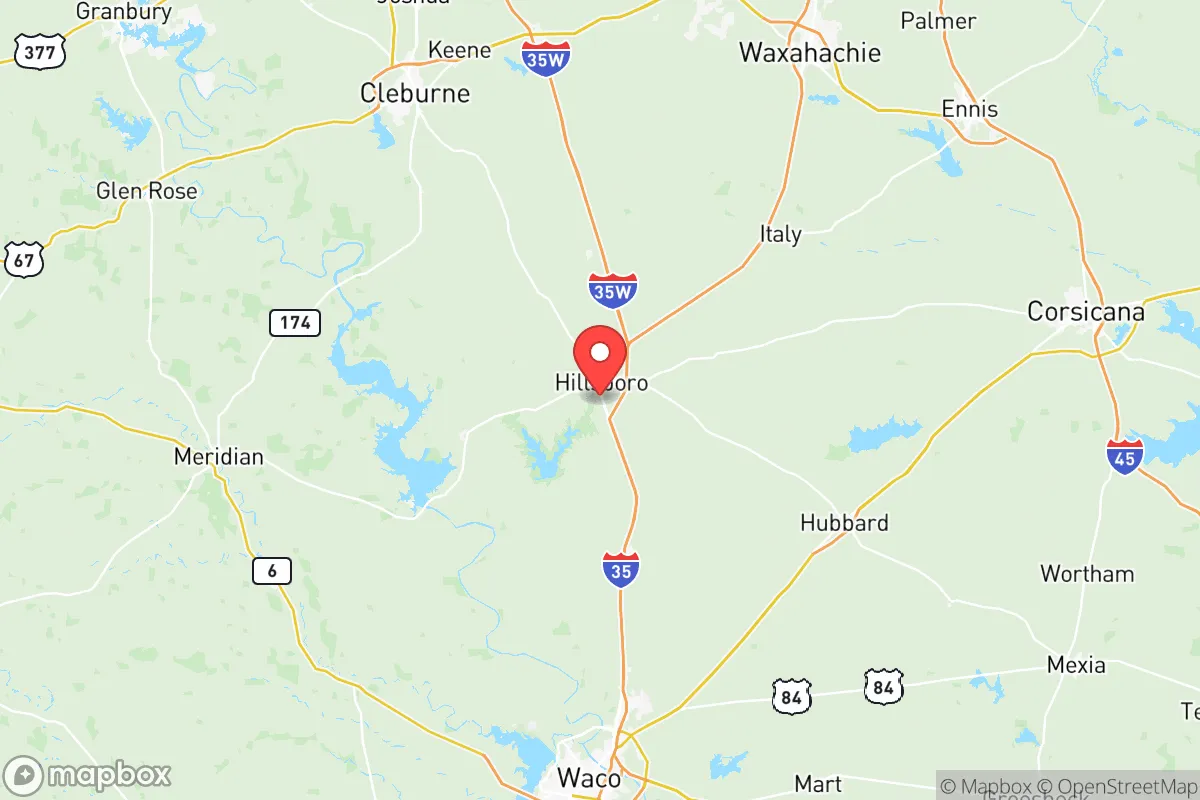
Hill County, Texas, is about as rock-ribbed Republican as they come, with a Cook PVI of R+14 that puts it well to the right of the state's already R+4 lean. That's not just a number on a map—it's the lived reality of a place where folks still believe in minding their own business and keeping the government out of their lives. But even here, you can feel the winds shifting, especially as the outer edges of the Dallas-Fort Worth metroplex start breathing down our necks. The county has voted red in every presidential election since 2000, but the margins have tightened a hair in the last two cycles, and that's got some of us paying close attention.
How it compares
Compared to Texas as a whole, Hill County is a fortress of conservative values. The state's R+4 PVI reflects a growing purple streak in places like Harris, Dallas, and Travis counties, but Hill County's R+14 is a different animal entirely. Hillsboro, the county seat, is the heart of that deep red—you'll see more Trump signs than stop signs during election season, and the local school board meetings are about as fiery as they get over curriculum and parental rights. Whitney, up by the lake, leans even harder red, driven by retirees and second-home owners who moved here specifically to escape the chaos of the cities. Itasca and Hubbard are solidly conservative too, though you'll find a few more blue-leaning households in Abbott, where the younger crowd from the nearby college in Waco sometimes trickles in. The swing precincts are mostly around the Lake Whitney area, where new subdivisions are bringing in folks from Dallas who still vote red but might be a little softer on things like property tax hikes or local bond measures. That's the real tension: the old guard versus the new transplants who want the same low taxes and freedom but don't always understand the history of why we fight so hard to keep it that way.
What this means for residents
For the people who live here, the political climate means you can still live your life without a bureaucrat looking over your shoulder. Gun rights are taken seriously—you won't find any of that red flag nonsense getting traction at the county commissioner's court. Property taxes are a constant battle, but the local officials are generally responsive to the outcry, unlike in Austin where they just spend your money on pet projects. The school board in Hillsboro has pushed back hard against critical race theory and gender ideology in the classroom, and the county sheriff's office doesn't waste time on federal overreach when it comes to immigration enforcement. That said, the creeping influence from the metroplex is real. You're starting to see more "Black Lives Matter" signs in a few yards near the lake, and the local Democratic party has a small but vocal presence in Hillsboro that shows up to every city council meeting to push for "equity" initiatives. It's not a takeover by any stretch, but it's a reminder that no place is an island anymore.
Culturally, Hill County still feels like the Texas of thirty years ago. Church attendance is high, the county fair is a bigger deal than any political rally, and folks wave at you on the backroads. The biggest policy distinction from the state at large is the county's aggressive stance on Second Amendment sanctuary status and its refusal to implement any state-level mandates that feel like overreach, like vaccine passports or mask mandates. The local economy is still driven by agriculture and small manufacturing, so there's a practical skepticism of any regulation that might cost a job. Looking ahead, the concern is that as more people flee the cities for the quiet life here, they'll bring the same big-government habits they were trying to escape. For now, though, Hill County remains a place where personal freedom isn't just a talking point—it's the way of life.

State Political ClimatePolitical Climate in Texas
State Political AnalysisPolitical Environment in the State
Texas has been a reliably Republican state for decades, with a Cook PVI of R+4, but the political landscape is far from monolithic. The dominant coalition has historically been a blend of social conservatives, fiscal libertarians, and rural voters, but rapid in-migration from blue states and demographic shifts are slowly chipping away at that foundation. Over the last 10-20 years, the state has seen a steady rightward tilt on cultural issues, even as its major metros have become more progressive, creating a tense, dynamic environment that any newcomer should understand before unpacking the moving truck.
Urban vs. rural divide
The political map of Texas is a study in contrasts. The sprawling, high-growth metros of Austin, Dallas, Houston, and San Antonio are the engines of Democratic growth, with Travis County (Austin) and Dallas County now reliably blue. Meanwhile, the vast rural and exurban expanses—places like Lubbock, Amarillo, and the Permian Basin—vote overwhelmingly Republican, often by margins of 70-80%. The real battleground is the suburban ring: counties like Collin (north of Dallas), Fort Bend (southwest of Houston), and Hays (south of Austin) have been trending leftward as educated, affluent newcomers arrive. In 2020, Bexar County (San Antonio) flipped blue, and Tarrant County (Fort Worth) is now a perennial swing county. The rural-urban split is so stark that a resident of El Paso (deep blue) and a rancher in Uvalde (deep red) might as well live in different countries when it comes to politics.
Policy environment
Texas remains a low-tax, low-regulation state by design. There is no state income tax, and property taxes are high but capped by a 3.5% appraisal increase limit (Proposition 4, 2023). The regulatory posture is aggressively pro-business, with minimal permitting hurdles for energy, construction, and manufacturing. On education, the state has championed school choice and parental rights, passing a universal Education Savings Account (ESA) program in 2025 that allows families to use state funds for private or homeschool expenses. Healthcare policy is a mixed bag: Texas did not expand Medicaid under the ACA, and the state has some of the strictest abortion laws in the nation (the Heartbeat Act, SB 8, and the near-total ban under HB 1280). Election laws have tightened significantly with SB 1 (2021), which banned 24-hour and drive-through voting, added ID requirements for mail ballots, and empowered partisan poll watchers. For a conservative-leaning resident, the policy environment is broadly favorable, though the property tax burden and rising insurance costs are real pain points.
Trajectory & freedom
On personal liberty, Texas has been a mixed bag in recent years. On the positive side for conservatives, the state has expanded gun rights significantly: permitless carry (HB 1927, 2021) allows any law-abiding adult to carry a handgun without a license. Parental rights were strengthened with the passage of the "Parental Bill of Rights" (HB 900, 2023), which requires schools to notify parents of curriculum changes and restricts sexually explicit materials in libraries. Medical freedom took a hit with the COVID-era mandates, but the state pushed back with a ban on vaccine passports (SB 968, 2021) and a prohibition on employer vaccine mandates (SB 7, 2023). On the concerning side, property rights have been eroded by the use of eminent domain for private infrastructure projects, and the state's heavy-handed approach to border security—while popular with conservatives—has led to federal lawsuits over SB 4 (2024), which allows state law enforcement to arrest and detain suspected illegal immigrants. The trend is toward more state-level control over personal choices, but the federal government's interference remains a constant threat.
Civil unrest & political movements
Texas has seen its share of political flashpoints. The 2020 Black Lives Matter protests in Austin and Houston were large and occasionally violent, leading to a backlash that helped fuel the "defund the police" debate. On the right, the "Patriot" movement is strong in rural areas, with groups like the Texas Freedom Coalition organizing around election integrity and Second Amendment rights. Immigration politics are the most visible flashpoint: the state's Operation Lone Star has bused thousands of migrants to sanctuary cities like New York and Chicago, and the border wall construction continues in the Rio Grande Valley. Secession rhetoric—"Texit"—surfaced in the 2022 Republican Party platform, but it remains a fringe position with no serious legislative path. Election integrity remains a hot-button issue: the 2020 and 2022 cycles saw widespread claims of fraud, though no major court cases proved systemic issues. A new resident will notice the constant political tension, especially in the suburbs where yard signs and bumper stickers are a form of local identity.
Projection
Over the next 5-10 years, Texas is likely to become more politically competitive, but not necessarily more liberal. The in-migration from California, New York, and Illinois is slowing, and many of those newcomers are actually conservatives fleeing high taxes and progressive policies in their home states. The Hispanic vote, long assumed to be a Democratic lock, is shifting rightward, especially in border communities like McAllen and Laredo. The state's Republican legislature will likely continue to push on school choice, property tax reform, and border security, while the Democratic strongholds in the big cities will fight for more local control. The wildcard is the federal government: if a Democratic administration in Washington tries to impose national gun control or abolish the Electoral College, Texas's political identity could harden further. For someone moving in now, expect a state that remains conservative on most issues, but with a growing, vocal progressive minority in the cities. The suburbs will be the decisive battleground for the next decade.
For a new resident, the bottom line is this: Texas offers a policy environment that respects personal freedom on taxes, guns, and education, but you'll need to navigate a rapidly changing demographic landscape. The state is still a safe bet for conservatives, but don't expect the uniform red of the 1990s. If you're moving to Fort Worth or College Station, you'll feel right at home. If you're heading to Austin or Dallas, be prepared for a political fight at the local level. Either way, you'll have more freedom than you left behind—for now.
* Values derived from national, state, county, city and local statistics and may differ in a specific area. Last updated: 2026-05-22T00:18:25.000Z
Narrative content on this page is AI-generated and may contain mistakes. Verify any details that matter before acting on them.
ReloMaps may earn a commission from affiliate links at no extra cost to you.

