

Photo: Wikipedia
Demographics of Cooke County
Affluence Level in Cooke County
A middle-class area roughly in line with national averages across income, home values, education, and employment.
People of Cooke County
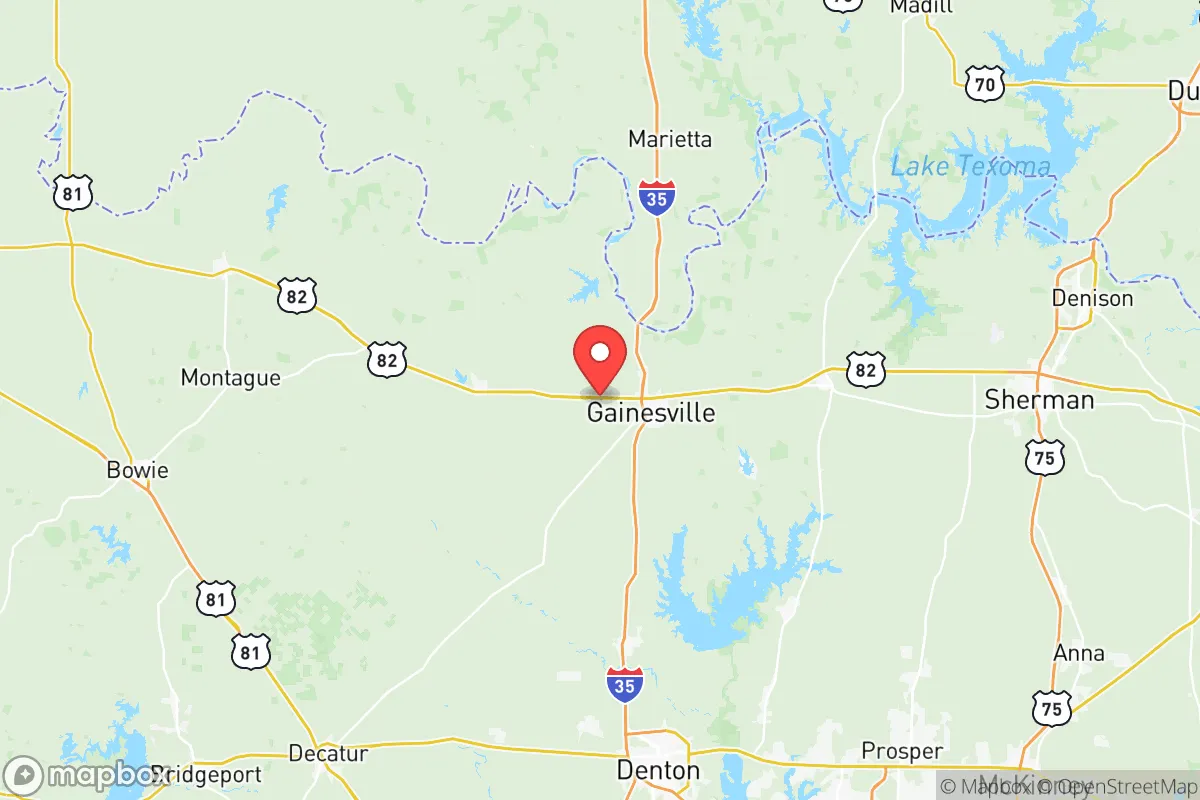
Cooke County, Texas, today is a predominantly White, politically conservative community of 42,473 residents, characterized by a strong rural identity centered on its county seat, Gainesville, and smaller towns like Lindsay, Muenster, and Valley View. The population is notably less diverse than the state average, with a 71.6% White (non-Hispanic) majority and a 20.5% Hispanic population, while foreign-born residents make up just 5.1% of the total. The county’s distinctive cultural markers include a deep German Catholic heritage in towns like Muenster and Lindsay, a robust agricultural and manufacturing economy, and a social fabric that remains largely stable and family-oriented, with a below-average college attainment rate of 23.6%.
Settlement & growth (pre-1960)
Before American settlement, the area now known as Cooke County was part of the traditional territory of several Native American nations, including the Wichita, Caddo, and Comanche, who used the region for hunting and seasonal camps. The first European presence was Spanish and French, but no permanent colonial settlements were established. The county was officially created in 1848 from the Peters Colony land grant, a massive empresario project that recruited settlers—primarily from the Upper South and Midwest—to populate the Texas frontier.
The earliest American settlers were predominantly of Scots-Irish and English descent, arriving from Tennessee, Kentucky, and Missouri in the 1850s. They were drawn by cheap land, the promise of cotton farming, and the establishment of the Butterfield Overland Mail route through Gainesville. By the 1870s, the arrival of the Missouri-Kansas-Texas Railroad (the Katy) transformed Gainesville into a regional trade hub, attracting merchants and laborers. A distinct and lasting wave began in the 1880s, when German Catholic immigrants, fleeing Bismarck’s Kulturkampf and economic hardship, settled in the northern part of the county. They founded the towns of Muenster (1889) and Lindsay (1891), establishing tight-knit farming communities centered on the Catholic Church, dairy farming, and grain production. These German enclaves remain culturally distinct today, with Muenster hosting an annual Germanfest and maintaining a strong Catholic identity.
The early 20th century brought a small influx of African American families, many of whom were descendants of freed slaves who worked as sharecroppers and tenant farmers on cotton plantations. They concentrated in Gainesville’s south side, forming a community that supported churches, schools, and businesses. The Dust Bowl and Great Depression of the 1930s drove a wave of “Okies” and Arkies—displaced farmers from Oklahoma and Arkansas—into Cooke County, where they found work in cotton fields and on ranches. This group largely assimilated into the existing White population. By 1950, the county’s population had reached roughly 22,000, with a demographic profile that was over 95% White and overwhelmingly native-born.
Modern era (post-1965)
The 1965 Hart-Cellar Act had a muted direct effect on Cooke County, as the area did not become a primary destination for the new waves of Asian or Latin American immigrants that reshaped major Texas cities. Instead, the county’s demographic change since 1965 has been driven primarily by domestic migration and natural increase. The most significant shift has been the growth of the Hispanic population, which rose from under 5% in 1970 to 20.5% by 2025. This growth stems from two sources: Mexican-American families already living in the region, and a steady stream of migrants from South Texas and Mexico who arrived for agricultural work (dairy, poultry, and hay farming) and later moved into construction, manufacturing, and service jobs in Gainesville. The Hispanic community is dispersed throughout the county, with a notable concentration in Gainesville’s east side and in the unincorporated community of Callisburg.
The East/Southeast Asian population remains very small at 0.7%, with no significant enclave forming. A handful of Vietnamese and Filipino families have settled in Gainesville, often working in healthcare or at the county’s industrial plants. The Indian-subcontinent population is effectively zero (0.0%). The Black population has remained stable at around 3.3%, concentrated in Gainesville, and has not experienced the out-migration seen in many rural Southern counties. The White population, while still the overwhelming majority, has seen a slight relative decline due to the growth of the Hispanic cohort and an aging demographic profile among non-Hispanic Whites.
Domestic in-migration since 2000 has been modest but notable. A small number of retirees and remote workers from the Dallas-Fort Worth metroplex, located about 60 miles south, have moved to Lake Kiowa, a gated lake community near Gainesville, and to rural acreages around Whitesboro and Collinsville. These newcomers are typically White, conservative, and drawn by lower property taxes, a slower pace of life, and the area’s hunting and fishing opportunities. They have not fundamentally altered the county’s cultural identity, as they largely share the political and social values of the existing population.
The future
Cooke County’s population is projected to grow slowly, reaching roughly 48,000–50,000 by 2040, driven by continued Hispanic natural increase and a trickle of exurban migration from the DFW metroplex. The Hispanic share is likely to rise to 25–28% over the next two decades, as the cohort is younger and has higher fertility rates than the White population. This growth is not producing tribalization or ethnic enclaves; instead, Hispanic families are increasingly integrated into the county’s social and economic mainstream, with many attending the same churches, schools, and community events as their White neighbors. Intermarriage rates are rising, particularly among second- and third-generation Mexican-Americans.
The East/Southeast Asian and Black populations are expected to remain small and stable, as the county lacks the job diversity and urban amenities that attract larger numbers of these groups. The White population will continue to age, with a growing share of retirees, but the county’s conservative cultural identity is unlikely to weaken. In-migration from the DFW area will accelerate slightly as housing costs in the metroplex push families northward, but these newcomers will be culturally similar to the existing population. The German Catholic heritage of Muenster and Lindsay will persist as a distinctive local identity, though it will become less dominant as the county diversifies.
For someone moving in now, Cooke County offers a stable, family-oriented community with a strong sense of place, low crime, and affordable land. The population is becoming slightly more diverse but remains overwhelmingly White and conservative, with a social fabric that values self-reliance, church involvement, and neighborliness. The county is not homogenizing into a generic suburb, nor is it tribalizing into hostile camps; it is slowly absorbing its growing Hispanic minority into a shared local culture. The bottom line: Cooke County is a place where tradition holds, change is gradual, and newcomers who respect the existing way of life will find a welcoming, if insular, community.

* Values derived from national, state, county, city and local statistics and may differ in a specific area. Last updated: 2026-05-21T10:23:16.000Z
Narrative content on this page is AI-generated and may contain mistakes. Verify any details that matter before acting on them.
ReloMaps may earn a commission from affiliate links at no extra cost to you.

