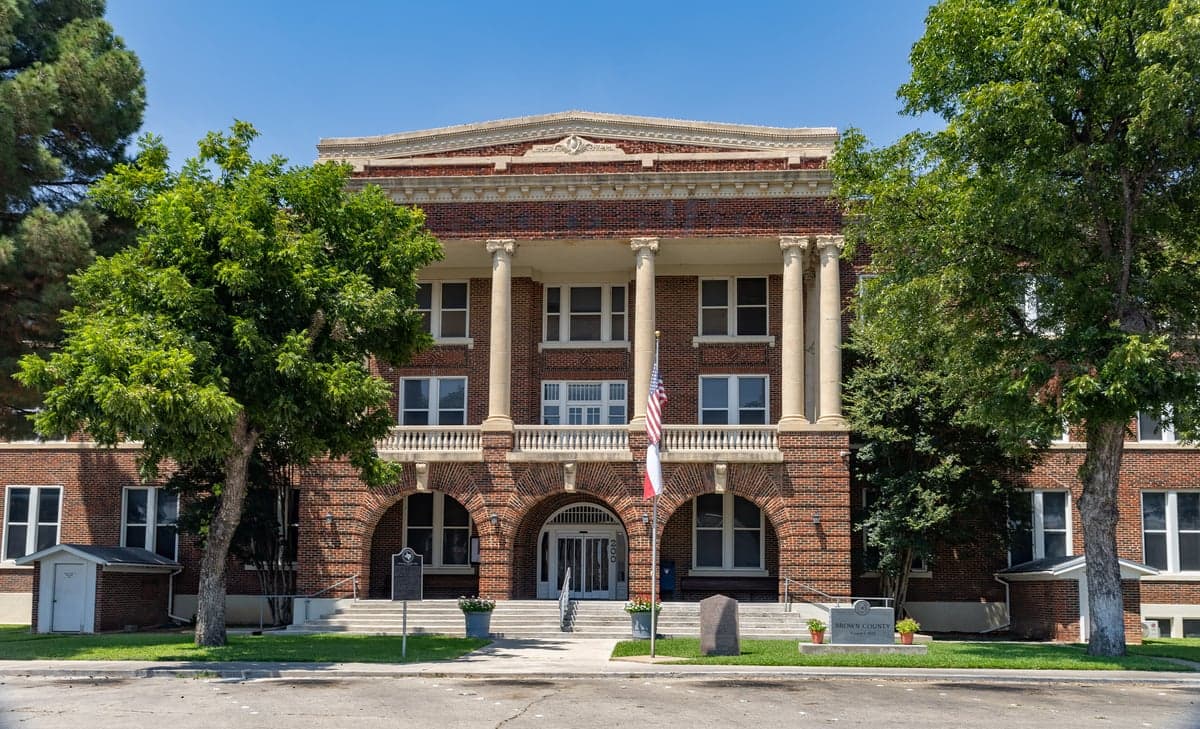
Photo: Wikipedia
Demographics of Brown County
Affluence Level in Brown County
A below-average socioeconomic profile. Incomes, home values, and educational attainment trail the U.S., with higher poverty and unemployment.
People of Brown County
Brown County, Texas, is a predominantly rural, conservative-leaning community of 38,294 residents, characterized by a population that is 70.5% White and 22.2% Hispanic, with a very low foreign-born share of just 2.2%. The county’s identity is rooted in its agricultural and energy history, with a population density of roughly 30 people per square mile, and its people are notably less college-educated (19.9%) than the state average, reflecting a workforce historically tied to ranching, farming, and oilfield labor. Distinctive markers include a strong sense of local independence, a deep connection to the region’s German and Scots-Irish pioneer heritage, and a growing Hispanic presence that is reshaping the cultural fabric of its main towns, particularly Brownwood and Early.
Settlement & growth (pre-1960)
Before American settlement, the area now known as Brown County was part of the traditional territory of the Comanche and Lipan Apache nations, who used the region for hunting bison and seasonal encampments along the Pecan Bayou. Spanish and Mexican claims to the land were largely nominal, with no permanent European settlements established in the county until after Texas independence. The first permanent American settlers arrived in the 1850s, primarily Scots-Irish and English families from the southern United States, drawn by the promise of cheap, fertile land for cotton farming and cattle ranching under the Texas land grant system. The town of Brownwood was founded in 1856 as the county seat, named after a local settler, and quickly became a trading hub for the surrounding ranches.
The post-Civil War period saw a modest influx of German immigrants, who established small farming communities like Blanket (founded 1879) and Zephyr (founded 1880), bringing with them a tradition of dryland farming and stone construction that still marks the county’s rural architecture. The arrival of the Gulf, Colorado and Santa Fe Railway in Brownwood in 1885 triggered the county’s first major growth spurt, turning the town into a regional shipping point for cotton, cattle, and wool. By 1900, the population had reached roughly 16,000, with the county’s economy supplemented by small-scale coal mining in the Thrifty area and limestone quarrying near Bangs. The Dust Bowl and Great Depression of the 1930s brought a wave of displaced farmers from Oklahoma and the Texas Panhandle—often called “Okies”—who settled in the county’s unincorporated areas, taking up sharecropping and day labor on ranches. World War II and the subsequent oil boom of the 1940s and 1950s drew additional domestic migrants, many from East Texas and Louisiana, to work in the newly developed oilfields around May and Lake Brownwood, cementing the county’s shift from a purely agricultural economy to one with a significant energy sector.
Modern era (post-1965)
The 1965 Hart-Cellar Act had a minimal direct impact on Brown County, as the region never became a primary destination for post-1965 immigration waves. The foreign-born population remains exceptionally low at 2.2%, compared to the national average of roughly 14%, and the county’s demographic shifts since the 1970s have been driven almost entirely by domestic migration and natural increase. The most significant change has been the growth of the Hispanic population, which rose from under 5% in 1970 to 22.2% today, fueled by Mexican-American families moving from South Texas and the Rio Grande Valley for work in construction, meatpacking, and the oilfields. This community is concentrated in Brownwood, particularly in the neighborhoods south of the downtown core and along the US-377 corridor, and in Early, where a growing number of Hispanic-owned businesses now operate. The East/Southeast Asian population (0.4%) and Indian subcontinent population (0.1%) are negligible, consisting of a handful of professionals employed at Howard Payne University and the local hospital, with no distinct enclave forming.
Domestic migration patterns since the 1980s have been a story of slow, steady decline in the county’s rural population, offset by modest growth in the Brownwood-Early urbanized area. The collapse of the cotton industry and the mechanization of ranching pushed younger generations to leave for Dallas-Fort Worth and Austin, while the oil busts of the 1980s and 2010s caused periodic out-migration from the energy-dependent towns of Bangs and Lake Brownwood. However, the county has seen a small but notable influx of retirees and remote workers since 2020, drawn by low housing costs and a slower pace of life, with new subdivisions appearing on the outskirts of Brownwood near the Lake Brownwood State Park. The Black population (3.2%) is largely descended from families who arrived during the post-Reconstruction era to work on cotton plantations, and today is concentrated in the historic Brownwood neighborhood of East Brownwood, where a small but active community church network remains.
The future
Brown County’s population is projected to remain stable or grow slowly over the next 10-20 years, likely reaching 40,000-42,000 by 2040, driven primarily by natural increase among the Hispanic population and continued domestic in-migration of retirees and remote workers. The county is not tribalizing into distinct ethnic enclaves; rather, the Hispanic community is steadily assimilating into the broader culture, with English becoming the dominant language among second-generation residents and intermarriage rates rising. The White population, while still the majority, is aging and declining in absolute numbers, as younger White residents continue to leave for urban job markets. The immigrant communities—both East/Southeast Asian and Indian—are unlikely to grow significantly, as the county lacks the economic pull factors (high-tech jobs, universities, ethnic networks) that drive such migration. The cultural identity of Brown County is being reshaped by the Hispanic influence, with Spanish-language church services, Mexican restaurants, and quinceañera celebrations becoming mainstream, but the county’s fundamental character—conservative, religious, and family-oriented—remains intact.
For someone moving in now, Brown County is becoming a place where the old pioneer and ranching culture is slowly blending with a more diverse, but still deeply traditional, Hispanic-influenced community. The low cost of living, strong sense of local identity, and proximity to outdoor recreation at Lake Brownwood offer a stable, predictable environment, but the limited economic opportunities and low educational attainment levels mean that newcomers should expect a community that values self-reliance and continuity over rapid change. The county is not homogenizing into a generic suburb, nor is it fragmenting into isolated enclaves—it is absorbing its new residents into a shared, if evolving, local identity rooted in the land and its history.

* Values derived from national, state, county, city and local statistics and may differ in a specific area. Last updated: 2026-05-12T13:53:17.000Z
Narrative content on this page is AI-generated and may contain mistakes. Verify any details that matter before acting on them.
ReloMaps may earn a commission from affiliate links at no extra cost to you.

