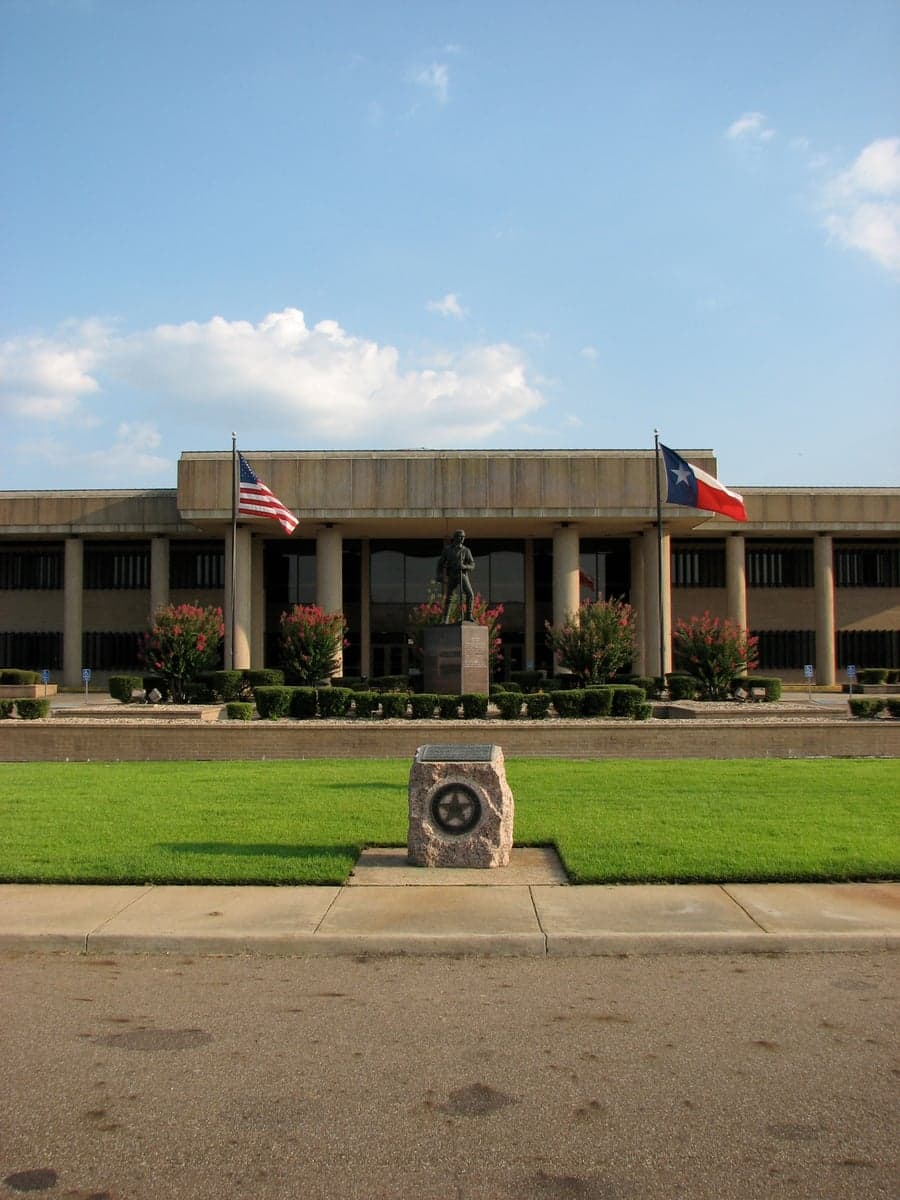
Photo: Wikipedia
Personal Sovereignty in Bowie County
Strong independent fundamentals that actively favor personal liberty and low regulation.
What does Personal Sovereignty tell us?
Personal Sovereignty measures your capacity for self-reliance and independence with minimal government friction. Higher scores mean fewer barriers between you and the way you want to live... but it assumes you have the space you need and good neighbors.
What does this tell us?
Personal Sovereignty measures your capacity for self-reliance and independence with minimal government friction. Higher scores mean fewer barriers between you and the way you want to live... but it assumes you have the space you need and good neighbors.
State Policy
Energy independence: Net exporter (220% of energy produced in-state)
Personal Liberty
Homesteading

Personal Liberty Analysis
Bowie County, Texas, offers a personal sovereignty environment that is markedly stronger than what most Americans experience in coastal or urban strongholds, but it is not a libertarian free-for-all. The county’s rural character, combined with Texas’s broad preemption laws and low-tax structure, creates a buffer against the most aggressive forms of government overreach. However, the presence of federal land (the Red River Army Depot and parts of the Piney Woods) and the proximity to Texarkana’s municipal codes mean that autonomy varies significantly depending on whether you settle in the unincorporated stretches near Hooks or De Kalb, versus inside the city limits of Texarkana or Nash. For a single individual or parent prioritizing self-reliance, the key is knowing where the lines are drawn—and Bowie County draws them favorably for those who plan ahead.
Tax burden and regulatory posture: how Bowie County compares to neighboring states
Texas has no state income tax, which immediately puts Bowie County ahead of neighboring Arkansas and Louisiana for anyone who values keeping more of their earnings. The county’s property tax rate hovers around 1.2% to 1.5% of assessed value, depending on the school district and municipality. Texarkana, Texas, imposes a city property tax on top of county and school taxes, but unincorporated areas like Maud or Redwater avoid that layer entirely. Sales tax in Bowie County is 8.25% (state plus local), which is standard for Texas but higher than some rural counties—a trade-off for the infrastructure of the Texarkana metro. Regulatory posture is light: no county-level building codes in unincorporated areas, no county-wide zoning (though Texarkana and Nash have municipal zoning), and no state-level permit requirements for most home-based businesses. The Texas Department of Licensing and Regulation does not impose the kind of occupational licensing found in California or New York. For a prepper or homesteader, the biggest regulatory win is the absence of a state property tax on vehicles or business inventory—Texas’s franchise tax is limited to larger entities. The bottom line: Bowie County’s tax burden is low enough that a single earner or family can retain significant capital for self-investment, and the regulatory climate does not actively punish self-reliance.
Self-defense and gun law specifics: what Bowie County offers for armed preparedness
Texas is a constitutional carry state, meaning no permit is required to carry a handgun openly or concealed for anyone 21 or older who can legally possess a firearm. Bowie County Sheriff’s Office does not impose additional restrictions beyond state law, and the county is generally considered 2A-friendly by local standards. Texarkana has a municipal ordinance prohibiting discharge of firearms within city limits (except on shooting ranges or in self-defense), but unincorporated areas like Redwater or Hooks allow target shooting on private property as long as it does not violate reckless discharge laws. The Red River Army Depot is a federal facility with its own security rules, but it does not affect civilian gun rights in the surrounding area. Stand-your-ground laws apply fully in Bowie County, and there is no duty to retreat in any place where you are lawfully present. For parents, Texas law explicitly protects the right to store firearms in vehicles on school parking lots (under the “School Safety” provision), which is a practical consideration for those who carry while dropping off children. The county has no local “assault weapon” bans, no magazine capacity limits, and no waiting periods. For a survivalist mindset, Bowie County offers a legal environment where you can arm yourself without bureaucratic hurdles—though you should still be aware that Texarkana’s city limits are more restrictive on discharge than the rural precincts.
Self-reliance and homesteading viability: lot sizes, zoning, and off-grid feasibility
Bowie County is one of the more homestead-friendly areas in Northeast Texas, largely because of its lack of county-wide zoning and relatively affordable land. Minimum lot sizes in unincorporated areas are not set by the county—they default to state subdivision rules, which generally allow parcels as small as one acre if you meet septic and well requirements. In practice, most rural properties near De Kalb or Maud are sold in 5- to 20-acre tracts, giving ample room for gardens, livestock, and water catchment. Off-grid living is feasible: Texas has no state law prohibiting rainwater collection (in fact, it encourages it via tax exemptions on collection equipment), and there are no county-level bans on composting toilets or solar panels. The main constraint is the well and septic permitting through the Bowie County Environmental Health Department, which requires a site evaluation and a permit (around $200–$400) but does not mandate connection to municipal water or sewer. Texarkana and Nash have stricter codes—Nash, for example, requires minimum lot sizes of 7,000 square feet in some subdivisions and mandates connection to city sewer where available. For a prepper looking to go fully off-grid, the unincorporated areas around Redwater or Hooks are the best bets. The county also has relatively loose animal ordinances: no limit on chickens or goats in unincorporated areas, though Texarkana limits fowl to six hens (no roosters) and prohibits swine. Overall, Bowie County supports a high degree of self-reliance for those who choose rural parcels, but the closer you get to Texarkana’s city limits, the more municipal codes intrude.
Personal liberties: parental rights, medical autonomy, speech, and property
Texas has strong statutory protections for parental rights, including the Parental Bill of Rights (Texas Family Code Chapter 151), which affirms that parents have the fundamental right to direct their children’s education, healthcare, and moral upbringing. Bowie County school districts—Texarkana ISD, Redwater ISD, and De Kalb ISD—generally respect these rights, though parents should be aware that Texas does not have a universal school choice voucher program (as of 2026, only Education Savings Accounts for special needs students exist). Medical autonomy is mixed: Texas banned COVID-19 vaccine mandates for private employers and government entities, and the state has a broad religious exemption for vaccinations. However, Texas does not recognize a general “right to refuse medical treatment” for children in life-threatening situations—Child Protective Services can intervene. For adults, the Texas Medical Freedom Act protects the right to decline any medical procedure, including vaccines, without penalty. Speech is fully protected under the First Amendment, and Texas has no state-level “hate speech” laws that criminalize expression. Property rights are strong: Texas has no state-level eminent domain for economic development (after the 2005 Kelo backlash, the legislature banned using eminent domain to transfer land to private developers). Bowie County does not have a county-wide tree ordinance or sign ordinance in unincorporated areas, though Texarkana regulates both. For a conservative-leaning individual, the key takeaway is that Bowie County’s legal environment respects personal autonomy in most domains, but the federal overlay (especially regarding medical mandates during public health emergencies) remains a concern—one that is mitigated by the county’s rural distance from centralized enforcement.
In the broader landscape of American personal sovereignty, Bowie County ranks well above the national median but below the most libertarian enclaves like northern Idaho or the Texas Panhandle. The absence of state income tax, constitutional carry, and minimal zoning in rural areas create a solid foundation for self-reliance. The trade-offs are the higher sales tax (8.25%) and the presence of municipal codes in Texarkana and Nash, which can feel restrictive to a prepper accustomed to total freedom. For a single individual or parent who wants to live with minimal government interference—while still having access to a regional hospital, Walmart, and an interstate—Bowie County is a pragmatic choice. The key is to buy land in the unincorporated precincts, stay out of Texarkana’s city limits for daily life, and keep your legal affairs in order. It is not a sovereign citizen fantasy, but it is a place where a prepared person can live largely on their own terms.

* Values derived from national, state, county, city and local statistics and may differ in a specific area. Last updated: 2026-05-27T18:11:40.000Z
Narrative content on this page is AI-generated and may contain mistakes. Verify any details that matter before acting on them.
ReloMaps may earn a commission from affiliate links at no extra cost to you.

