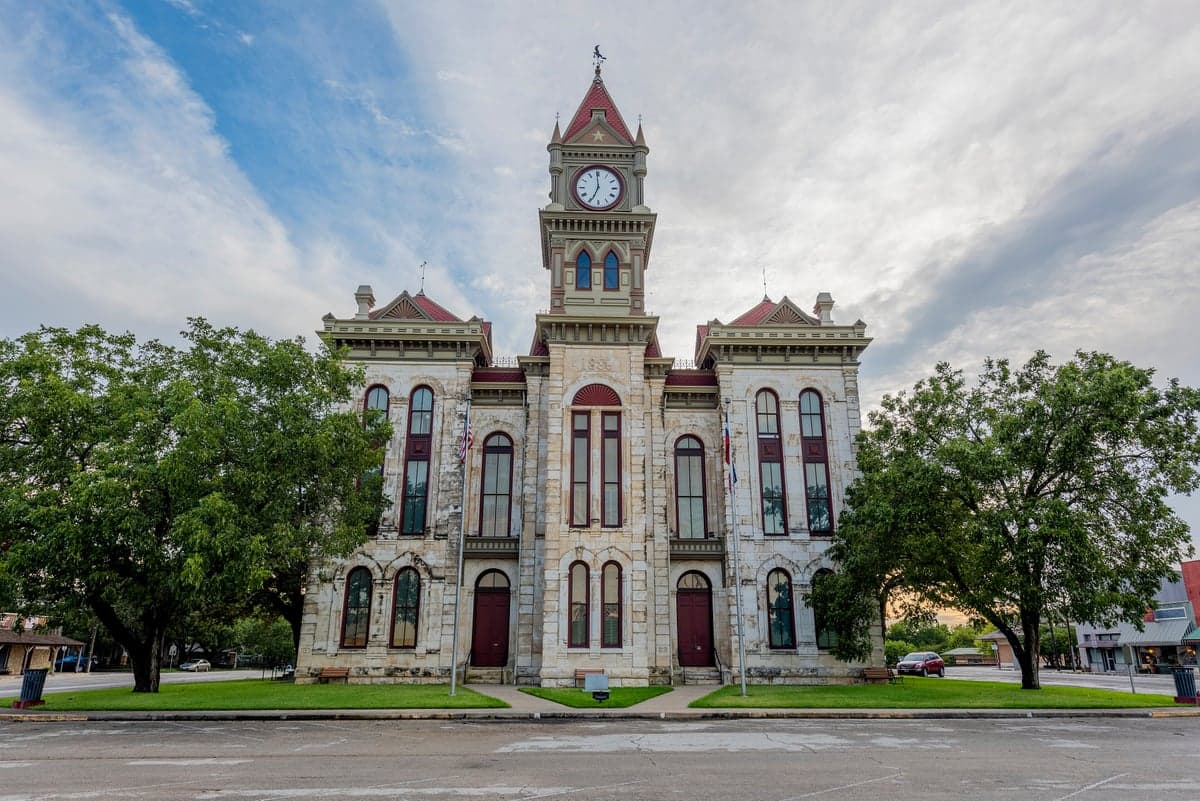
Photo: Wikipedia
Political ClimatePolitical Climate in Bosque County
Showing district-level results — no local-only data available.
Local Political AnalysisPolitical Analysis of Bosque County
Bosque County, Texas, is a reliably conservative area with a Cook Partisan Voting Index (PVI) of R+11, making it significantly more Republican than the state of Texas as a whole, which sits at R+4. This isn't a new development; the county has voted for the Republican presidential candidate in every election since 2000, and the margins have only widened. The rural character of the county, combined with its strong agricultural and ranching roots, creates a political environment where small-government and traditional values are the baseline assumptions, not points of debate.
How it compares
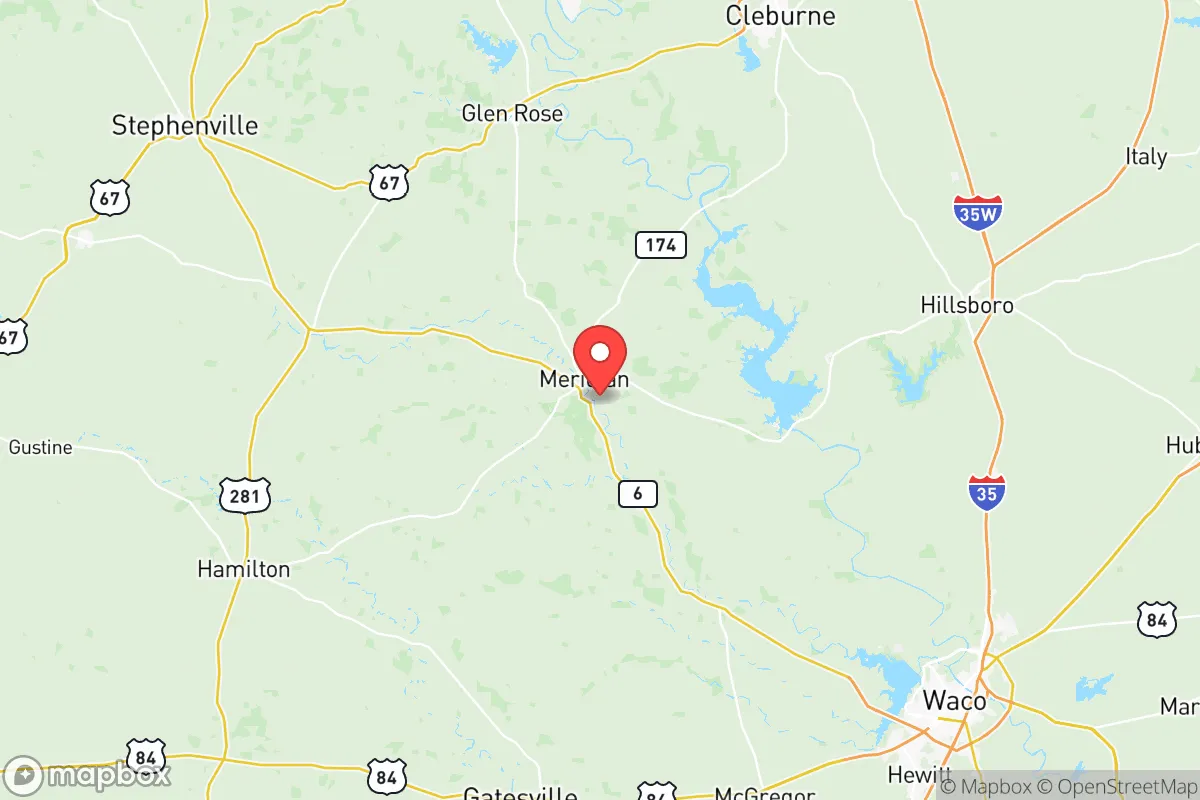
The R+7 gap between Bosque County and the state of Texas is substantial. While Texas is a solidly red state, its urban centers—Houston, Dallas, Austin, San Antonio—create a more competitive statewide environment. Bosque County, by contrast, has no major city to pull it leftward. The county seat, Meridian, is a small town of under 1,500 people, and its politics are deeply conservative. However, there are subtle variations. The town of Clifton, home to a sizable Norwegian-American community and a small liberal arts college (Clifton College), tends to be the most moderate precinct in the county, occasionally producing a few more Democratic votes than the surrounding rural areas. Conversely, the unincorporated areas around Lake Whitney and the town of Walnut Springs are among the most staunchly Republican, driven by a mix of retirees and ranching families. The swing precincts are essentially non-existent; the county's political trajectory has been a steady march rightward since the 1990s, with no sign of reversal.
What this means for residents
For conservative residents, Bosque County feels like a natural fit. Local government is dominated by Republicans, and policy debates tend to center on property taxes, water rights, and maintaining rural infrastructure—issues that align with a limited-government philosophy. A conservative can expect their views to be the majority in most public meetings and social settings. For liberal residents, the reality is more about finding community within a minority. There is a small but active Democratic club in Clifton, and the county's few progressive voices tend to coalesce around local issues like school funding or environmental protection of the Bosque River. They won't face hostility, but they will be in a clear minority. The practical effect of the county's lean is that national political debates often feel distant; the focus is on local concerns like the condition of Highway 6 or the cost of a new fire truck for the Iredell Volunteer Fire Department.
Culturally, Bosque County is distinct from the fast-growing suburbs of Dallas-Fort Worth or the liberal bubble of Austin. The pace of life is slower, and community ties are strong. There is a palpable sense of self-reliance, reflected in the number of "In God We Trust" signs on police cars and the popularity of the Bosque County Fair. Policy-wise, the county is a Second Amendment sanctuary, and local officials have publicly resisted state-level mandates they view as overreach, whether from Austin or Washington. For anyone moving here, the key takeaway is that Bosque County offers a stable, predictable political environment where the conservative majority sets the tone, but where there is still room for respectful disagreement on local matters. It's a place where your vote matters less in the national conversation and more in deciding who fixes the roads and runs the school board.

State Political ClimatePolitical Climate in Texas
State Political AnalysisPolitical Environment in the State
Texas has been a reliably Republican state for the past three decades, with a Cook Partisan Voting Index of R+4, but that label masks a dramatic and ongoing realignment. The state’s dominant coalition is a mix of rural and suburban conservatives, evangelical Christians, and business interests, but the 10-to-20-year trajectory shows a slow but steady shift toward competitiveness driven by explosive growth in the Democratic-leaning urban cores of Houston, Dallas, San Antonio, and Austin. In 2020, Donald Trump still won Texas by 5.6 points, down from 9 points in 2016 and 16 points in 2012, and in 2024 he carried it by a similar margin, signaling that the GOP’s hold is stable but no longer expanding.
Urban vs. rural divide
The political map of Texas is a study in stark contrasts. The state’s four largest metros—Houston, Dallas-Fort Worth, San Antonio, and Austin—are the engines of Democratic growth. Harris County (Houston) flipped blue in 2018 and has stayed there, while Dallas and Tarrant counties (Fort Worth) have become battlegrounds; Tarrant County, a longtime GOP stronghold, voted for Biden in 2020 and Trump in 2024, reflecting its suburban swing. Austin’s Travis County is the bluest urban core, routinely giving Democrats 70%+ of the vote. Meanwhile, rural West Texas (Lubbock, Midland, Odessa) and East Texas (Tyler, Longview) are deeply Republican, often voting 80%+ for the GOP. The Rio Grande Valley, historically Democratic, has shifted right—Hidalgo County (McAllen) went from +40 D in 2012 to +15 D in 2024, driven by working-class Hispanic voters moving toward the GOP on economic and cultural issues. Suburban counties like Collin (north of Dallas) and Williamson (north of Austin) are the real battlegrounds; Collin is still red but trending purple, while Williamson has flipped blue in presidential years.
Policy environment
Texas’s policy environment is defined by a low-tax, low-regulation posture that appeals to conservative relocators. There is no state income tax, funded instead by a reliance on property taxes and a 6.25% state sales tax (local options can push it to 8.25%). The regulatory climate is business-friendly, with minimal zoning in many areas and a right-to-work law that limits union power. Education policy is a flashpoint: the state uses a school finance system that relies heavily on local property taxes, leading to wide disparities between wealthy and poor districts. The 2023 school voucher bill (SB 8) failed in the House due to rural Republican opposition, but Governor Greg Abbott has made it a priority for 2025. Healthcare is a major gap—Texas has the highest uninsured rate in the nation (about 17%), having refused Medicaid expansion under the ACA. Election laws have tightened: the 2021 SB 1 restricted mail-in voting, added ID requirements, and limited drive-through and 24-hour voting, a response to Harris County’s 2020 innovations. Abortion is effectively banned after the 2021 “trigger law” (SB 8) and the 2023 near-total ban (HB 1280), with no exceptions for rape or incest, only for the life of the mother.
Recent policy direction
The last five years have seen Texas move decisively to the right on cultural and liberty issues, even as the electorate has grown more diverse. On gun rights, the state enacted permitless carry (HB 1927) in 2021, allowing most adults to carry handguns without a license or training. Parental rights in education were strengthened by the 2023 “Parental Bill of Rights” (HB 900), which requires schools to post curriculum online and allows parents to opt children out of certain materials. Speech on campus has been protected by the 2019 “Campus Free Speech” law (SB 18), which prohibits public universities from limiting speech in outdoor areas. Privacy and surveillance saw a win for conservatives with the 2023 ban on TikTok on government devices (SB 1893), but the state also expanded police surveillance powers through the 2021 “George Floyd Act” (HB 9), which mandated body cameras and chokehold bans. Medical and bodily autonomy is tightly restricted: abortion is banned, and the 2023 “Save Women’s Sports” act (SB 15) bars transgender girls from female school sports. Property rights are strong—Texas has no state-level property tax, but local appraisal caps (10% annual increase for homesteads) provide some protection. Voting access has been restricted, as noted, but early voting hours remain generous (two weeks). Taxation remains the biggest draw: no income tax, but property taxes are among the highest in the nation, averaging 1.6% of home value.
Civil unrest & political movements
Texas has seen significant civil unrest and organized activism on both sides. The 2020 Black Lives Matter protests in Austin, Houston, and Dallas were among the largest in the country, with Austin seeing nightly demonstrations for weeks. In response, the 2021 “Back the Blue” legislation (HB 9) increased penalties for rioting and blocking highways. Immigration politics are a constant flashpoint: the 2023 “Operation Lone Star” border mission, launched by Abbott, has deployed thousands of National Guard troops and state troopers to the border, bused migrants to northern cities, and installed razor wire and buoys in the Rio Grande. The state has sued the Biden administration over border policies, and the 2024 SB 4 law, which allows state police to arrest and deport migrants, is currently tied up in court. Secession rhetoric has flared among some far-right activists, with the “Texit” movement gaining a small but vocal following, though no serious political figure endorses it. Election integrity controversies have been a major theme since 2020, with the state GOP pushing for forensic audits in four counties (Harris, Dallas, Tarrant, Collin), though no widespread fraud was found. A new resident would notice the heavy police presence in border towns like El Paso and Brownsville, and the occasional protest at the state capitol in Austin on hot-button issues like abortion and guns.
Projection
Over the next 5-10 years, Texas will continue its slow shift toward competitiveness, but the GOP’s structural advantages—no income tax, strong rural turnout, and a growing Hispanic conservative vote—will keep it red for the foreseeable future. The key demographic driver is in-migration: about 1,000 people move to Texas daily, many from California and the Northeast, and they tend to be younger and more diverse. However, they are not uniformly liberal—many are attracted by the low-tax, business-friendly environment and may vote Republican. The suburbs of Dallas, Houston, and Austin will be the decisive battlegrounds; places like Frisco, McKinney, and Round Rock are growing fast and could flip blue in the next decade. The Rio Grande Valley’s rightward shift is a wild card—if it continues, it could offset urban gains. Policy-wise, expect continued fights over school vouchers, property tax reform, and border security. A new resident moving in now should expect a state that remains conservative on cultural issues (abortion, guns, education) but is increasingly divided along geographic and generational lines.
For a new resident, the bottom line is that Texas offers a low-tax, high-freedom environment for conservatives, with strong gun rights, no income tax, and a business-friendly climate. Liberals will find vibrant urban communities in Austin, Houston, and Dallas, but will face a state government that is actively hostile to their priorities on abortion, voting, and immigration. The political climate is intense but not chaotic—most people live in politically homogeneous bubbles, and the day-to-day experience is shaped more by traffic and weather than by partisan conflict. If you’re moving here, pick your county carefully: it will determine your school quality, tax burden, and political representation more than the state as a whole.
* Values derived from national, state, county, city and local statistics and may differ in a specific area. Last updated: 2026-06-11T03:46:01.000Z
Narrative content on this page is AI-generated and may contain mistakes. Verify any details that matter before acting on them.
ReloMaps may earn a commission from affiliate links at no extra cost to you.

