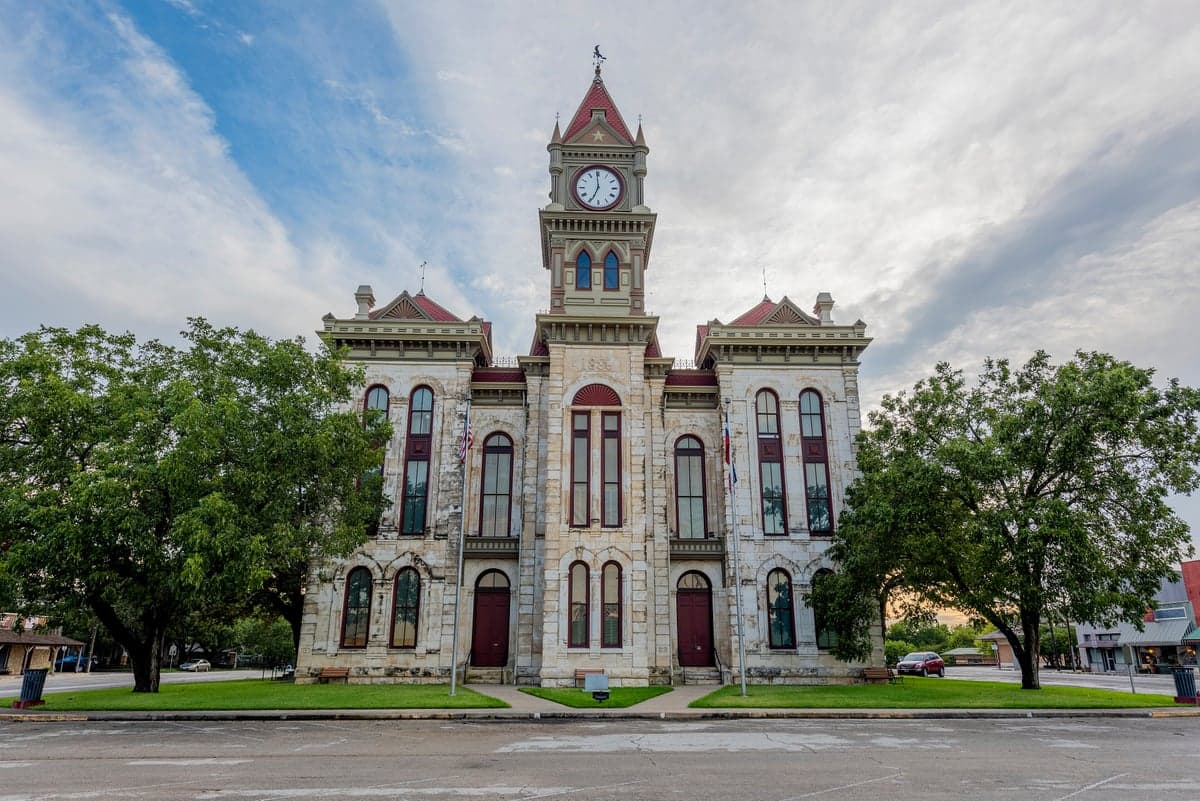
Photo: Wikipedia
Demographics of Bosque County
Affluence Level in Bosque County
A middle-class area roughly in line with national averages across income, home values, education, and employment.
People of Bosque County
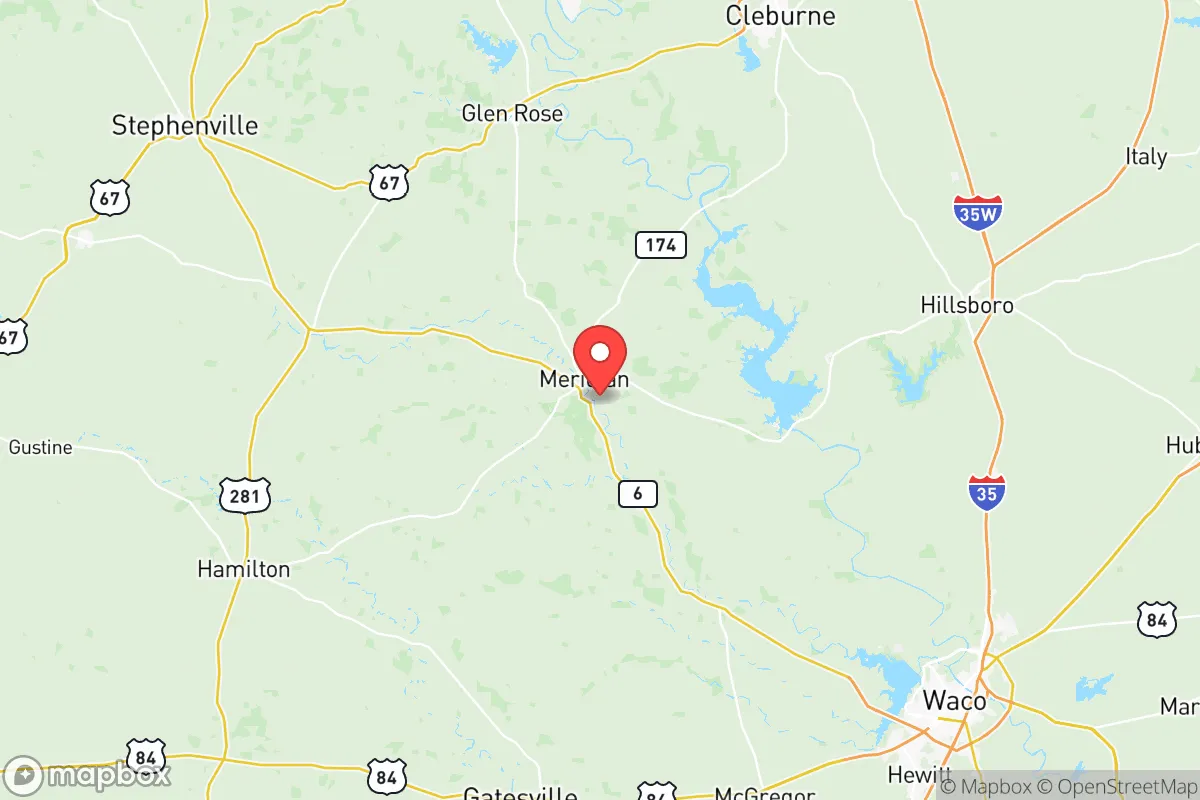
The people of Bosque County, Texas today number 18,546, a population that is 75.6% white and 18.8% Hispanic, with a foreign-born share of just 3.9%. This rural county, anchored by the towns of Meridian, Clifton, and Valley Mills, retains a distinctly Texan character shaped by 19th-century European settlement and a slow, steady diversification in recent decades. With only 20.7% of adults holding a college degree, the county’s identity is rooted in agriculture, small-town life, and a conservative social fabric that appeals to families seeking space and tradition.
Settlement & growth (pre-1960)
Before Anglo-American settlement, the area now known as Bosque County was part of the traditional lands of the Wichita and Comanche nations, who used the Bosque River valley for hunting and seasonal camps. Spanish and Mexican authorities claimed the region but established no permanent settlements here, leaving the land largely under Native control until the Texas Republic era. The first Anglo settlers arrived in the 1850s, drawn by cheap land grants from the state of Texas and the promise of fertile blackland prairie for cotton farming. Bosque County was formally organized in 1854, with Meridian designated as the county seat.
The most significant wave of settlement came from Norwegian immigrants beginning in the 1850s, who established a concentrated community in and around Clifton. These families, fleeing land scarcity and religious pressures in Norway, were drawn by the Texas Land and Emigration Company’s promotions and the availability of affordable farmland. By the 1870s, Clifton had become the heart of Norwegian Texan culture, with its own Lutheran churches, Norwegian-language newspapers, and a distinct architectural heritage that persists today. The town of Cranfills Gap, settled by Norwegian immigrants in the 1860s, became another stronghold, and the nearby Our Savior’s Lutheran Church remains a landmark of this heritage.
Simultaneously, German and Czech immigrants arrived in smaller numbers, settling in areas like Iredell and Walnut Springs, where they established farms and small businesses. These groups, like the Norwegians, were drawn by land availability and the promise of religious freedom. The county’s population grew steadily through the late 19th century, peaking at around 20,000 in 1900 before a gradual decline as younger generations moved to urban centers. The African American population, which reached about 10% in the 1880s, was concentrated in small communities like Mosheim and around Meridian, where freedmen worked as sharecroppers and tenant farmers after the Civil War. However, the Great Migration (1910–1970) drew most Black families out of the county to cities like Dallas and Fort Worth, reducing the Black share to its current 1.2%.
By 1960, Bosque County’s population had stabilized around 11,000, with a nearly homogenous white population of Norwegian, German, and Czech descent. The economy remained agricultural—cotton, cattle, and pecans—with small towns serving as trade and service centers. The county’s isolation from major highways and its lack of industrial development kept growth minimal through the mid-20th century.
Modern era (post-1965)
The 1965 Hart-Cellar Act had little direct impact on Bosque County, as the county’s remote rural character and limited job opportunities did not attract the new immigrant waves that reshaped urban Texas. Instead, the county’s modern demographic shift has been driven by domestic migration from within the United States. Since the 1990s, a steady influx of Hispanic families—primarily of Mexican descent—has moved into the county, drawn by work in agriculture, construction, and the service industries in towns like Clifton and Meridian. This group has grown from a negligible share in 1980 to 18.8% today, making them the largest minority population. They tend to settle in the county’s unincorporated areas and smaller towns, often working on ranches or in the pecan orchards that dot the Bosque River valley.
Domestic migration from other parts of Texas and the U.S. has also increased since 2000, as retirees and families from the Dallas-Fort Worth metroplex seek cheaper land and a slower pace of life. Valley Mills, on the county’s eastern edge, has seen modest suburban-style development as a bedroom community for commuters to Waco and even Fort Worth. This influx is predominantly white and middle-class, reinforcing the county’s existing cultural character. The East/Southeast Asian population remains tiny at 0.3%, and the Indian subcontinent population is 0.2%, both concentrated among a handful of professionals in healthcare and education in Clifton and Meridian. The county’s foreign-born share of 3.9% is well below the Texas average of 17%, reflecting its limited draw for international immigrants.
Suburbanization has been modest, with no major subdivisions or master-planned communities. Instead, new residents tend to buy existing farmhouses or build on acreage, preserving the county’s rural feel. The population has grown from 17,204 in 2000 to 18,546 in 2020, a slow but steady increase driven entirely by domestic in-migration, as natural increase (births minus deaths) has been flat or negative.
The future
Bosque County is projected to continue its slow growth, reaching roughly 20,000 by 2040, driven primarily by continued domestic migration from the Dallas-Fort Worth and Waco metro areas. The county is becoming slightly more diverse, with the Hispanic share expected to rise to around 25% by 2040, as younger Hispanic families have higher birth rates and continued in-migration. The white share will likely decline to the low 70% range, but the county will remain overwhelmingly non-Hispanic white and culturally conservative. The Black, Asian, and Indian populations are expected to remain below 2% each, as the county’s limited job base and lack of ethnic infrastructure do not attract significant international migration.
New communities are likely to concentrate along the State Highway 6 corridor between Clifton and Meridian, where commuter access to Waco is improving. The town of Laguna Park, on Lake Whitney’s eastern shore, may see modest growth as a retirement and recreation destination. However, the county’s cultural identity—rooted in Norwegian Lutheran heritage, small-town independence, and agricultural traditions—is likely to persist, as new residents are drawn to that character rather than transforming it. The county’s political leanings, already strongly Republican, will likely remain so, with the growing Hispanic population tending toward conservative social values.
For someone moving in now, Bosque County offers a stable, slow-changing rural environment where community ties are strong and newcomers are expected to integrate into existing social structures. The population is aging—the median age is 46.5, well above the Texas median of 35—but younger families are arriving, creating a gradual generational turnover. The county is not becoming a multicultural melting pot; it is becoming a slightly more diverse version of its historical self, with the Norwegian and German heritage still visible in place names, church steeples, and annual festivals like Clifton’s Norwegian Country Christmas.

* Values derived from national, state, county, city and local statistics and may differ in a specific area. Last updated: 2026-06-11T03:46:01.000Z
Narrative content on this page is AI-generated and may contain mistakes. Verify any details that matter before acting on them.
ReloMaps may earn a commission from affiliate links at no extra cost to you.

