Photo: Wikipedia
Demographics of Texarkana, AR
Affluence Level in Texarkana, AR
A below-average socioeconomic profile. Incomes, home values, and educational attainment trail the U.S., with higher poverty and unemployment.
People of Texarkana, AR
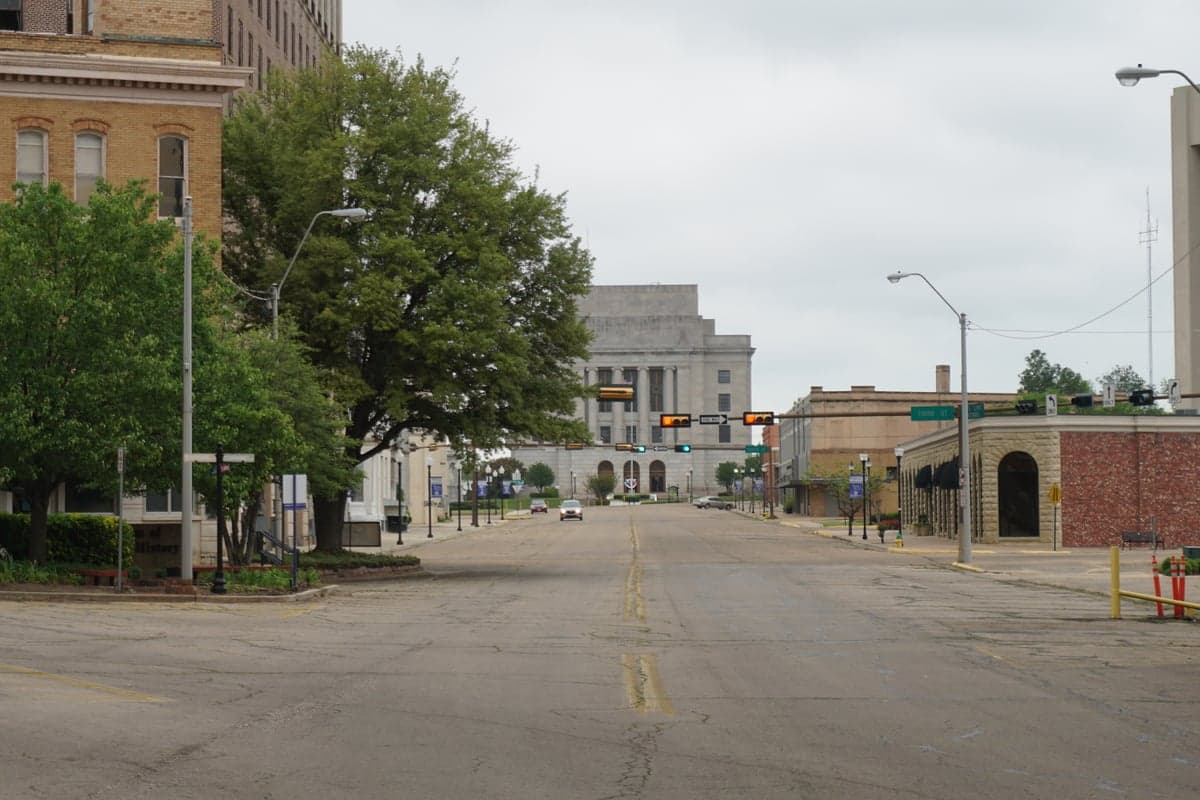
The people of Texarkana, Arkansas are a predominantly native-born population of 29,343, characterized by a biracial Black and White demographic core with very low ethnic diversity. The city’s identity is rooted in its railroad and manufacturing history, with a population density of roughly 1,200 people per square mile and a strong sense of local place that spans the state line. Only 0.8% of residents are foreign-born, making it one of the least internationally diverse cities in the South, while the college-educated share sits at 16.7%, below the national average.
How the city was settled and grew
Texarkana, Arkansas was founded in 1873 as a railroad town, born directly from the convergence of the Cairo and Fulton Railroad (later the Texas and Pacific Railway) and the St. Louis, Iron Mountain and Southern Railway. The original population was drawn by railroad construction jobs and the promise of commerce at the Arkansas-Texas border. The earliest settlers were overwhelmingly White migrants from the Upper South—Tennessee, Kentucky, and Missouri—who arrived in the 1870s and 1880s. They built the first residential blocks in what is now the Downtown Texarkana district, clustering along the rail corridor. By the 1890s, African American laborers, many from rural Arkansas and Louisiana, arrived to work as railroad hands, domestic servants, and in the burgeoning timber and cotton industries. They established the East Side neighborhood, east of the tracks, which became the historic center of Black life in the city. A smaller wave of German and Irish immigrants came through the railroad in the 1880s, settling in the College Hill area near the old Arkansas Agricultural and Mechanical College (now Texas A&M University-Texarkana). The city’s population grew steadily through the early 20th century, reaching about 11,000 by 1930, driven by the railroad, a major lumber mill, and the Red River Army Depot established in 1941.
Modern era (post-1965)
After the 1965 Hart-Cellar Act, Texarkana, AR saw virtually no new international immigration—the foreign-born share remains below 1%—so the city’s demographic story since the 1970s is entirely about domestic migration and suburbanization. The White population, which was roughly 70% in 1970, declined to 55.9% by the 2020s as many middle-class White families moved to newer subdivisions in the Pleasant Grove area (on the Texas side of the metro) and to the North Heights neighborhood within the Arkansas city limits. The Black population, historically concentrated in East Side, expanded into the Southside district and the Miller County unincorporated areas as housing patterns shifted. The Hispanic share, at 4.3%, is small but grew from near zero in 1990, driven by Mexican-origin workers in construction and poultry processing in the broader region. The East/Southeast Asian population (0.3%) and Indian subcontinent population (0.2%) are tiny, mostly professionals associated with the local hospital system and Texas A&M University-Texarkana, living in the College Hill area near the campus. The city has not experienced significant suburbanization within its own borders; instead, the Arkansas side has remained more compact and older, while newer growth has leapfrogged to the Texas side of the metro.
The future
The population of Texarkana, AR is likely to remain stable or decline slightly over the next 10–20 years, as the city has lost about 2% of its population since 2010. The White share is expected to continue a slow decline, while the Black share may stabilize or grow modestly through natural increase. The Hispanic population will likely grow slowly from its small base, possibly reaching 6–7% by 2040, but will remain a minority within a minority. The East/Southeast Asian and Indian communities are too small to drive any measurable demographic shift and will likely remain below 1% combined. The city is not homogenizing into a single identity; rather, it is solidifying into two distinct residential zones: the East Side and Southside remain predominantly Black, while College Hill and North Heights are majority White. The Downtown area is seeing some reinvestment but remains a commercial and government hub, not a major residential draw. For a newcomer, this means moving into a city where neighborhood choice strongly correlates with racial background, and where the population is aging—the median age is 37.5—with limited in-migration of young families.
Texarkana, Arkansas is becoming a smaller, older, and more residentially segregated city, with a biracial character that shows little sign of diversifying. For a conservative-leaning individual or family considering relocation, the city offers a low-cost, low-crime environment relative to larger metros, but with a demographic reality that is starkly divided by neighborhood and unlikely to change significantly in the coming decades. The practical takeaway: choose your neighborhood carefully, as the social and economic character varies sharply between the historic Black east side and the Whiter west and north sides.

* Values derived from national, state, county, city and local statistics and may differ in a specific area. Last updated: 2026-04-23T03:18:26.000Z
Narrative content on this page is AI-generated and may contain mistakes. Verify any details that matter before acting on them.
ReloMaps may earn a commission from affiliate links at no extra cost to you.

