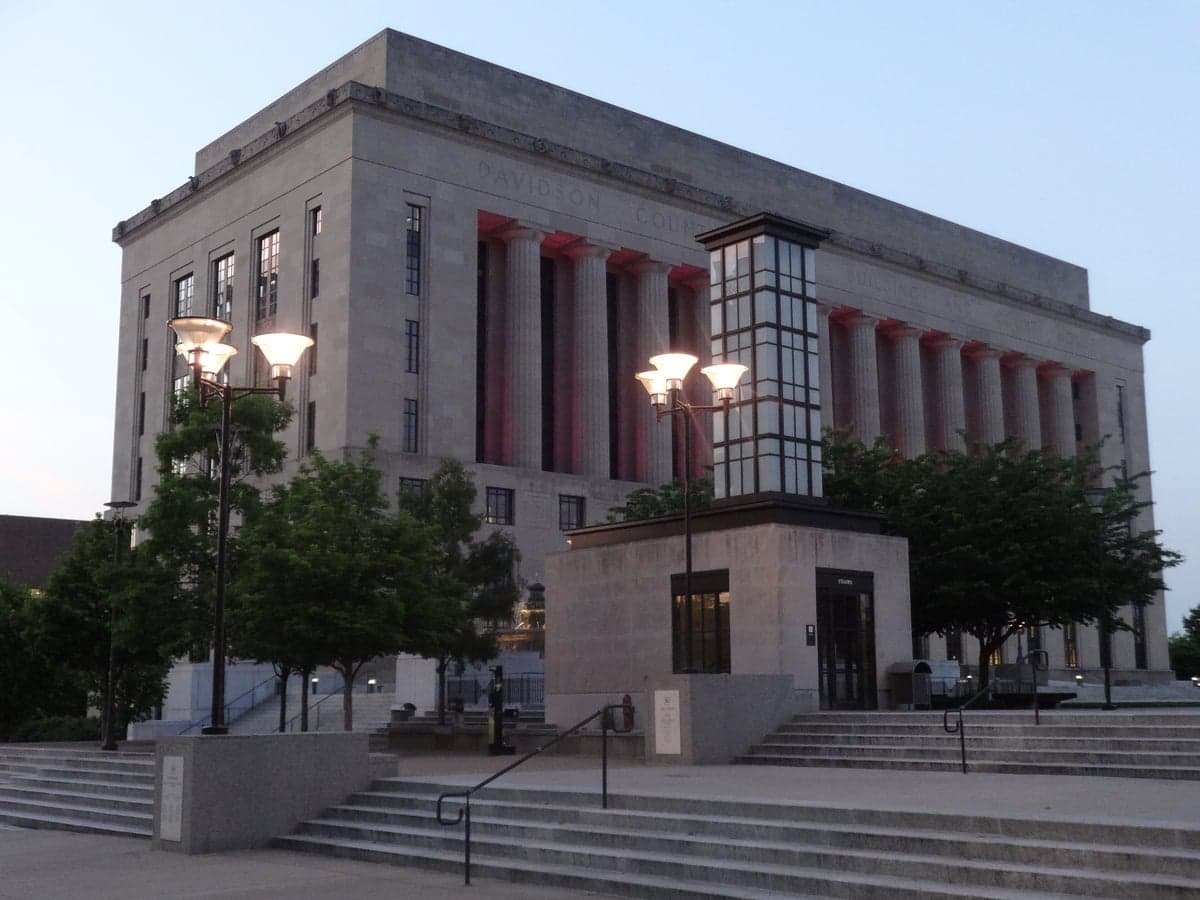
Photo: Wikipedia
Demographics of Davidson County
Affluence Level in Davidson County
A middle-class area roughly in line with national averages across income, home values, education, and employment.
People of Davidson County
The people of Davidson County, Tennessee, today form a dense, majority-minority urban core of 709,846 residents, characterized by a 53.5% white population, a substantial 24.9% Black community, a rapidly growing 13.6% Hispanic population, and smaller but significant East/Southeast Asian (2.5%) and Indian (0.9%) enclaves. With 47.3% of adults holding a college degree, the county is highly educated and politically liberal, a sharp contrast to the surrounding, more conservative and rural Middle Tennessee region. The county’s identity is defined by its role as the state’s economic and cultural engine, anchored by Nashville, a city that has transformed from a regional hub into a national destination for both domestic migrants and international arrivals.
Settlement & growth (pre-1960)
Before American settlement, the area now known as Davidson County was primarily used as a hunting ground by the Cherokee and Chickasaw nations, with no permanent Native American villages within the county’s modern boundaries. The first permanent European settlers were Scots-Irish and English pioneers who arrived in the late 1770s, led by James Robertson and John Donelson. They founded Fort Nashborough in 1779 on the Cumberland River, a fortified settlement that would become the nucleus of Nashville. These early settlers were granted land under the North Carolina land grant system, drawn by the fertile river valleys and the promise of self-sufficient farming.
Through the 19th century, the population grew steadily, driven by two primary forces: the expansion of slavery-based cotton agriculture and the rise of Nashville as a river trade and transportation hub. By 1860, enslaved African Americans made up roughly a quarter of the county’s population, concentrated in the rural areas around Belle Meade and Donelson, where large plantations operated. After the Civil War and emancipation, many freed Blacks moved into Nashville proper, forming neighborhoods like North Nashville and Edgehill, which became centers of Black business, education (Fisk University, Meharry Medical College), and culture.
The late 19th and early 20th centuries brought a wave of European immigrants, though smaller than in Northern industrial cities. German and Irish immigrants arrived in the 1840s-1880s, many working as laborers on the railroads and in the growing tobacco and printing industries. They settled in working-class areas like Germantown (north of downtown) and East Nashville. A smaller wave of Italian and Greek immigrants followed in the 1890s-1910s, opening grocery stores and restaurants, particularly in the South Nashville area. The Great Migration of African Americans from the rural South to Nashville accelerated between 1910 and 1960, with the Black population growing from 30% to nearly 40% of the county total by 1960, concentrated in North Nashville and Bordeaux.
Modern era (post-1965)
The 1965 Hart-Cellar Act fundamentally reshaped Davidson County’s demographics, though the effects were slower to appear than in coastal cities. The first major post-1965 immigrant group was from Southeast Asia: Vietnamese and Laotian refugees arrived in the late 1970s and 1980s, resettled by church and nonprofit sponsors. They concentrated in South Nashville along Nolensville Pike, an area that remains the heart of the county’s East/Southeast Asian community, with Vietnamese grocery stores, pho restaurants, and Buddhist temples. The Asian population (East/Southeast Asian, excluding Indian subcontinent) now stands at 2.5% of the county.
Hispanic immigration began in earnest in the 1990s, driven by construction, hospitality, and service-industry jobs in Nashville’s booming economy. Mexican and Central American immigrants settled heavily in South Nashville and Antioch, creating a vibrant corridor along Nolensville Road and Murfreesboro Pike. The Hispanic population has grown from under 2% in 1990 to 13.6% today, making it the fastest-growing demographic group in the county. This community is predominantly Mexican and Salvadoran, with smaller numbers from Guatemala and Honduras.
Domestic migration has been equally transformative. Since the 1990s, Nashville has attracted a steady stream of domestic migrants from the Rust Belt (Ohio, Michigan, Illinois) and, more recently, from coastal states like California and New York. These newcomers are disproportionately young, college-educated, and white, drawn by the city’s relatively low cost of living (historically), booming healthcare and music industries, and no state income tax. This influx has driven the white population share down from 66% in 1990 to 53.5% today, not because whites are leaving, but because the county is becoming more diverse overall. The Indian subcontinent community (0.9%) is a smaller but notable group, concentrated in the Brentwood and Franklin areas just south of the county line, working in healthcare and IT.
Suburbanization has reshaped the county’s geography. While Nashville’s urban core has densified with luxury apartments and condos, the county’s southern and eastern edges—Antioch, Hermitage, and Donelson—have become majority-minority suburbs, with large Black, Hispanic, and immigrant populations. The wealthier western neighborhoods, like Belle Meade and West Meade, remain predominantly white and affluent.
The future
Davidson County is likely to continue its trajectory toward a majority-minority population, with the Hispanic share projected to reach 18-20% by 2035, driven by both immigration and higher birth rates. The Black population share is stabilizing around 25%, as some middle-class Black families move to surrounding counties like Rutherford and Williamson. The East/Southeast Asian and Indian communities are growing slowly but steadily, primarily through professional migration tied to Nashville’s healthcare and tech sectors.
The county is not homogenizing but rather tribalizing into distinct enclaves: a liberal, white, college-educated urban core; a diverse, working-class southern crescent; and affluent, predominantly white western neighborhoods. The cultural identity of Nashville is being reshaped by in-migration: the old “Music City” identity is giving way to a more generic Sun Belt boomtown character, with rising costs and traffic that are beginning to slow domestic migration. The immigrant communities, particularly Hispanic and Southeast Asian, are assimilating economically but maintaining distinct cultural neighborhoods.
For someone moving in now, Davidson County is a place of stark contrasts: a highly educated, politically progressive urban core surrounded by a diverse, working-class periphery. The county offers economic opportunity and cultural dynamism, but at the cost of rising housing prices and increasing congestion. The next decade will likely see continued diversification, with the Hispanic community becoming an increasingly influential political and economic force, while the white college-educated population continues to drive the city’s cultural and economic agenda.

* Values derived from national, state, county, city and local statistics and may differ in a specific area. Last updated: 2026-05-09T19:31:42.000Z
Narrative content on this page is AI-generated and may contain mistakes. Verify any details that matter before acting on them.
ReloMaps may earn a commission from affiliate links at no extra cost to you.

