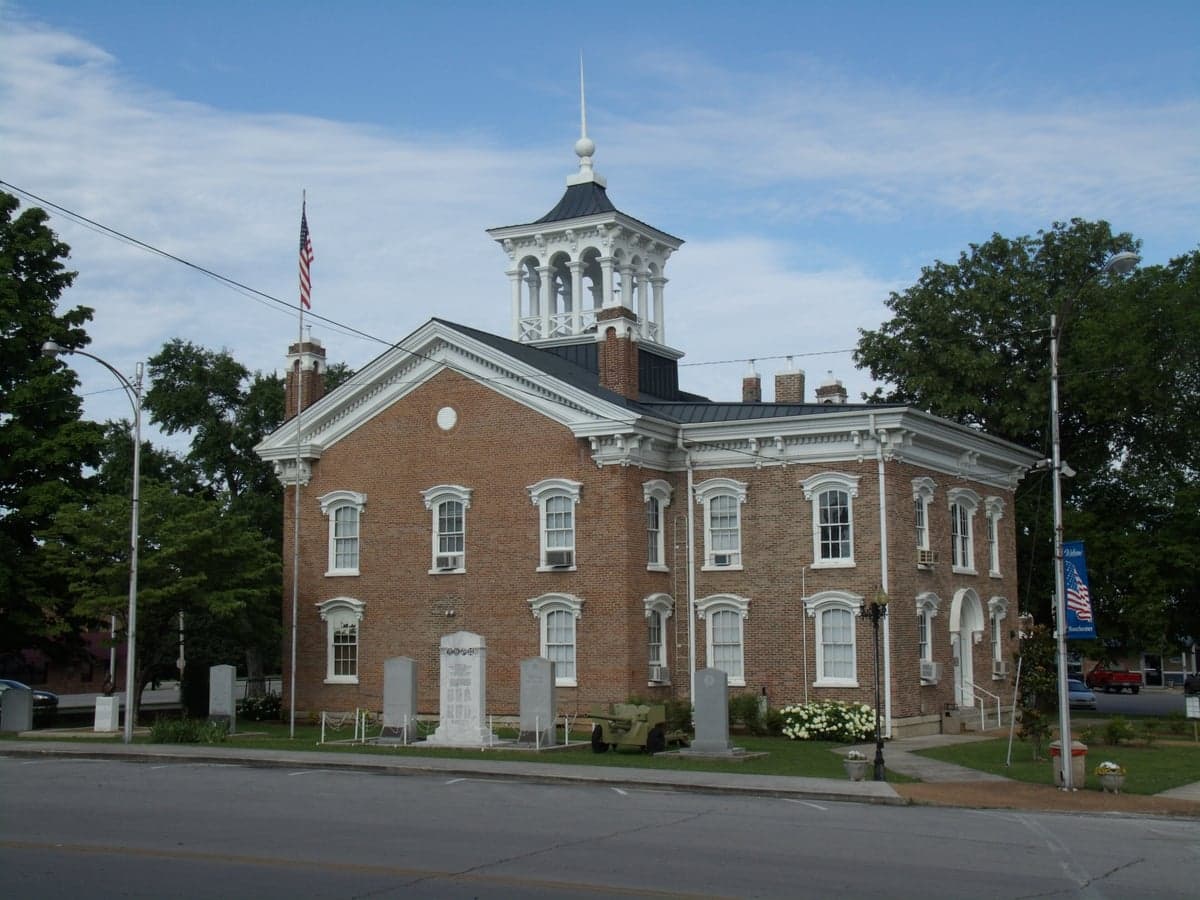
Photo: Wikipedia
Demographics of Coffee County
Affluence Level in Coffee County
A middle-class area roughly in line with national averages across income, home values, education, and employment.
People of Coffee County
Coffee County, Tennessee, is home to 58,940 residents who form a predominantly white, native-born population with a strong Southern identity and a growing Hispanic minority. The county’s character is shaped by its agricultural roots, its historic role as a railroad and manufacturing hub, and a steady but modest influx of newcomers. With a foreign-born population of just 1.6% and a college attainment rate of 22.9%, Coffee County remains a place where traditional values, family ties, and local industry define daily life more than cosmopolitan diversity.
Settlement & growth (pre-1960)
Before American settlement, the area now known as Coffee County was part of the hunting grounds of the Cherokee and Creek nations. European incursion was minimal until after the Cherokee Removal of the 1830s, which opened the region to white settlers. The county was formed in 1836 from parts of Bedford, Warren, and Franklin counties, named after General John Coffee, a hero of the War of 1812 and a close ally of Andrew Jackson.
The first major wave of settlers were Scots-Irish and English farmers from Virginia, North Carolina, and East Tennessee, who arrived in the 1830s and 1840s. They were drawn by cheap, fertile land in the Duck River Valley and the promise of subsistence farming and small-scale cotton cultivation. These early families established the county seat of Manchester (1836) and the smaller communities of Tullahoma (1852) and Hillsboro. Their descendants still form the core of the county’s white population today, concentrated in these same towns.
The next transformative wave came with the railroad. The Nashville and Chattanooga Railroad reached Tullahoma in 1852, turning it into a regional shipping and manufacturing center. During the Civil War, the county was a strategic supply point for the Union Army, and the post-war period saw an influx of freed slaves who settled in small enclaves around Manchester and Tullahoma, working as sharecroppers and laborers. By 1870, Black residents made up roughly 15% of the county’s population, a share that would decline steadily through the 20th century due to out-migration.
The early 20th century brought a modest wave of German and Irish immigrants who worked on railroad construction and in the emerging timber and flour milling industries. They settled primarily in Tullahoma and the railroad stop of Summitville. The 1930s and 1940s saw the arrival of Appalachian migrants from eastern Tennessee and Kentucky, drawn by jobs at the new Arnold Engineering Development Center (AEDC) near Tullahoma, established in 1947 as a U.S. Air Force testing facility. This federal installation became the county’s largest employer and attracted a wave of engineers, technicians, and military personnel, many of whom were from outside the South. The AEDC’s presence gave Tullahoma a more educated, professional class than the surrounding rural areas.
By 1960, Coffee County’s population was 85% white, 14% Black, and less than 1% foreign-born. The economy was a mix of agriculture (dairy, poultry, soybeans), manufacturing (textiles, auto parts), and the growing federal presence at AEDC.
Modern era (post-1965)
The 1965 Hart-Cellar Act had a minimal direct impact on Coffee County. Unlike major metropolitan areas, the county did not see large-scale immigration from Asia, Latin America, or the Middle East. The foreign-born population today stands at just 1.6%, far below the national average of 13.7%. The most visible change has been the growth of the Hispanic population, which rose from less than 1% in 1990 to 6.0% today. This growth is driven by Mexican and Central American immigrants who arrived from the 1990s onward, attracted by jobs in poultry processing, construction, and agriculture. They have concentrated in Manchester and Tullahoma, where a small but established Hispanic community supports Spanish-language churches, tiendas, and a growing second generation.
The Black population has declined from its post-Civil War peak to 4.0% today, reflecting the broader Great Migration out of the rural South and a lack of new in-migration. The East/Southeast Asian population (1.0%) and Indian subcontinent population (0.3%) are tiny and largely tied to professional roles at AEDC and the local hospital system. These groups are dispersed rather than forming distinct enclaves.
Domestic migration has been more significant than international immigration. Since the 1980s, Coffee County has attracted Rust Belt retirees and manufacturing workers from Ohio, Michigan, and Illinois, drawn by lower housing costs, a lower tax burden, and a slower pace of life. This in-migration has been especially visible in the lake communities around Timberlake and Lake Tansi, where many newcomers are seasonal or permanent residents. The county has also seen a modest influx of suburban spillover from the Nashville metropolitan area, as workers in the state capital seek affordable housing within a 90-minute commute. This has fueled new subdivisions around Manchester and along the I-24 corridor.
Suburbanization has been limited compared to Nashville’s outer suburbs. Coffee County remains largely rural, with no incorporated city exceeding 20,000 residents. The population density is 89 people per square mile, and the county’s identity remains tied to small-town life, church communities, and outdoor recreation (hunting, fishing, hiking at Old Stone Fort State Archaeological Park).
The future
Coffee County’s population is projected to grow slowly, reaching roughly 65,000 by 2040, driven by continued domestic in-migration from the Rust Belt and Nashville’s exurbs. The Hispanic share is likely to rise to 8-10% as the existing community grows through births and continued labor migration, but the county will remain overwhelmingly white and native-born. The Black and Asian populations are expected to remain stable or decline slightly, as there are no major pull factors for these groups.
The county is not tribalizing into distinct ethnic enclaves. Instead, it is slowly homogenizing: the small Hispanic community is assimilating into the broader Southern culture, with English-language dominance and intermarriage rates rising among the second generation. The white population, while still dominant, is becoming more diverse in origin — a mix of old-stock Southerners, Appalachian transplants, and Midwestern retirees. This blending is creating a cultural identity that is broadly conservative, churchgoing, and family-oriented, but less insular than it was a generation ago.
The biggest demographic wildcard is the AEDC and its spin-off industries. If federal defense spending shifts or the facility downsizes, the county could lose its most educated and highest-earning residents. Conversely, if the base expands or attracts private aerospace contractors, the county could see a modest influx of engineers and technicians from outside the region, potentially raising the college attainment rate (currently 22.9%) and diversifying the population slightly.
For someone moving in now, Coffee County offers a stable, low-cost, culturally conservative environment with a strong sense of place. It is not a place of rapid change or ethnic diversity, but it is also not stagnant. The population is aging slowly, and the schools in Tullahoma and Manchester are well-regarded. The county’s future is one of gradual, organic growth — more of the same, rather than a dramatic transformation.

* Values derived from national, state, county, city and local statistics and may differ in a specific area. Last updated: 2026-05-12T08:54:57.000Z
Narrative content on this page is AI-generated and may contain mistakes. Verify any details that matter before acting on them.
ReloMaps may earn a commission from affiliate links at no extra cost to you.

