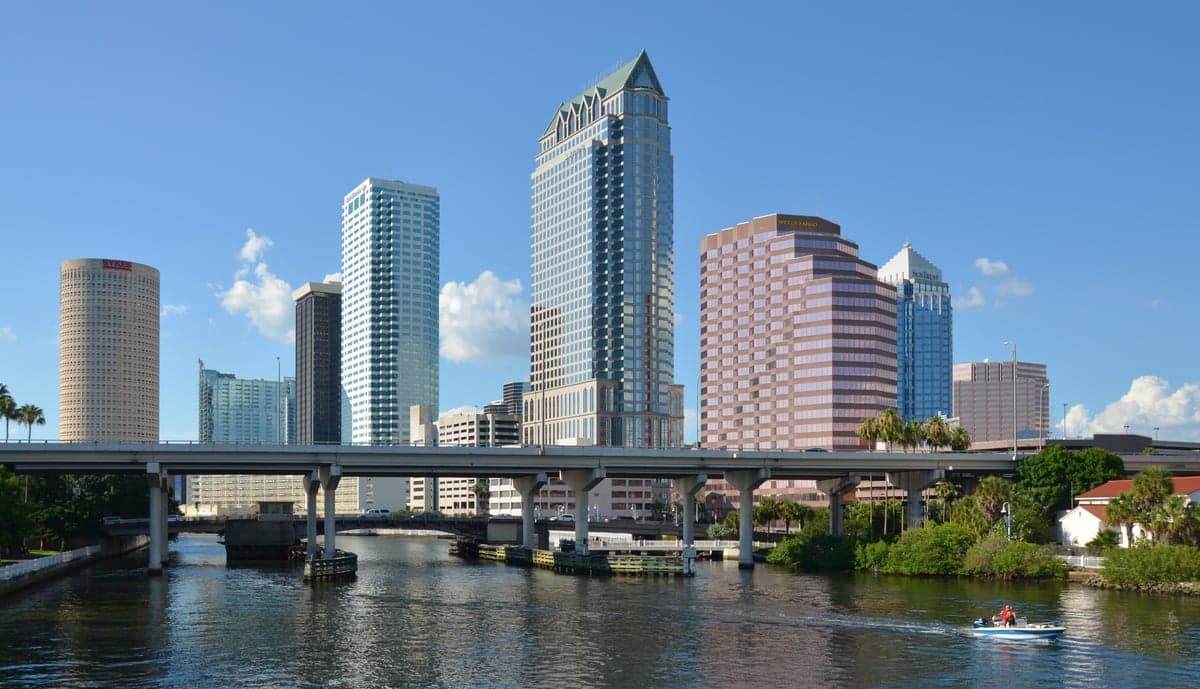
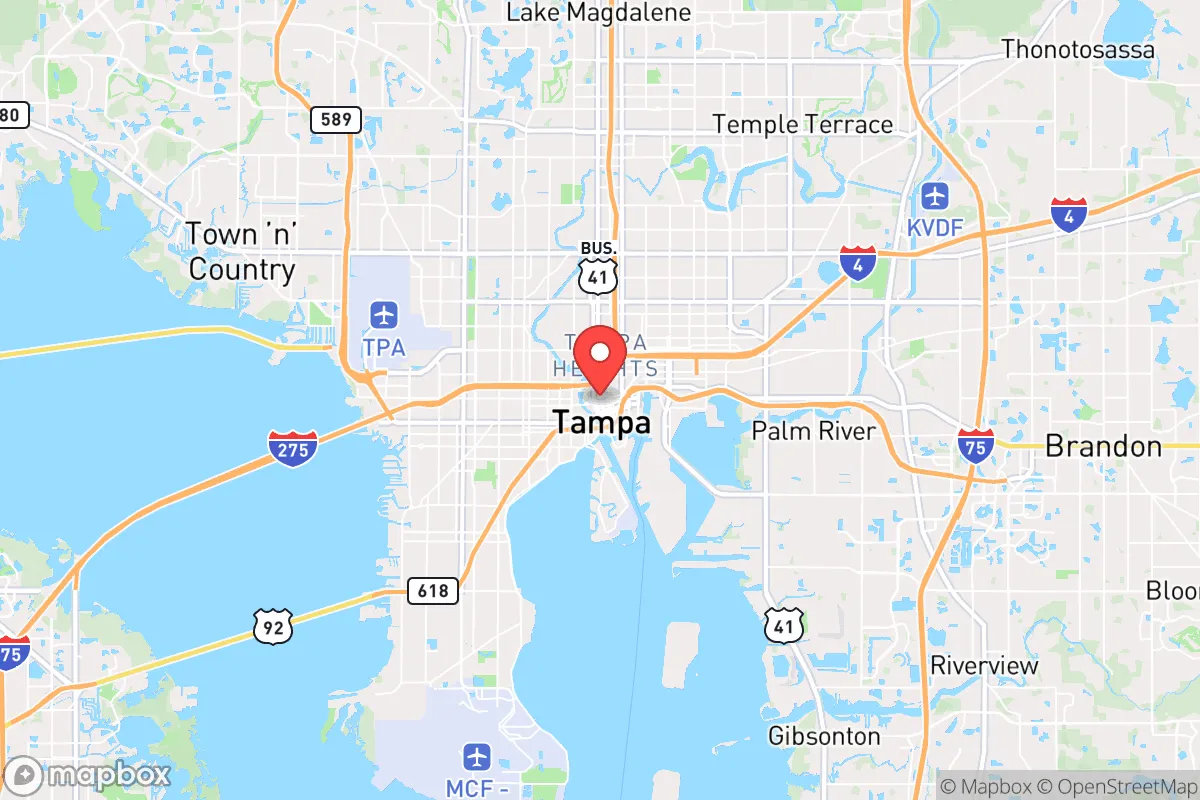
Photo: Wikipedia
Demographics of Tampa, FL
Affluence Level in Tampa, FL
A middle-class area roughly in line with national averages across income, home values, education, and employment.
People of Tampa, FL
Tampa today is a mid-sized, majority-minority city of 393,389 residents, defined by a tri-ethnic balance of White (44.2%), Hispanic (26.2%), and Black (20.1%) populations, with smaller but notable East/Southeast Asian (2.3%) and Indian-subcontinent (2.4%) communities. The city’s character is distinctly working-to-middle class, with a 44.6% college-educated rate that trails national averages for Sun Belt peers, and a foreign-born share of just 8.9% — lower than many coastal metros, reflecting a population built more by domestic migration than international arrivals. Tampa’s identity is rooted in its Cuban and Spanish cigar-making heritage, its role as a military and shipping hub, and a recent influx of retirees and remote workers from the Northeast and Midwest, giving it a blend of Old Florida grit and new suburban polish.
How the city was settled and grew
Tampa’s population history begins not with Spanish settlement (which was sparse) but with the U.S. Army’s establishment of Fort Brooke in 1824, which drew a small garrison and trading post. The real founding wave came after 1885, when Vicente Martinez Ybor, a Cuban cigar manufacturer, relocated his operations from Key West to escape labor unrest, building the company town of Ybor City. This neighborhood became the epicenter of Tampa’s first major population boom, drawing thousands of Cuban, Spanish, and Italian immigrants — mostly cigar workers — who lived in tightly packed wooden casitas and formed mutual-aid societies like the Centro Español and Centro Asturiano. By 1900, Tampa’s population had surged to 15,839, with Ybor City as the economic and cultural heart. A second wave followed the 1915 opening of the Port of Tampa and the 1920s land boom, which brought Anglo-American migrants from the rural South and Midwest to neighborhoods like Hyde Park and Davis Islands, the latter a planned community built on dredged land for the white professional class. The Black population, meanwhile, concentrated in West Tampa and the Central Avenue corridor, drawn by jobs in cigar factories and the port, though they faced strict Jim Crow segregation that lasted well into the 1960s. By 1950, Tampa had grown to 124,681, a diverse but deeply segregated city of cigar workers, port laborers, and a small professional elite.
Modern era (post-1965)
The post-1965 period reshaped Tampa’s population through two forces: the end of restrictive immigration quotas and the rise of air conditioning and interstate highways. The 1965 Hart-Cellar Act opened doors for Cuban refugees fleeing Castro’s regime, many of whom settled in West Tampa and Town 'N' Country, transforming the Hispanic share from a small Cuban enclave into a broad, multi-generational community that now includes Puerto Ricans, Colombians, and Mexicans. Simultaneously, the construction of I-75 and I-275 fueled white flight from the urban core to suburbs like New Tampa (annexed in the 1980s) and Carrollwood, draining the city’s White population from over 80% in 1960 to 44.2% today. The Black population, which had been concentrated in West Tampa and the now-demolished Central Avenue district, spread into East Tampa and Sulphur Springs after desegregation, though these areas remain among the city’s poorest. The Asian and Indian populations are a more recent phenomenon, arriving primarily after 1990: East/Southeast Asian communities (Vietnamese, Filipino, Chinese) cluster in New Tampa and the University of South Florida area, drawn by tech and healthcare jobs, while Indian-subcontinent families (2.4% of the city) are concentrated in the same northern suburbs, often working in IT and medicine. The foreign-born share, at 8.9%, is notably low for a Sun Belt city — Tampa’s growth has been driven more by domestic migrants from the Northeast and Midwest than by international arrivals, giving it a less cosmopolitan feel than Miami or Orlando.
The future
Tampa’s population is trending toward a more homogenized, suburbanized profile, with the city’s core gentrifying and its outer edges absorbing most new growth. The Hispanic share is rising steadily (from 19% in 2000 to 26.2% today), driven by both domestic migration and second-generation births, while the White share continues to decline. The Black population has plateaued at around 20%, with little net in-migration from other states. The East/Southeast Asian and Indian communities, though small, are growing rapidly in New Tampa and Wesley Chapel (just outside city limits), but they remain geographically concentrated and are not yet reshaping the city’s broader identity. The biggest wild card is the influx of remote workers and retirees from high-tax states like New York and Illinois, who are driving up home prices in Hyde Park, SoHo, and Downtown, accelerating gentrification that is pushing lower-income Black and Hispanic families into eastern suburbs like Brandon and Riverview. Over the next 10-20 years, Tampa will likely become more Hispanic (approaching 30-35%), slightly less Black, and more economically stratified, with a wealthy, college-educated core surrounded by a working-class periphery.
For someone moving in now, Tampa is a city in transition — still affordable by coastal standards, but losing its blue-collar character as new arrivals from the North and Midwest reshape its politics, housing, and culture. The population is becoming more Hispanic and more suburban, but the city remains less diverse and less immigrant-driven than its Florida peers, offering a more traditionally American, middle-class environment for families and singles alike.

* Values derived from national, state, county, city and local statistics and may differ in a specific area. Last updated: 2026-04-15T23:46:30.000Z
Narrative content on this page is AI-generated and may contain mistakes. Verify any details that matter before acting on them.
ReloMaps may earn a commission from affiliate links at no extra cost to you.

