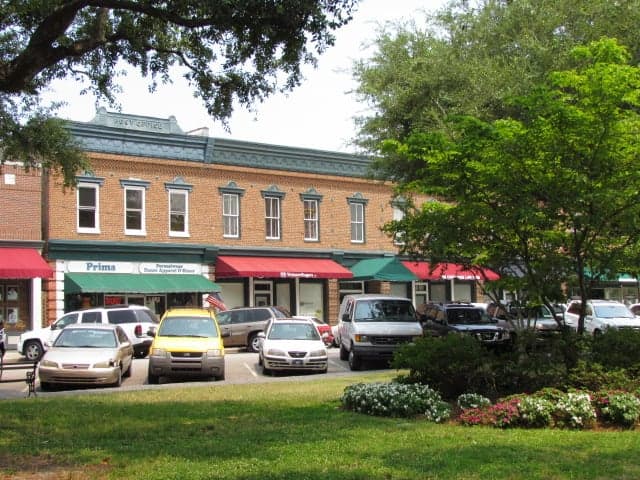
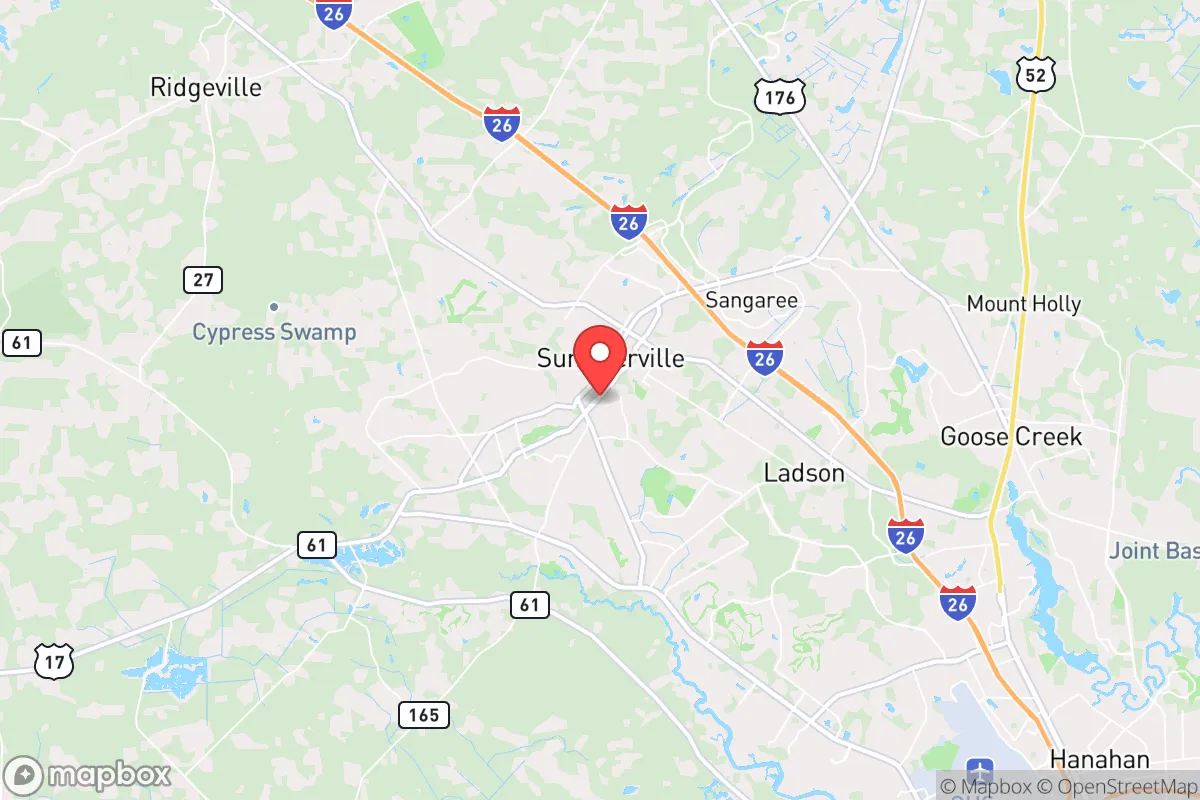
Photo: Wikipedia
Personal Sovereignty in Summerville, SC
Viable for self-reliance. Generally workable, though some barriers may limit total independence.
What does Personal Sovereignty tell us?
Personal Sovereignty measures your capacity for self-reliance and independence with minimal government friction. Higher scores mean fewer barriers between you and the way you want to live... but it assumes you have the space you need and good neighbors.
What does this tell us?
Personal Sovereignty measures your capacity for self-reliance and independence with minimal government friction. Higher scores mean fewer barriers between you and the way you want to live... but it assumes you have the space you need and good neighbors.
State Policy
Energy independence: Importer (25% of energy produced in-state)
Personal Liberty
Homesteading

Personal Liberty Analysis
For the liberty-minded individual or family evaluating Summerville, South Carolina, as a potential relocation destination, the personal sovereignty environment is a mixed but generally favorable picture. The town sits within a state that has made deliberate legal and cultural choices to preserve individual autonomy, particularly when compared to the regulatory density of the Northeast or West Coast. However, the rapid growth of the Charleston metro area—Summerville is roughly 25 miles inland from the coast—means that some of the pressures of suburbanization, including HOA restrictions and zoning creep, are increasingly present. For those operating from a survivalist or prepper mindset, the key question is whether Summerville offers enough legal and practical space to live according to your own rules, or whether it is becoming another enclave of managed living. The answer, as of 2026, is that the state-level framework strongly supports personal sovereignty, but the local implementation requires careful due diligence on specific neighborhoods and property types.
Tax burden and regulatory posture for the self-reliant individual
South Carolina’s tax structure is a significant asset for anyone seeking to minimize government extraction from their labor and assets. The state imposes a flat income tax rate of 6.2% as of 2026, down from a progressive system that previously topped out at 7%. This is not the lowest in the country, but it is predictable and avoids the bracket-creep that penalizes increased earnings. More importantly for the prepper mindset, South Carolina has no state-level tax on Social Security benefits and offers a generous $15,000 deduction on other retirement income for those over 65. Property taxes in Dorchester County, where Summerville is primarily located, are among the most favorable in the region. The effective property tax rate hovers around 0.55% of assessed value, roughly half the national average. This means a $400,000 home would incur about $2,200 annually in property taxes—a figure that allows you to retain more capital for your own preparedness investments, whether that’s land, supplies, or defensive infrastructure. On the regulatory side, South Carolina is a “right-to-work” state with minimal business licensing hurdles, and there is no state-level occupational licensing for many trades that would be relevant to a self-sufficient lifestyle, such as general handyman services or small-scale farming. The state also has no universal building code adoption at the local level; Dorchester County follows the International Residential Code, but enforcement is generally less aggressive than in urbanized areas like Charleston proper. For the individual who wants to build a workshop, install a rainwater catchment system, or keep livestock on their property, the regulatory posture is permissive, though you must verify that your specific subdivision or HOA does not impose stricter rules.
Self-defense rights and gun law specifics in South Carolina
For those prioritizing the right to keep and bear arms as a cornerstone of personal sovereignty, South Carolina is a solid but not absolute stronghold. The state is a constitutional carry jurisdiction as of 2024, meaning that any law-abiding adult 18 or older may carry a concealed firearm without a permit. This eliminates a bureaucratic barrier that many states use to chill the exercise of the right. However, there are nuances that the serious prepper must understand. South Carolina does not have a “stand your ground” law on the books; instead, it operates under a “castle doctrine” that presumes a reasonable fear of death or great bodily injury when an intruder unlawfully enters your home, vehicle, or place of business. Outside of those locations, you have a duty to retreat if safely possible before using deadly force. This is a meaningful distinction for those who envision defending their property beyond the home’s threshold. Additionally, the state has a 10-round magazine limit for handguns that was enacted in 2021, though it is currently being litigated and enforcement is uneven. For rifles, there is no magazine capacity restriction. The state also prohibits the open carry of handguns in certain locations, including restaurants that serve alcohol (unless you have a concealed weapons permit), and private property owners can ban firearms with posted signage. For the survivalist, the practical takeaway is that you can legally keep a well-stocked armory at home and carry concealed without government permission, but you must be aware of the retreat duty and the magazine limit if you carry a handgun for everyday defense. The political climate in Dorchester County is strongly supportive of Second Amendment rights, with local sheriffs generally taking a pro-owner stance and issuing concealed weapons permits (still useful for reciprocity in other states) without undue delay.
Self-reliance and homesteading viability: lot sizes, zoning, and off-grid feasibility
The viability of a self-reliant lifestyle in Summerville depends heavily on where exactly you land within the sprawling town limits. Summerville proper is a suburban environment with typical lot sizes of 0.25 to 0.5 acres in most subdivisions. These areas are governed by HOAs that often restrict everything from the number of vehicles you can park to the type of fencing you can install, and they generally prohibit livestock, chickens, or any structure that could be considered “unsightly” from the street. For the prepper seeking true autonomy, this is a non-starter. However, the unincorporated areas of Dorchester County, particularly north and west of Summerville along Highway 78 toward St. George, offer a different picture. Here, zoning allows for agricultural use on parcels as small as 2 acres, and many properties are available in the 5- to 20-acre range. These areas are not subject to HOA restrictions, and the county’s zoning code explicitly permits the keeping of livestock, poultry, and bees as accessory uses. Off-grid feasibility is moderate: South Carolina has no state law prohibiting rainwater collection, and well water is common in rural areas. However, the county requires a septic system permit for any dwelling, and there is no legal pathway to live entirely without a permanent structure—the county will not issue a certificate of occupancy for a tiny home on wheels or a converted shipping container unless it meets the building code for a dwelling. Solar panels are permitted without special restrictions, but net metering policies from the local utility, Dominion Energy, are not generous; they credit excess generation at the avoided cost rate, which is roughly 2-3 cents per kilowatt-hour. For the serious homesteader, the best strategy is to buy at least 5 acres in the unincorporated county, install a well and septic, and build a conventional home with solar backup, while keeping livestock and a substantial garden. The climate is forgiving for year-round growing, with a 220-day growing season, but you will need to contend with humidity and the occasional hurricane threat.
Personal liberties: parental rights, medical autonomy, speech, and property
South Carolina has positioned itself as a state that broadly respects personal liberties in several key areas that matter to the conservative-leaning individual. Parental rights are explicitly protected under state law, with a 2023 statute affirming that parents have the fundamental right to direct the upbringing, education, and healthcare of their minor children. This includes the right to opt out of any school curriculum or activity that conflicts with their religious or moral beliefs, and the state does not mandate any form of comprehensive sex education that would require parental consent. Medical autonomy is a mixed bag: South Carolina has no state-level vaccine mandate for adults, and the 2024 legislative session saw the passage of a bill prohibiting discrimination based on vaccination status for employment or public accommodations. However, the state does require certain vaccines for school attendance, with a religious exemption available but no philosophical exemption. For the prepper concerned about medical freedom, the state’s Right to Try Act allows terminally ill patients access to experimental treatments, and there is no state-level prescription drug monitoring program that would flag a patient for seeking multiple providers—though federal laws still apply. Free speech is robustly protected under the state constitution, and there are no hate speech laws that criminalize political or social commentary. Property rights are strong, with South Carolina being a “property rights” state that requires just compensation for any regulatory taking. The state also has a Stand Your Ground law for property in the sense that you may use force to prevent the commission of a felony on your property, though the retreat duty outside the home still applies. One notable liberty concern is the state’s eminent domain authority, which has been used aggressively for road widening projects in the Summerville area, particularly along the I-26 corridor. Property owners have been compensated at fair market value, but the process can be disruptive for those who have invested in long-term improvements.
In the broader landscape of personal sovereignty, Summerville offers a functional balance for the liberty-minded individual who is willing to be strategic about location. The state-level framework is among the most favorable in the Southeast for tax burden, gun rights, and parental authority, but the local reality of suburban growth means that you cannot simply buy any house in Summerville and expect to live unencumbered. The prepper or survivalist will find the best outcome by purchasing land in the unincorporated county, where zoning is permissive, HOAs are absent, and the legal structure supports self-reliance. Compared to areas like Portland, Oregon, or New York’s Hudson Valley, Summerville is a clear win for personal sovereignty. Compared to more rural parts of the state like McCormick or Allendale counties, it is more expensive and more regulated, but it offers better access to medical care, supply chains, and a like-minded community. The bottom line: Summerville is a viable base for a self-determined life, provided you choose your specific piece of ground with care and understand that the town itself is trending toward conventional suburban norms.

* Values derived from national, state, county, city and local statistics and may differ in a specific area. Last updated: 2026-04-30T03:26:00.000Z
Narrative content on this page is AI-generated and may contain mistakes. Verify any details that matter before acting on them.
ReloMaps may earn a commission from affiliate links at no extra cost to you.

