Photo: Wikipedia
Demographics of Stamford, CT
Affluence Level in Stamford, CT
An upper-middle-class area. Household wealth, education levels, and homeownership run ahead of national benchmarks.
People of Stamford, CT
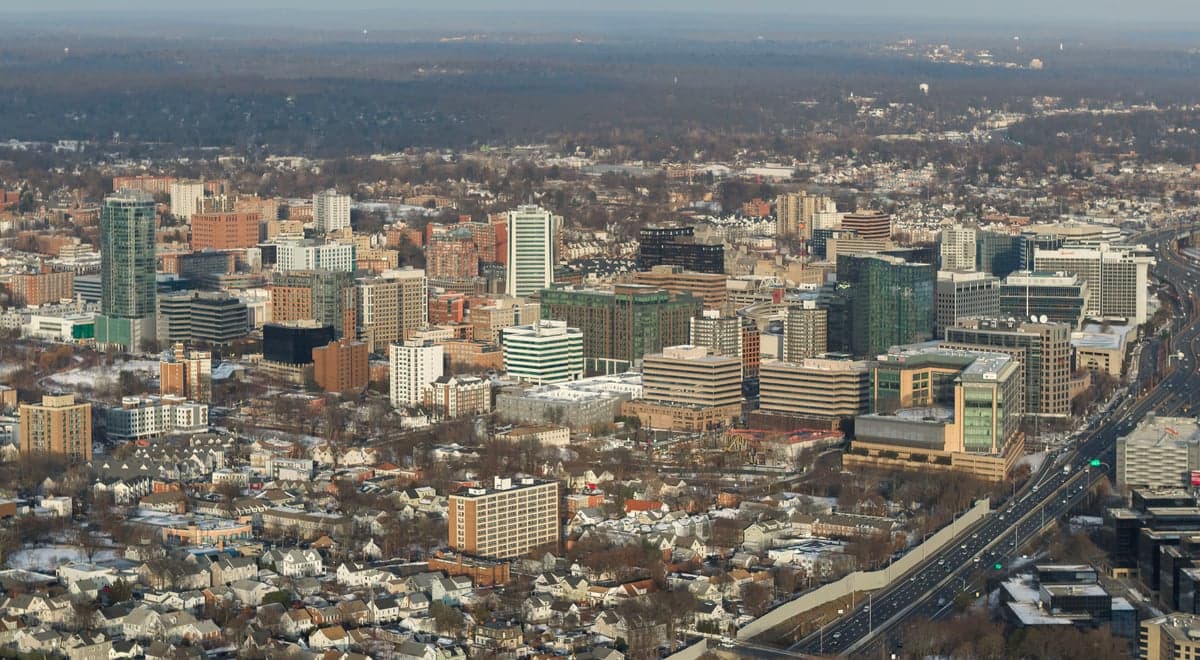
Stamford, Connecticut, is a dense, fast-growing city of 135,806 residents that blends a historic New England downtown with a modern, commuter-driven economy. Its population is notably diverse: 42.5% white, 28.1% Hispanic, 19.3% Black, 3.8% Indian (subcontinent), and 3.3% East/Southeast Asian, with 16.2% foreign-born and 51.7% college-educated. The city’s identity is shaped by successive waves of immigration and suburbanization, creating distinct ethnic enclaves and a highly educated, multilingual workforce.
How the city was settled and grew
Stamford was founded in 1641 by English Puritan settlers from the New Haven Colony, who purchased land from the Siwanoy tribe. The original settlement clustered around the harbor and the Rippowam River, an area now known as the Downtown and South End neighborhoods. Agriculture and maritime trade dominated for two centuries. The arrival of the railroad in 1848 transformed Stamford into a manufacturing hub, drawing Irish immigrants to work in factories and on the railroad; they settled heavily in the West Side and Shippan areas. Italian immigrants followed in the 1880s–1910s, finding work in the city’s thriving lock, tool, and textile industries, and establishing a strong presence in the East Side and Springdale neighborhoods. By 1900, Stamford’s population had grown to roughly 15,000, with a solid base of European ethnic communities that would dominate through the mid-20th century.
Modern era (post-1965)
The 1965 Hart-Cellar Act reshaped Stamford’s demographics. The city’s industrial base declined, but corporate relocations—notably by Champion International, GTE (now Verizon), and UBS—drew a new wave of white-collar workers. Simultaneously, African American families moved north from the South during the Great Migration’s later stages, settling primarily in the West Side and South End. Hispanic immigration accelerated from the 1980s onward, with Puerto Ricans, Dominicans, and later Central Americans establishing a strong presence in the West Side and Downtown areas. The 1990s and 2000s saw a surge of Indian professionals, many employed in finance and IT at Stamford’s corporate headquarters; they concentrated in the North Stamford and High Ridge neighborhoods, drawn by good schools and larger homes. East/Southeast Asian communities—primarily Chinese and Korean—grew more modestly, settling in North Stamford and parts of the East Side. By 2020, Stamford had become a majority-minority city, with no single ethnic group holding a numerical majority.
The future
Stamford’s population is projected to continue growing, driven by corporate relocations and its role as a more affordable alternative to New York City. The Hispanic share is rising steadily, while the white share is declining. The Indian and East/Southeast Asian populations are growing, though from smaller bases, and are likely to increase as tech and finance sectors expand. The city is not homogenizing; instead, it is tribalizing into distinct enclaves. The West Side remains heavily Hispanic and Black; North Stamford is predominantly white and Indian; the East Side retains an Italian-American and now growing East/Southeast Asian character; and the South End is undergoing rapid gentrification, attracting young professionals of all backgrounds. The foreign-born share (16.2%) is stable, suggesting that immigration is being offset by assimilation and out-migration of second-generation families to suburbs. The next decade will likely see continued diversification, with the Hispanic share approaching one-third and the white share falling below 40%.
For a conservative-leaning mover, Stamford offers a high-density, high-opportunity environment with strong schools, low crime relative to peer cities, and a tax base supported by corporate headquarters. The city is becoming more diverse and more educated, but also more segmented by neighborhood. New arrivals should expect a place where community identity is strongly tied to geography and ethnic heritage, and where the pace of change is steady but not disruptive.

* Values derived from national, state, county, city and local statistics and may differ in a specific area. Last updated: 2026-04-30T03:48:24.000Z
Narrative content on this page is AI-generated and may contain mistakes. Verify any details that matter before acting on them.
ReloMaps may earn a commission from affiliate links at no extra cost to you.

