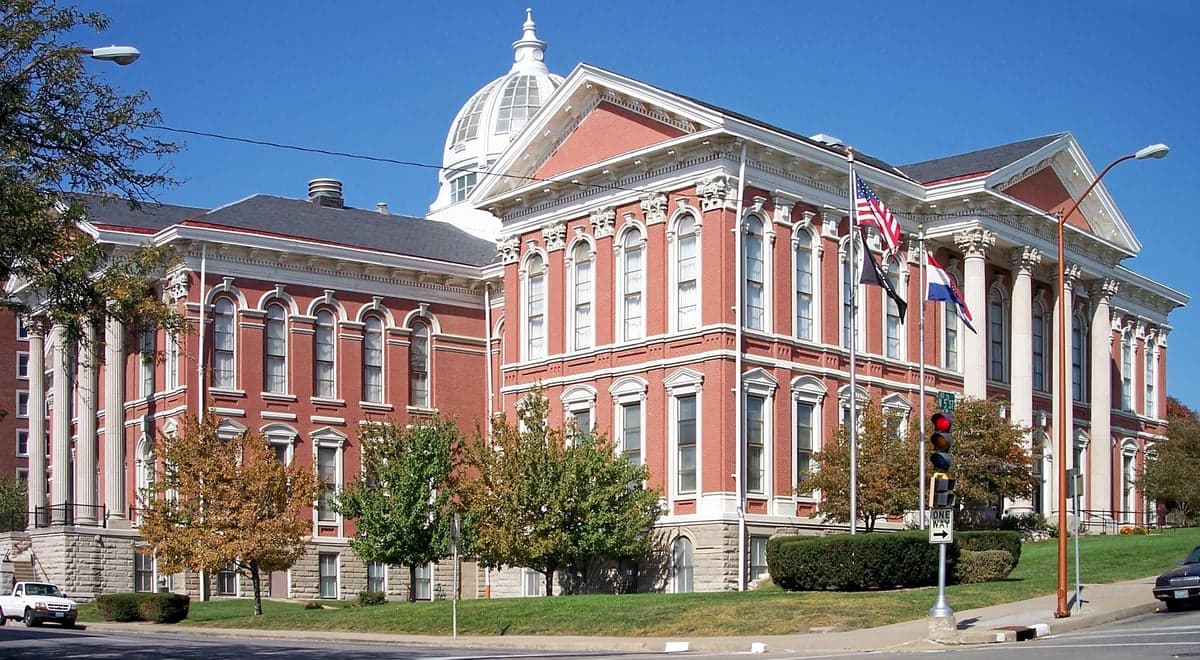
Photo: Wikipedia
Demographics of St Joseph, MO
Affluence Level in St Joseph, MO
A below-average socioeconomic profile. Incomes, home values, and educational attainment trail the U.S., with higher poverty and unemployment.
People of St Joseph, MO
The people of St. Joseph, Missouri, today number roughly 71,542, forming a community that is predominantly White (78.6%) with a notable Hispanic minority (7.7%) and a smaller Black population (6.6%). The city retains a distinctively Midwestern, working-class character, shaped by its history as a river port, railroad hub, and meatpacking center, with a lower college attainment rate (22.7%) than the national average. Its population density is moderate, and its identity is marked by a strong sense of local heritage, visible in the well-preserved historic districts and a slower pace of life compared to Kansas City, just 50 miles south.
How the city was settled and grew
St. Joseph’s population history begins with its founding in 1843 by Joseph Robidoux, a fur trader who saw the potential of the Missouri River bluff as a trading post. The city exploded in the 1850s and 1860s as the western terminus of the Hannibal and St. Joseph Railroad, drawing a wave of German and Irish immigrants who built the railroad and worked the riverfront. These groups settled in distinct neighborhoods: the South Side became a stronghold for German Catholic families, with their churches and breweries, while the Near North Side attracted Irish laborers who built St. Patrick’s Church. The city’s role as a jumping-off point for westward expansion—the Pony Express launched from here in 1860—brought a transient population of merchants and adventurers. By the late 19th century, the meatpacking industry (Armour and Swift plants) drew a second wave of European immigrants, including Italians and Poles, who clustered in the East Side near the stockyards. The Black population grew during the Great Migration (1910–1940), with families settling in the Midtown area around 10th and Faraon streets, establishing a vibrant commercial corridor. The city peaked at over 102,000 residents in 1900, then began a long decline as the packing plants moved west and the railroad industry contracted.
Modern era (post-1965)
After the 1965 Immigration and Nationality Act, St. Joseph saw only modest new immigration, reflecting its inland location and shrinking industrial base. The foreign-born population today is just 2.2%, far below the national average. The most significant post-1965 demographic shift has been the growth of the Hispanic community, which rose from a tiny fraction to 7.7% of the population. This wave began in the 1990s, driven by work in meatpacking and food processing plants (e.g., Triumph Foods, opened 2003). Hispanic families concentrated in the South End near the industrial corridor along Highway 36, and in the King Hill neighborhood, where small Mexican groceries and taquerias now anchor a growing commercial strip. The Black population has remained relatively stable at 6.6%, with many families still rooted in Midtown and the Robidoux neighborhood, though some have moved to newer subdivisions in the North Side. The East/Southeast Asian community (1.0%) is small and dispersed, with no single ethnic enclave, while the Indian subcontinent population (0.3%) is even smaller, largely composed of professionals working at the local hospitals or Missouri Western State University. The White population, while still the majority, has aged and suburbanized, with many families moving to newer developments on the North Side and in the Belt Highway corridor, leaving older neighborhoods like the South Side with a higher share of rental properties and lower homeownership rates.
The future
The population of St. Joseph is projected to remain flat or decline slightly over the next decade, as the city struggles to retain young adults who leave for Kansas City or St. Louis. The Hispanic community is the fastest-growing segment, likely to reach 10–12% of the population by 2035, driven by both births and continued recruitment for manufacturing jobs. This growth is concentrated in the South End and King Hill, creating a more distinct ethnic enclave than exists today. The Black population is expected to remain stable, with some out-migration to larger metro areas offset by in-migration from rural Missouri. The White population will continue to age, with the 65+ cohort growing as younger families move to suburbs like Savannah or Easton. The city is not tribalizing into hostile enclaves, but it is becoming more spatially stratified by income and ethnicity, with the North Side and Belt Highway corridor drawing higher-income residents, while the South Side and Midtown see more poverty and rental turnover. For a conservative-leaning newcomer, this means a community that is still overwhelmingly White and English-speaking, with a growing but assimilating Hispanic population, and a political culture that leans Republican (Buchanan County voted +28 for Trump in 2024).
St. Joseph is becoming a quieter, more affordable version of its industrial past—a place where the population is slowly diversifying but remains anchored by a White, working-class majority. For someone moving in now, the city offers low housing costs and a strong sense of local history, but limited job growth and a demographic trajectory that points toward continued slow decline unless new industries arrive. The neighborhoods to watch are the South End for Hispanic growth, the North Side for new subdivisions, and Midtown for its historic Black community, each offering a different slice of this stable, unpretentious Missouri river town.

* Values derived from national, state, county, city and local statistics and may differ in a specific area. Last updated: 2026-04-30T02:35:25.000Z
Narrative content on this page is AI-generated and may contain mistakes. Verify any details that matter before acting on them.
ReloMaps may earn a commission from affiliate links at no extra cost to you.

