
Photo by Ian Hutchinson on Unsplash
Demographics of St Clair Shores, MI
Affluence Level in St Clair Shores, MI
A middle-class area roughly in line with national averages across income, home values, education, and employment.
People of St Clair Shores, MI
The people of St. Clair Shores, Michigan, form a predominantly white, middle-class community of 58,287 residents, characterized by a strong blue-collar and public-safety heritage and a notably low foreign-born population of just 1.5%. The city’s identity is rooted in its historic role as a summer resort and post-war bedroom suburb for Detroit’s auto and defense workers, creating a dense, family-oriented environment along the Lake St. Clair shoreline. Today, it is a stable, older suburb with a 29.4% college-educated rate, a modestly growing Hispanic population at 2.6%, and a Black population of 5.0%, while East/Southeast Asian residents (0.6%) and Indian-subcontinent residents (0.3%) remain very small communities. The city’s population is aging and slowly diversifying, but it remains overwhelmingly anchored by families whose roots trace back to the European ethnic waves of the early-to-mid 20th century.
How the city was settled and grew
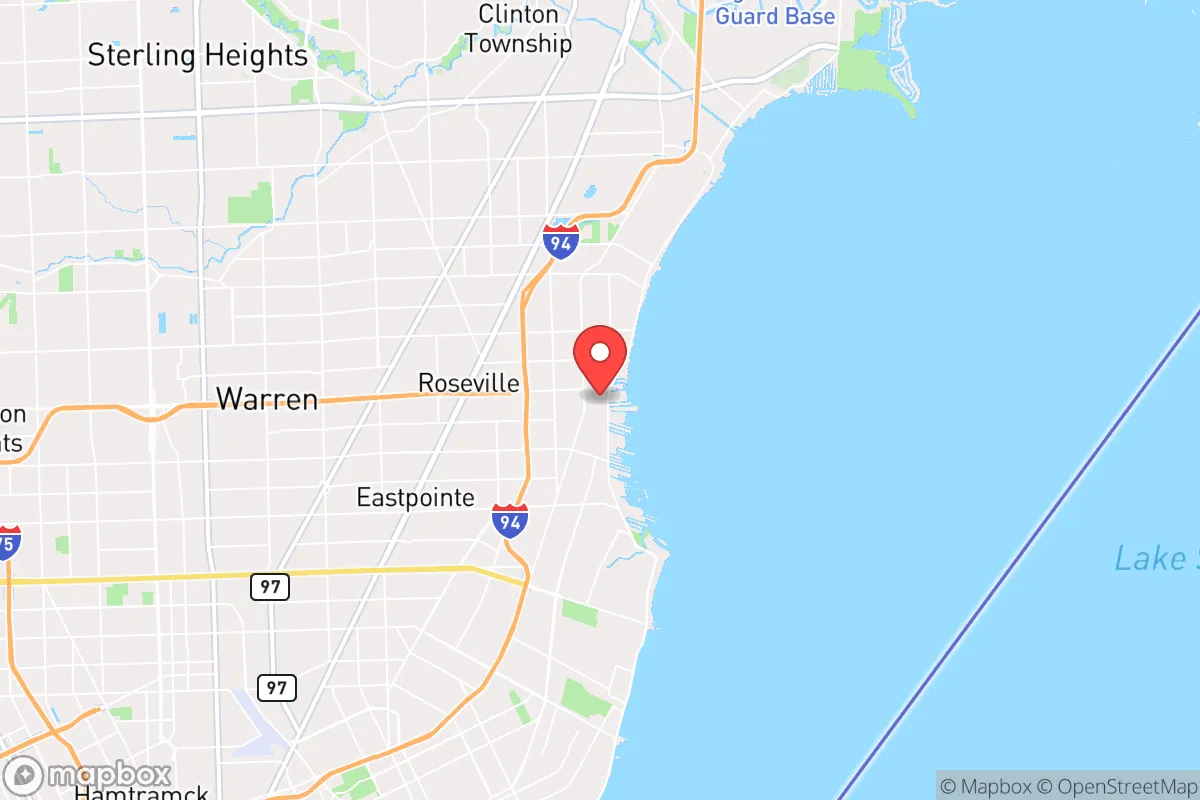
St. Clair Shores was not a colonial-era settlement; its development began in earnest after 1900, driven by its location on the shores of Lake St. Clair and the expansion of Detroit’s industrial economy. The area was originally part of Lake Township, a sparsely populated farming and fishing region. The first major population wave came in the 1910s and 1920s, when Detroit’s booming auto industry drew workers to build summer cottages and modest year-round homes along the lakefront. The Jefferson Beach and Lake Shore neighborhoods were among the earliest settled, with families of German, Polish, and Irish descent constructing simple frame houses and small marinas. The second, far larger wave arrived after World War II, when returning GIs and auto workers sought affordable suburban housing. The city incorporated in 1951, and developers rapidly filled in the remaining farmland with grid-patterned subdivisions. The Greater St. Clair Shores area—including the Harper Woods border zone and the I-94 corridor—saw an influx of Italian, Polish, and Ukrainian families moving from Detroit’s east side. These groups built the city’s dense, single-family-home character, with many residents working at the nearby Chrysler plants in Warren and the General Motors Technical Center in Sterling Heights. By 1970, the population had peaked near 88,000, making it one of Michigan’s most densely populated suburbs.
Modern era (post-1965)
After the 1965 Hart-Cellar Act and the subsequent suburbanization of Detroit’s Black middle class, St. Clair Shores experienced modest but steady demographic change. The city’s Black population grew from less than 1% in 1970 to 5.0% today, with most new Black residents settling in the southwest quadrant near the border with Eastpointe and along Harper Avenue. This area, closer to the I-94 interchange, offered older, more affordable housing stock compared to the pricier lakefront neighborhoods. The Hispanic population, now 2.6%, began growing in the 1990s, concentrated in the central corridor around 9 Mile Road and Greater Mack Avenue, where small businesses and service jobs anchor a working-class community. East/Southeast Asian residents (0.6%) and Indian-subcontinent residents (0.3%) remain tiny enclaves, with families typically settling in the northern lakefront area near 10 Mile Road, drawn by the highly rated Lakeview Public Schools. The city’s white population, still 88.2%, has aged in place, with many adult children moving out of state. The foreign-born share (1.5%) is among the lowest in Macomb County, reflecting limited new immigration. The city’s population has declined steadily from its 1970 peak, dropping to 58,287 by 2020, as younger families have been priced out of lakefront homes or drawn to newer, cheaper suburbs farther north.
The future
St. Clair Shores is heading toward continued slow population decline and gradual racial diversification, though it will remain a predominantly white, middle-class suburb for the foreseeable future. The city’s housing stock—largely built between 1940 and 1970—is aging, and the lack of large new subdivisions limits in-migration. The Hispanic and Black populations are expected to grow modestly, particularly in the southwest neighborhoods and along the Harper Avenue commercial corridor, as these areas offer the most affordable entry points. The East/Southeast Asian and Indian communities are likely to remain very small, as the city lacks the ethnic grocery stores, religious institutions, and job clusters that attract larger populations to Warren or Troy. The city is not tribalizing into distinct enclaves; rather, it is slowly homogenizing into a lower-density, older community with a stable but aging white majority. The next 10-20 years will likely see the city’s population settle around 55,000, with a slightly higher share of Hispanic and Black residents, but no dramatic shift in its fundamental character.
For someone moving in now, St. Clair Shores offers a safe, lake-adjacent community with strong public safety services and a deep-rooted sense of place, but it is not a destination for those seeking rapid growth or significant ethnic diversity. The city is best suited for families and individuals who value stable, older neighborhoods, easy access to Lake St. Clair, and a quiet, low-turnover environment where neighbors have known each other for decades. The trade-off is a shrinking tax base and an aging population, which may pressure local schools and services over the long term.

* Values derived from national, state, county, city and local statistics and may differ in a specific area. Last updated: 2026-04-24T07:43:40.000Z
Narrative content on this page is AI-generated and may contain mistakes. Verify any details that matter before acting on them.
ReloMaps may earn a commission from affiliate links at no extra cost to you.

