Strategic Assessment of St Anthony, ID
Strong survivability profile. Good buffer from population centers, with manageable environmental and tactical risks.
What does the Strategic Assessment tell us?
Our Strategic Assessment grades tactical survivability of an area. Major population centers, military targets, fallout zones, natural disasters, and border exposure all drive risk — lower exposure means a more defensible position in a crisis.
This is heavily inspired by Joel Skousen's Strategic Relocation book. Highly recommended you checkout the book ($)What does this tell us?
Our Strategic Assessment grades tactical survivability of an area. Major population centers, military targets, fallout zones, natural disasters, and border exposure all drive risk — lower exposure means a more defensible position in a crisis.
This is heavily inspired by Joel Skousen's Strategic Relocation book. Highly recommended you checkout the book ($)Strategic Pillars

Key Distances
Regional Safe Places
Below is our recommended "safe zones" in Idaho and the surrounding area based on our strategic heuristics. For most people, it's unrealistic to live in a “safe zone” full-time due to work, family or other personal reasons. They tend to be more rural. However, many of these areas are perfect for second homes and retreat properties that double as a vacation home or even a short-term rental.
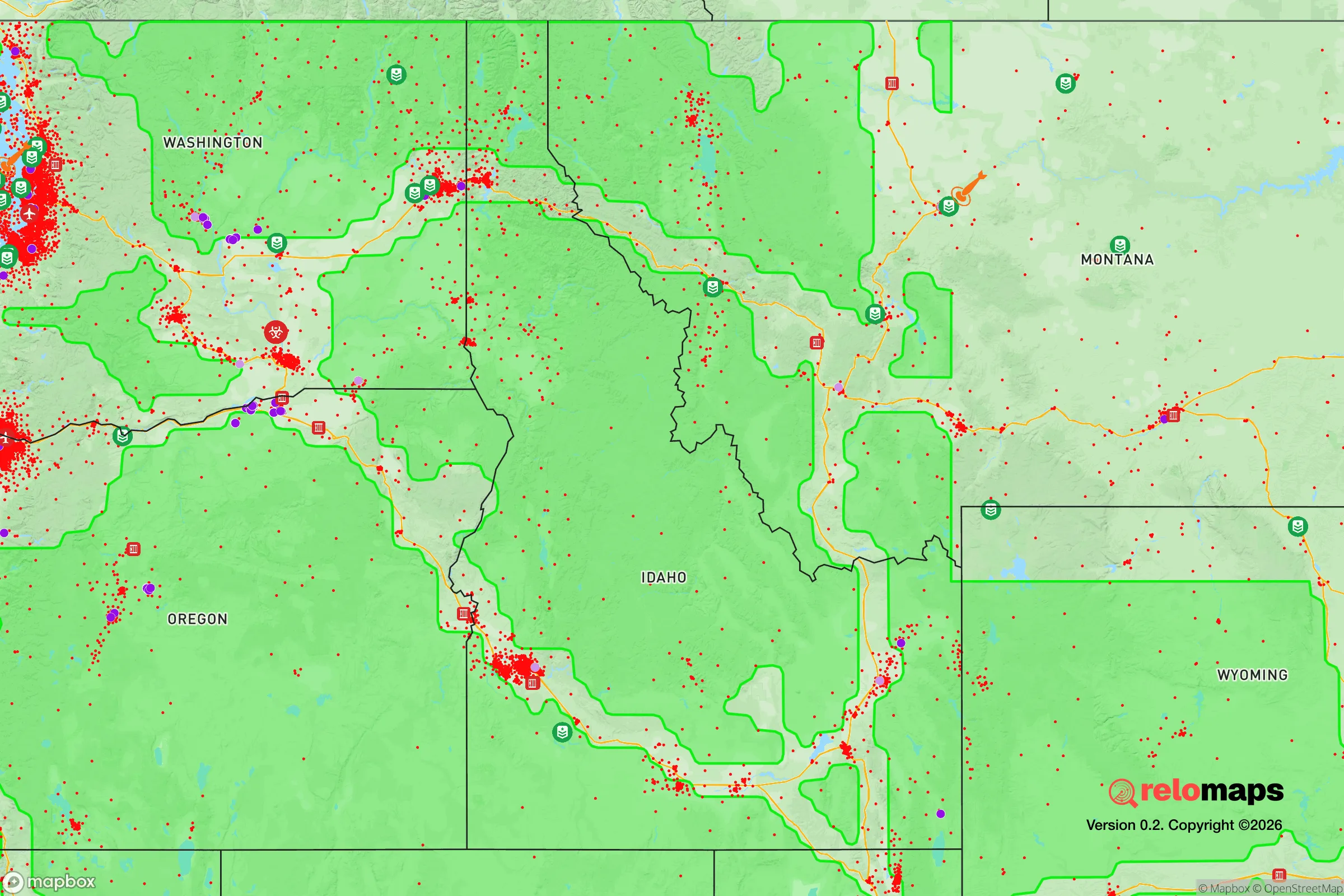
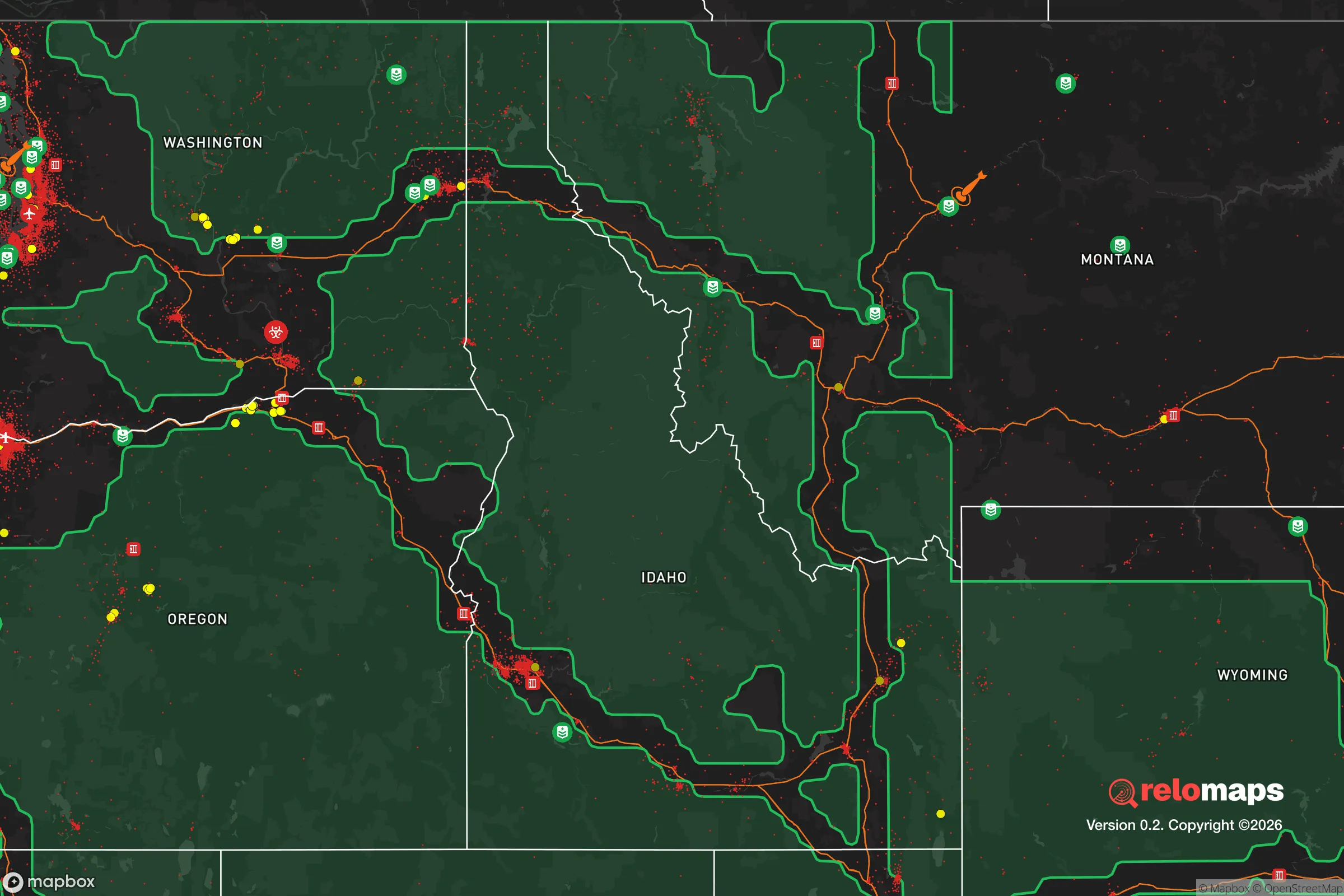


Important Note: For informational purposes only. This does not mean nothing bad ever happens in the green zones. Please use common sense. This is based on public data and modeled with AI. We tried to take a conservative approach but mistakes happen. We update this regularly as new information becomes available.
Solar Generator Recommendations
Backup power matters more here than in safer locations. We've picked three solar generators across budgets and capacity tiers — start with the budget unit if you only need a few essentials, or step up if you want to run a fridge and HVAC for days at a time.

Jackery Portable Power Station Explorer 300
Budget OptionPower on the Go: Weighing only 11 lbs, it's convenient to set up and store with book-sized foldable solar panels

BLUETTI Portable Power Station AC180
Designed for both indoor and outdoor scenarios, AC180 is highly capable as it has a robost capacity and continuous output power.

EF ECOFLOW DELTA Pro Ultra Power Station
Upgraded PickEcoFlow DELTA Pro Ultra is a whole-home energy system designed to grow with your family. Integrated with the Smart Home Panel 2, it scales to meet your evolving energy needs — keeping your home powered, intelligent, and secure through every stage of life.
We earn a commission, at no additional cost to you.
Strategic Assessment Analysis
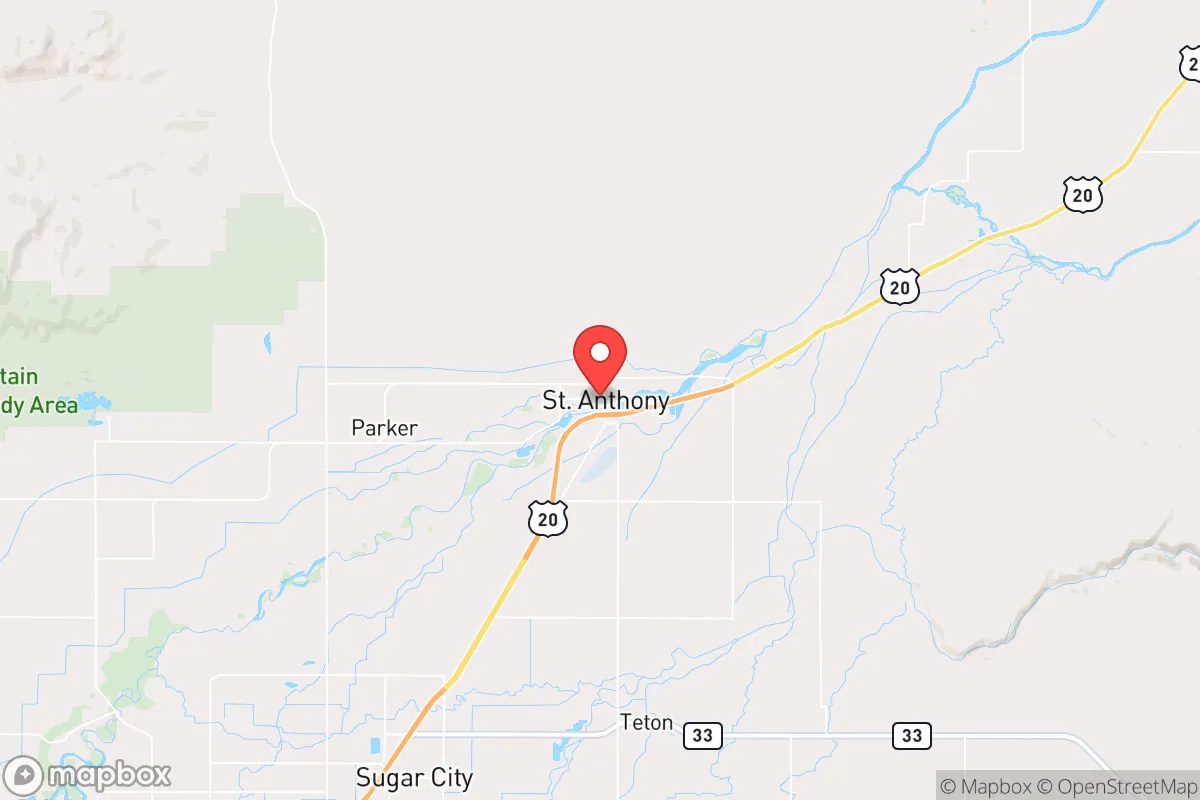
St. Anthony, Idaho, sits in a sweet spot for those thinking long-term about resilience: it’s remote enough to dodge the chaos of major population centers, yet close enough to essential infrastructure to make daily life practical. This small town in Fremont County, with a population hovering around 3,500, offers a strategic base for individuals or families who want to be prepared for civic unrest, natural disasters, or supply-chain disruptions without going completely off-grid. The area’s low population density, agricultural self-sufficiency, and distance from high-value targets make it a serious contender for a relocation that prioritizes security and sustainability.
Geographic position and natural advantages for long-term security
St. Anthony’s location in the Upper Snake River Valley gives it a natural buffer against the kind of cascading failures that plague urban centers. It sits about 30 miles northeast of Idaho Falls, which is the nearest city of any size—large enough to have hospitals and big-box stores, but small enough that it’s not a primary target for civil unrest or strategic strikes. The area is flanked by the Targhee National Forest to the east and the Caribou-Targhee National Forest to the south, providing vast, sparsely populated terrain for hunting, foraging, or retreat if needed. The Snake River runs through the valley, offering a reliable water source that doesn’t depend on municipal systems. Elevation here is around 5,000 feet, which means cooler summers and serious winters—a climate that naturally discourages casual migration and forces residents to develop real cold-weather skills. For a prepper mindset, that’s a feature, not a bug: harsh winters act as a filter, keeping out those who aren’t committed to self-reliance.
Risks, exposures, and proximity to fallout-relevant landmarks
No place is risk-free, and St. Anthony has its own set of vulnerabilities that a strategic relocator needs to weigh. The most obvious is the Idaho National Laboratory (INL), located about 50 miles southwest near Arco. INL is a major nuclear research facility, and while it’s not a commercial power plant, it handles spent fuel and conducts reactor experiments. In a worst-case scenario—a major earthquake, a terrorist attack, or a cascading grid failure—INL could become a contamination source. Prevailing winds in the region generally blow from the southwest, which means St. Anthony is downwind of INL for much of the year. That’s a real concern for fallout planning. Additionally, the area sits in a seismically active zone; the 1959 Hebgen Lake earthquake (magnitude 7.3) was felt strongly here, and the Yellowstone Caldera, about 100 miles to the east, is a long-term volcanic wildcard. On the plus side, St. Anthony is far from major military installations, large ports, or dense urban corridors that would be primary targets in a conflict. The nearest interstate (I-15) is 20 miles west, providing a route for evacuation or supply runs without putting you directly on a major artery that could become a chokepoint during unrest.
Practical resilience for a relocator: food, water, energy, and defensibility
For someone serious about self-sufficiency, St. Anthony checks several critical boxes. The Fremont County area is agricultural, with potato, barley, and hay farms dominating the landscape. That means local food production is a reality, not a hypothetical. Farmers markets and direct-from-farm purchasing are common, and the growing season—though short (roughly 90–110 days)—is enough for cold-hardy crops like root vegetables, kale, and grains. Water is abundant: the Snake River aquifer provides clean groundwater, and many rural properties have irrigation rights or wells. For energy, the region is served by Fall River Electric Cooperative, which has a strong track record of grid reliability, but solar potential is decent—about 4.5 peak sun hours per day—and off-grid setups are feasible given the rural zoning. Defensibility is a mixed bag. The town itself is flat and open, which makes it hard to secure a perimeter, but the surrounding forested hills and canyon country offer plenty of hide-and-hold options for a retreat property. The local culture leans heavily conservative and self-reliant; neighbors are likely to be armed, church-going, and suspicious of federal overreach. That’s a social asset in a collapse scenario—community trust and mutual aid are more valuable than any piece of gear. However, the population is small, so a relocator should plan to integrate slowly and build relationships before assuming any support network exists.
The overall strategic picture for St. Anthony as a relocation destination
St. Anthony isn’t a bug-out location for the weekend warrior; it’s a place to build a life that’s already resilient by design. The trade-offs are real: harsh winters, limited medical facilities (the nearest hospital is in Rexburg, 15 miles away, with a Level IV trauma center), and a job market dominated by agriculture, education, and small retail. For a remote worker or someone with a portable skill set, that’s manageable. For a family, the schools are solid by rural standards—Fremont High School has a graduation rate around 90%—and the low crime rate (violent crime is roughly half the national average) means kids can roam safely. The biggest strategic weakness is the INL proximity and the Yellowstone supervolcano risk, but those are long-tail threats that most of the country shares in some form. What St. Anthony offers that few other places can match is a combination of water abundance, low population density, agricultural self-sufficiency, and a cultural baseline that values preparedness. If you’re looking to get out ahead of the curve—before the next wave of unrest or supply-chain shock—this is a place where you can dig in, grow your own food, and sleep soundly knowing your neighbors aren’t going to loot your pantry. It’s not a fortress, but it’s a solid foundation.

* Values derived from national, state, county, city and local statistics and may differ in a specific area. Last updated: 2026-05-01T13:05:44.000Z
Narrative content on this page is AI-generated and may contain mistakes. Verify any details that matter before acting on them.
ReloMaps may earn a commission from affiliate links at no extra cost to you.

