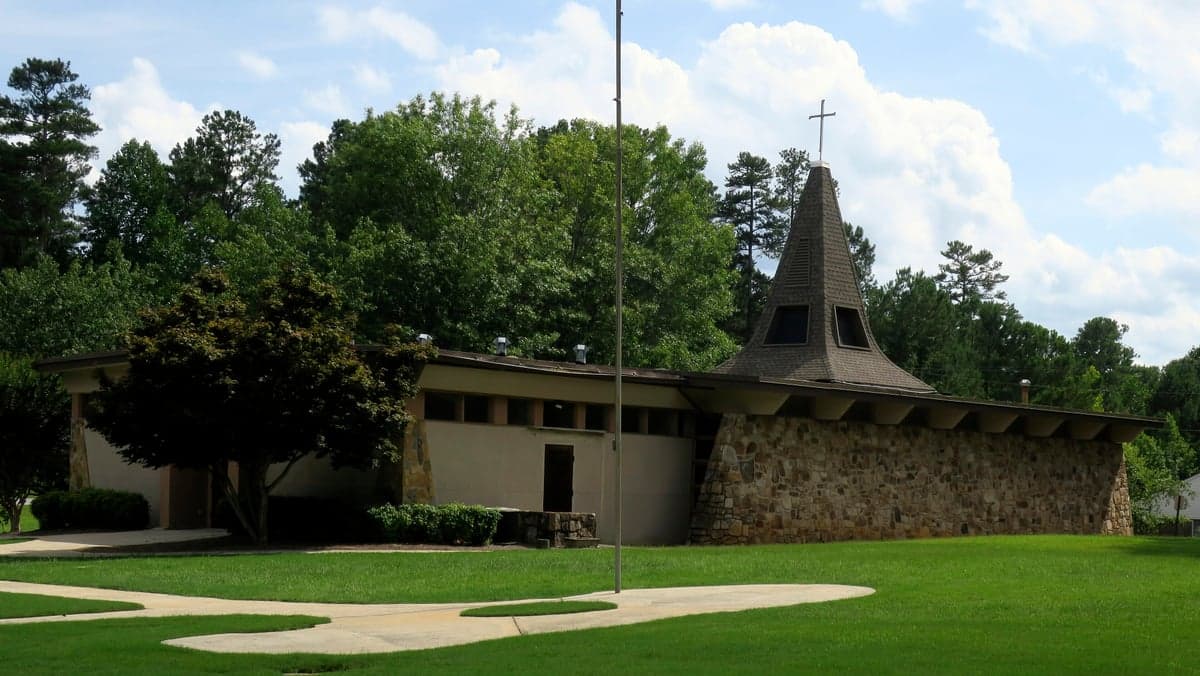
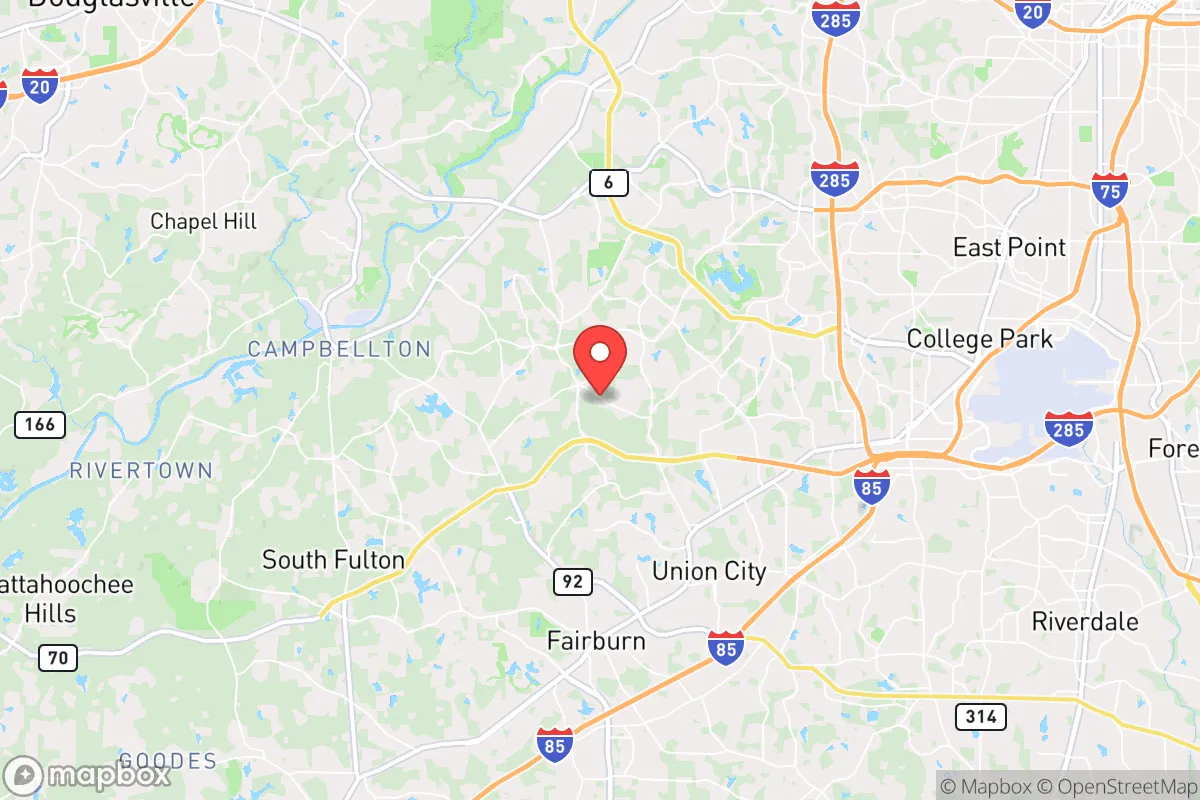
Photo: Wikipedia
Demographics of South Fulton, GA
Historical data isn't available for South Fulton, GA. Trends shown are for Fulton County, Georgia.
Affluence Level in South Fulton, GA
A middle-class area roughly in line with national averages across income, home values, education, and employment.
People of South Fulton, GA
The people of South Fulton, Georgia, today form one of the most heavily African American major cities in the United States, with a population of 109,157 that is 90.9% Black. This is a majority-Black city by design and by history, not merely by statistical chance — a place where Black homeownership, Black political leadership, and Black institutional life define the civic character. The city is also notably homogeneous: only 2.9% White, 3.2% Hispanic, and a combined 0.9% Asian and Indian, with a foreign-born share of just 3.0% that is far below the national average of roughly 14%.
How the city was settled and grew
South Fulton did not exist as a city until 2017, when voters in a large unincorporated swath of southern Fulton County approved incorporation. But the area’s settlement story begins in the 19th century as a rural crossroads for cotton and timber. The original population was a mix of white yeoman farmers and enslaved Black laborers who worked the plantations along Camp Creek and the Chattahoochee River. After the Civil War, freedmen established small farming communities and church-centered hamlets. The most enduring of these is Red Oak, a historic Black settlement that grew around the Red Oak Creek and the Atlanta & West Point Railroad. By the early 1900s, Red Oak had its own school, several churches, and a tight-knit population of Black landowners. Nearby Camp Creek, named for the creek that runs through the area, became another anchor for Black families who bought land during Reconstruction and held onto it through Jim Crow. These communities remained small and rural until the post-World War II era, when Atlanta’s suburban expansion began pushing southward.
Modern era (post-1965)
The 1965 Hart-Cellar Act and the Fair Housing Act of 1968 opened suburban housing to Black families who had been confined to Atlanta’s inner-city neighborhoods. South Fulton became the primary destination for upwardly mobile Black professionals leaving the city — a pattern that accelerated through the 1980s and 1990s. The area’s large tracts of undeveloped land, lower property taxes compared to Atlanta proper, and proximity to Hartsfield-Jackson Atlanta International Airport made it attractive. Stonewall Tell, a neighborhood along Stonewall Tell Road, saw rapid construction of single-family homes in the 1990s and 2000s, drawing Black families from southwest Atlanta and College Park. Cliftondale, another historic Black community, experienced a similar transformation, with new subdivisions replacing old farmsteads. The white population, which had been a small minority even in the 1970s, continued to decline as white families moved further south to Coweta and Fayette counties. By the 2010s, South Fulton was not just majority-Black but overwhelmingly so — a demographic reality that the 2017 incorporation vote cemented. The city’s 38.9% college-educated rate reflects the professional class that drove this migration: doctors, lawyers, airline employees, and government workers who chose a suburban Black-majority environment over more integrated or predominantly white suburbs.
The future
South Fulton’s population is likely to remain heavily African American for the foreseeable future. The city’s foreign-born population is tiny (3.0%) and shows no signs of rapid growth; the Hispanic share (3.2%) is stable but not surging, and the East/Southeast Asian and Indian communities combined account for less than 1% of residents. This is not a city absorbing diverse immigrant streams — it is a city where Black Americans, overwhelmingly native-born, are the near-total population. The key demographic question is whether South Fulton will continue to attract middle-class and affluent Black families, or whether it will experience the same out-migration of younger professionals to newer exurbs that has affected other inner-ring Black suburbs. The city’s median age of roughly 37 and its high homeownership rate suggest stability, but the lack of major new employment centers within city limits means that future growth depends on Atlanta’s overall economic health. If the airport corridor continues to develop, South Fulton could see a modest influx of younger Black professionals. If not, the population may plateau or even decline slightly as older residents age in place and younger adults move to Douglasville or Fayetteville.
For someone moving in now, South Fulton offers a rare thing in 2026 America: a large, self-governing city where Black culture, Black institutions, and Black political power are the norm, not the exception. It is not a melting pot — it is a community of choice for Black families who want suburban space, good schools in some pockets, and a civic environment where they are not a minority. The trade-off is limited ethnic and racial diversity, which may matter to some relocating families and not at all to others. The city’s trajectory is one of consolidation, not transformation: it will likely remain what it is today, only more so.

* Values derived from national, state, county, city and local statistics and may differ in a specific area. Last updated: 2026-04-29T19:32:21.000Z
Narrative content on this page is AI-generated and may contain mistakes. Verify any details that matter before acting on them.
ReloMaps may earn a commission from affiliate links at no extra cost to you.

